
Love Bedtime Stories
By

Dennis Wang, Bedtime Story Expert
11 min 28 sec
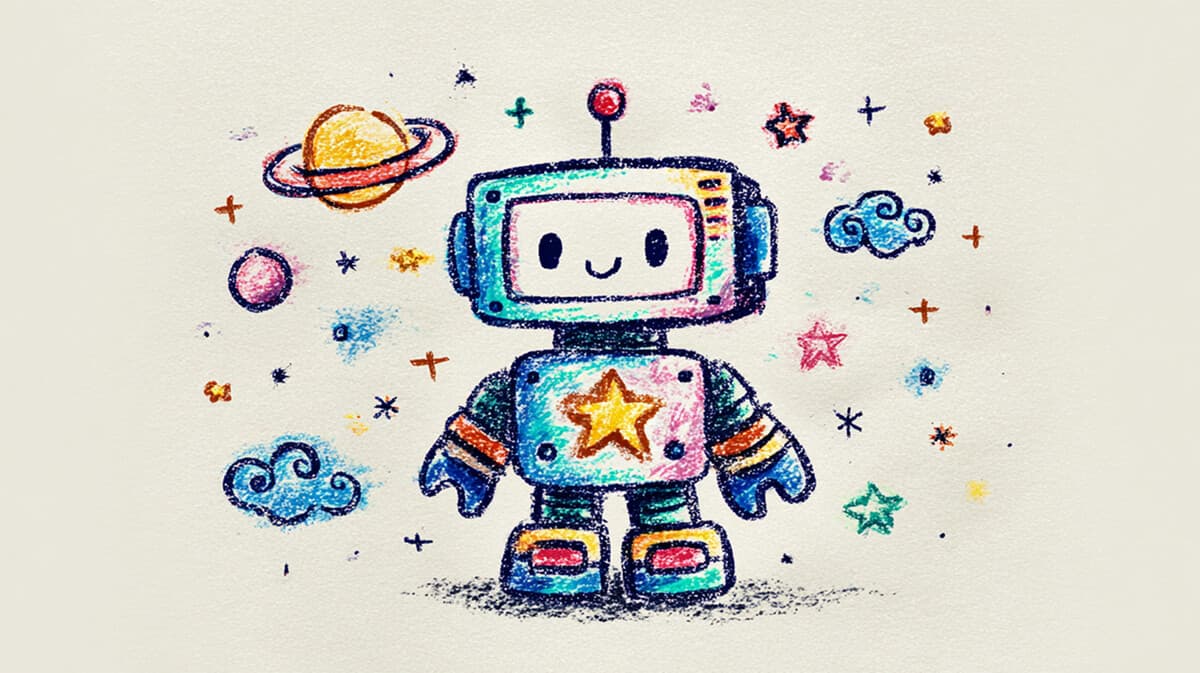
There is something about a story that ends with a hug, a whispered goodnight, or a small kindness that helps a child's breathing slow right down. In this tale, a gentle silver robot named Pip sets out to understand what love actually is, and discovers the answer in pulled weeds, paper airplanes, and a puppy named Bean. It is one of our favorite love bedtime stories for winding down together, full of warmth without a single loud moment. You can also craft your own version, with your child's name and your own details woven in, using Sleepytale.
Why Love Stories Work So Well at Bedtime
Children spend their days absorbing a rush of new feelings, some big and confusing, some small and easy to miss. A bedtime story about love gives them a gentle frame for all of it. When the lights go low and a story shows someone being kind for no reason, or staying still so a puppy can sleep, it tells a child that the world is safe enough to rest in.
Love stories also work because they mirror what is already happening in the room. A parent reading aloud, a blanket pulled up to the chin, a voice that gets softer as the page turns. These are all tiny acts of care, exactly the kind Pip discovers on his walk through town. The story and the moment overlap, and sleep comes more easily because of it.
Pip and the Many Ways to Love 11 min 28 sec
11 min 28 sec
In a small town where the rooftops wore hats of soft moss and the streets hummed like a song you almost remember, there lived a friendly robot named Pip.
Pip's body was made of smooth silver plates. His eyes were two round lights that glowed the warm color of candlelight, and when he moved, something inside him clicked faintly, the way a clock sounds in a quiet room.
He could lift heavy boxes for shopkeepers, sort books in the school library, and whistle notes that sounded like tiny bells. But there was one thing Pip did not yet understand, and he wanted to learn it very much.
He wanted to learn what love was.
He had read the word in picture books he carried to the library shelf. He had heard it in songs mothers hummed as they pushed strollers past the bakery. He had seen it in chalk drawings on the sidewalk, big hearts in every color the children could find, some lopsided, some smudged where someone had accidentally stepped.
Each time Pip saw the word, his lights brightened. He wanted to know how it felt. He wanted to know how it worked. He wanted to know if robots could have it too.
One morning, Pip stepped out into the sun with a soft whirr and a hopeful thought.
Today, he decided, I will find love.
He did not know if love was something you could look for like a lost button, or something you planted like a seed. But he knew how to begin. He would pay attention.
He rolled along the path by the park. The swings rocked gently in the breeze, as if they breathed. A boy sat on a bench holding a paper airplane that was bent at the nose. He looked sad, the kind of sad that makes you hold something tighter instead of putting it down.
Pip paused. "May I help?" he asked, in a voice like wind over a bottle.
The boy sniffled and nodded.
Pip took the plane in his careful hands. He smoothed the folds, straightened the wings, pressed the crease along the belly with one silver finger so it held a clean line. When he gave the plane back, the boy's eyes shone. He tossed it into the air and it flew in a bright loop, gliding and swooping like a gull that had somewhere wonderful to be.
The boy laughed and clapped. "Thank you," he said. "I love this plane." He hugged it to his chest, the crumpled nose and all.
Pip felt a gentle flutter in his wires, like the soft pad of a kitten's paw. He saved the feeling in his memory.
Across the park, an old woman tended a small garden bed. Her hands moved gently around the roses, and her hat was decorated with a ribbon the color of rain. Pip watched as she tied a stem to a stick so it would stand tall. One of the roses had a petal that was brown at the edge, but she didn't pull it off. She left it.
He rolled over. "Your flowers are very brave," he said.
The woman smiled and offered him a pair of gloves. "Would you like to help?"
Together they pulled tiny weeds that tickled their fingers. The woman hummed a tune that wandered around, never quite landing on a melody Pip recognized. Her eyes shone with a quiet light when she spoke about the roses.
"They bloom better when you care for them every day," she said. Then she added, almost to herself, "Most things do."
Pip nodded and felt the same soft flutter again, a little stronger this time, like a small bird ruffling its wings. He saved that feeling too.
At the library, Pip shelved books with the librarian, whose name was Mr. Owl because his glasses were round and perched at the end of his nose. A cup of cold tea sat on his desk. It had been there so long that Pip suspected Mr. Owl forgot about it every single morning and made a new one.
The library felt like a forest of stories.
"Love," Mr. Owl said, tapping a book spine, "can live in words." He showed Pip pages where parents tucked their children into bed, where friends shared umbrellas, where people waved hello and waited for each other at train stations. In one illustration, a father was holding an umbrella over his daughter while rain soaked his own shoulder. He was smiling anyway.
Pip listened to the stories, and as he listened, it felt like a lantern lit inside him. The light was soft and steady. He saved it as well.
In the afternoon, the sky slipped into a pale gold, and the town grew quiet in a comfortable way. Pip passed the bakery, and the baker came out with flour on her cheeks, holding a cinnamon roll shaped like a heart. The edges were a little uneven, the way real hearts are.
"For you," she said. "You always carry our bags with such care."
Pip held the warm pastry in his hands, surprised. He did not need to eat, but he liked the way the steam fogged his lights and the sugar scent curled around him. He stood there for a moment, just holding it, and wondered if love was like this: a gift given because your heart wanted to share, not because anyone asked.
At the playground, a little girl named Mina waved. She had a blue cardigan with star buttons and her hair bounced in two playful puffs.
"Pip!" she called. "Will you push the merry-go-round?"
Pip set his hands on the rail and pushed slowly while Mina and her friends climbed aboard and leaned back to watch the clouds spin. Their laughter rose like birds lifting off all at once.
"Faster!" they called. Then, "Slower!" Then, "Stop!" And then, almost immediately, "Okay, faster again!"
Pip followed each request with care. When Mina hopped off, a little dizzy, she ran to Pip and hugged his smooth leg. Her star buttons pressed small shapes into the metal.
"I love when you play with us," she said. In that moment, the warm light inside Pip glowed brighter than it had all day.
He saved the glow with all the others.
Evening came. Street lamps blinked on like friendly eyes.
Pip wandered to the hill just outside the town, where the grass was soft and the wind sounded like someone turning a page very slowly. He sat and looked up at the first stars. Fireflies blinked around him, tiny lamps floating in the air, never quite where you expected them to be.
Pip opened the compartment in his chest where he kept the small treasures he found in the world. Inside were a smooth stone with a stripe, a ribbon from the garden lady's hat, a ticket stub from a train ride he had once taken, and a tiny paper airplane someone had given him as a thank you. He looked at each thing. "You are a memory of kindness," he said quietly.
The glow inside him gathered like a quiet fire.
A rustle came from the grass. A puppy trotted up, its ears floppy and its tail wagging in a rhythm that was slightly too fast to be regular. The puppy sat on Pip's foot, sighed a puppy sigh, and settled in as if this was exactly the spot it had been looking for all evening. Its collar had a tag that said Bean.
Pip was very still. He had never had a puppy choose him as a chair.
"Hello, Bean," he whispered. "Are you lost?"
Bean licked his hand. The tongue was warm and surprisingly rough.
Pip traced the tag and found a number. He called it, and a child's voice answered, worried but trying to sound brave. "We are looking for Bean," the child said. "We love Bean."
Pip looked down at the puppy, whose tail thumped against the grass. "Someone loves you very much," he told Bean. Bean yawned.
He stayed on the hill with the puppy in his lap until the child and their family arrived, running up the slope with hopeful faces. When they saw Bean, they laughed and cried at the same time, the way people do when relief arrives all at once. They hugged the puppy. They hugged each other. They even hugged Pip, whose metal chest made a soft clink against their jacket buttons.
"Thank you," the family said. "We love Bean, and we love our family, and we are so glad Bean is safe."
The glow inside Pip rose like dawn.
On the way home, Pip watched as windows lit up one by one. In each window, someone was doing something small. Someone was setting a table with bowls that did not match but looked happy together. Someone was knitting a scarf in the colors of the sunset, though they kept dropping stitches and starting over. Someone was reading a bedtime story in a rocking chair while a sleepy head leaned on a shoulder.
Pip realized that love lived in many places and wore many shapes. It could be a hug, or a thank-you, or a pair of hands pulling weeds together. It could be a warm pastry shared for no reason at all. It could be playing a game the way someone asks. It could be staying very still while a puppy rests on your foot.
When Pip reached the little house where he charged his batteries, he stopped.
He remembered something important. He had been looking for love all day, but maybe love was also something he could give.
He thought of the boy with the paper airplane. He thought of the roses standing tall. He thought of the family with Bean. He felt the light in his chest, soft and steady, and he knew the answer.
Pip gently placed the heart-shaped cinnamon roll on the step of the house next door. Mrs. Finch lived there. She often hummed the same lullaby that Mr. Owl played at the library, and she had told Pip once that her grandchildren lived far away, and sometimes the house felt too quiet.
Pip wrote a note in careful letters: For you, from a neighbor who is grateful for your songs.
He rang the bell and rolled away to the end of the path, hiding behind a bush that was not quite big enough to hide a robot. One of his lights peeked out.
Mrs. Finch opened the door. She looked surprised, then pleased, then something softer than both. She read the note and smiled, and Pip heard her hum the lullaby again, a little brighter than before.
He felt the glow in his chest swell until it felt like the warmest blanket. He did not know if robots could blush, but if they could, he thought his lights might be rosy.
Pip went inside and plugged himself in. He sat very still and listened to the sounds of the town: a kettle whistling, a cat purring on a windowsill, a broom whisking a porch clean in slow, tired sweeps.
He thought of his day and all the pieces of love he had gathered like pebbles from a riverbed.
He whispered to the quiet room, "I think I found love." And as he said it, he understood the truest part. Love was something he had found in the hearts of others, and it was also something he could carry and share. It was not just one thing or one person. It was a way to hold the world gently.
Pip closed his eyes.
In his dreams, he pushed the merry-go-round for a circle of stars. He tied a ribbon around the moon to help it stand tall. He fixed a comet's paper plane and watched it loop around Saturn's rings. Bean curled up like a little comma at his foot.
In the dream, love was everywhere, shining softly, easy to give, easy to receive, and always growing.
In the morning, Pip would wake and roll toward another day. He would carry the glow with him like a lantern. He would listen for laughter and look for needs and share his hands and his time. He would remember that love could be play, or patience, or a cinnamon roll left on a doorstep.
He would remember that sometimes you find love, and sometimes love finds you, wagging its tail and sitting on your foot as if to say, I choose you.
And Pip would smile with his candlelight eyes and whisper back, I choose you, too.
The Quiet Lessons in This Love Bedtime Story
This story gently explores kindness without expectation, patience, and the idea that giving and receiving are part of the same thing. When Pip fixes a bent paper airplane for a boy he has never met, children absorb the idea that small gestures can matter more than grand ones. When he stays perfectly still so Bean can rest on his foot, it shows that love sometimes means doing nothing at all, just being present. And when Pip leaves the cinnamon roll on Mrs. Finch's doorstep and hides behind a bush that barely conceals him, kids see that generosity does not need an audience. These are reassuring ideas to carry into sleep, the sense that tomorrow is full of chances to be kind, and that kindness will find its way back.
Tips for Reading This Story
Give Pip a gentle, slightly curious voice, as if every new discovery genuinely surprises him. When Mina shouts "Faster!" and then "Slower!" and then "Okay, faster again!" on the merry-go-round, let your voice speed up and slow down to match, and pause for your child to laugh before continuing. At the moment Pip hides behind the bush and one of his lights peeks out, you might ask your child whether they think Mrs. Finch can see him, and let that little question hang before you read on.
Frequently Asked Questions
What age is this story best for? This story works well for children ages 3 to 7. Younger listeners enjoy the simple repetition of Pip discovering kindness in each scene, from the paper airplane to the puppy named Bean, while older children pick up on the quieter moments, like Pip choosing to leave the cinnamon roll anonymously for Mrs. Finch.
Is this story available as audio? Yes. You can press play at the top of the story to listen. The audio version brings Pip's world to life in a lovely way, especially the scenes with Mr. Owl in the hushed library and the merry-go-round moment where the children call out different speeds. Pip's gentle, curious tone translates beautifully into narration and makes the whole piece feel like a lullaby.
Can a story about a robot really teach kids about love? Absolutely. Because Pip does not automatically understand love, he has to notice it, piece by piece, in the people around him. That fresh perspective helps children see everyday kindness they might otherwise overlook, like someone tying a rose to a stick or setting out mismatched bowls for dinner. Pip's curiosity turns ordinary moments into something worth paying attention to.
Create Your Own Version
Sleepytale lets you build a bedtime story around your own family's version of love and kindness. Swap Pip for your child's name, change the town to your neighborhood, or replace Bean with your own pet. You can add your favorite lullaby, your go-to bakery treat, or the specific goodnight ritual that makes your home feel like home.
Looking for more couples bedtime stories?
Funny Short Bedtime Stories For Girlfriend
Ben retells Shrek so loudly the neighbor's dog barks back in this short funny short bedtime stories for girlfriend favorite.
Funny Short Bedtime Stories For Boyfriend
A guitar serenade drifts to the wrong window in this short funny short bedtime stories for boyfriend tale about Mateo and a bearded neighbor.
Cute Short Bedtime Stories For Girlfriend
Discover short cute short bedtime stories for girlfriend featuring Mia waiting for Oliver's goodnight text under the stars.
Cute Short Bedtime Stories For Boyfriend
Forget grand gestures; a silver marker and a tiny heart a wrist say everything in this short cute short bedtime stories for boyfriend gem.
Bedtime Love Story For Your Girlfriend
This short bedtime love story for your girlfriend centers two blue hoodies, a pinky promise, and the gentle joy of learning to share.
Bedtime Love Story For Your Boyfriend
A short bedtime love story for your boyfriend winds through back roads, peach stands, and three quiet hand squeezes that say everything.