
Alice In Wonderland Bedtime Story
By

Dennis Wang, Bedtime Story Expert
7 min 2 sec
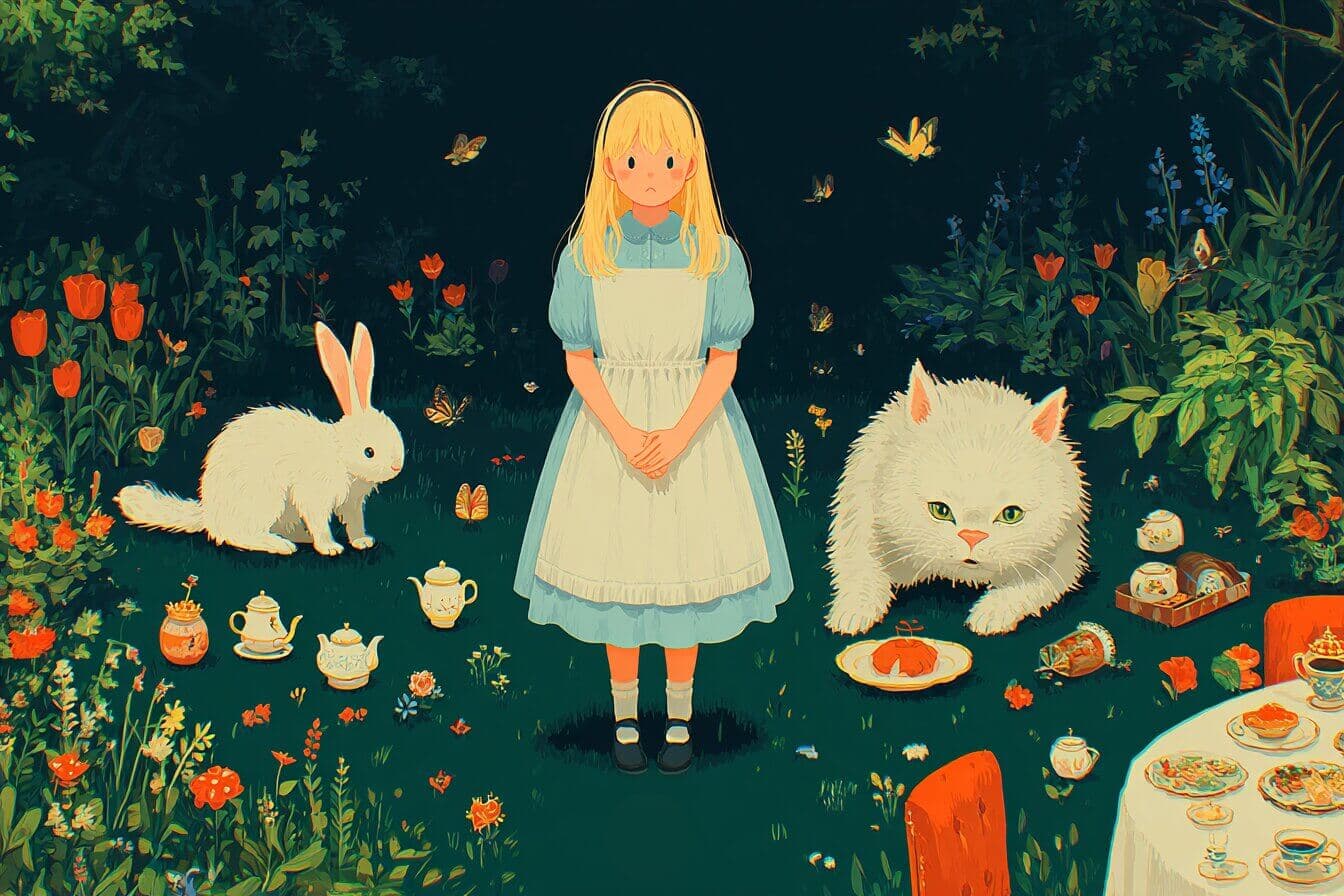
There is something about falling down a rabbit hole that feels exactly right at bedtime, that slow tumble into a world where nothing makes sense and somehow everything is fine. This gentle Alice In Wonderland bedtime story follows a curious girl through mushroom gardens, nonsense tea parties, and a grinning cat who floats in midair, all winding back to the safety of her own bedroom. Alice meets riddle-loving hatters, card-painting soldiers, and a caterpillar who speaks like he has all the time in the world. If you want to shape the adventure around your own child's imagination, you can create your own version with Sleepytale.
Why Alice in Wonderland Stories Work So Well at Bedtime
Wonderland operates on dream logic, and that is exactly why it belongs at the end of the day. The world Alice enters does not follow rules, but it never feels threatening. Mushrooms change your size, cats disappear, and tea parties go on forever. For a child already drifting toward sleep, this kind of gentle nonsense mirrors the loose, floaty feeling of a mind letting go. Nothing needs to be solved. You just follow Alice and see what happens next.
There is also deep comfort in the structure underneath the silliness. Alice always finds her way home. No matter how strange the Queen acts or how baffling the Hatter's riddles are, the story circles back to a familiar bedroom, a mother's voice, a soft pillow. A bedtime story about Alice gives kids permission to wander in their imaginations while trusting that the path leads back to safety every single time.
Alice and the Whimsical Wonderland 7 min 2 sec
7 min 2 sec
Alice was a curious girl who loved exploring her garden, the kind of girl who turned over rocks to see what lived underneath and pressed her ear against tree bark for no particular reason.
One afternoon, she spotted a white rabbit wearing a waistcoat. He was checking a pocket watch and muttering to himself, the way people do when they know they have forgotten something but cannot remember what.
She followed him through the flower beds.
He disappeared down a rabbit hole at the base of the old oak, and Alice, without thinking at all, jumped in after him.
The fall was slow. She drifted past shelves crammed with teacups, mismatched clocks, and a jar labeled "Orange Marmalade" that turned out to be empty. She had time to wonder whether she would land at all before she did, softly, on a pile of autumn leaves that smelled like wet earth and cinnamon.
The rabbit was already gone. His footprints led through a forest where the trees leaned in like they were sharing a secret. Alice followed.
She came out into a clearing. A mushroom the size of a dining table sat in the middle, and on top of it lounged a blue caterpillar blowing bubbles from a tiny pipe. Each bubble wobbled upward and popped with a sound like someone whispering "oh."
"Who are you?" he asked. His voice was so slow it made Alice yawn.
She explained about the rabbit, and the caterpillar considered this for a very long time. Then he said, "Eat a bit of the left side. Then a bit of the right. You will figure out which is which."
Alice nibbled the left. She shrank until the grass towered over her and a ladybug the size of a dog trundled past, looking bored. She nibbled the right and shot up taller than the treetops, which was dizzying and also lonely. On her third try, she found the right balance and walked on, her shoes crunching on the strange mossy path.
Around the next bend, she found a tea party.
A long table sat beneath a tree that grew teacups instead of fruit. A hatter in a crooked hat was pouring tea into a cup that was already overflowing. A dormouse slept with his nose in the sugar bowl. A march hare was buttering a pocket watch with a knife.
"Sit, sit!" the hatter called. "It is always six o'clock here, which means it is always teatime, which means you are never late and never early. You are exactly on time for the first time in your life, probably."
Alice sat down. The chair wobbled.
"Why is a raven like a writing desk?" the hatter asked, grinning.
"I do not know," Alice said.
"Neither do I," said the hatter, delighted.
The dormouse stirred just enough to mumble something about three sisters who lived at the bottom of a treacle well and drew pictures of things that started with the letter M. "Mousetraps, memory, muchness," he said, and fell asleep again.
Alice wanted to ask more, but the hatter had started stacking cups into a tower, humming to himself. She excused herself quietly, the way you leave a room when someone is concentrating on something that only makes sense to them.
The path beyond the tea party was made of playing cards, face up, so Alice walked on the three of diamonds and the seven of spades. Ahead, a group of card soldiers were painting white roses red, slopping paint everywhere, arguing about whose fault it was that the roses were white in the first place.
"The Queen likes red," one of them whispered. "If she sees white, well." He drew a finger across his throat.
And then the Queen arrived. She was shorter than Alice expected, with a crown that sat slightly crooked, and a voice that could have knocked birds out of trees.
"Who is this?" she bellowed, pointing at Alice.
"I am Alice," Alice said, and she curtseyed, because it seemed like the right thing to do even though her knees were shaking.
"Off with her head!"
Alice ran. She ran through hedges shaped like cards, past fountains that ran uphill, around a corner where the grass was checkered black and white like a chessboard. The soldiers clattered behind her, but they kept tripping over each other, because card soldiers are not built for speed.
She turned one last corner and stopped.
A cat sat in the air. Just sat there, the way a cat sits on a windowsill, except there was no windowsill. He was striped, and he was grinning so wide that the grin seemed to exist separately from the rest of him.
"You look lost," the Cheshire Cat said.
"I am lost," Alice admitted.
"Good. Everyone here is lost. It is the only honest way to be in a place like this." He stretched one paw. "If you want to go home, find the rabbit's house. There is a mirror inside. Walk through it."
"How do I find the rabbit's house?"
"Go that way until you feel like you have gone too far. Then keep going." He began to fade, starting with his tail and ending with his grin, which hung in the air for a moment like a lantern before it too disappeared.
Alice went that way. She went past a garden where the flowers whispered but never said anything useful, past a pond where a fish in a bowler hat tipped it at her politely. She went until she was sure she had gone too far, and then she kept going.
The rabbit's house was small and cozy, dug into a hillside. Inside, furniture made from acorns and leaves filled the rooms. A tiny kettle whistled on a tiny stove. And against the far wall stood a mirror, tall and plain, showing her own bedroom on the other side.
Alice looked at Wonderland behind her. The sky was turning lavender. Somewhere far off, she could hear the faint clink of teacups.
She stepped through the glass.
She tumbled onto her own bed, which was real and solid and smelled like laundry soap. The quilt was bunched up under her. Downstairs, her mother called, "Alice, have you been daydreaming again?"
Alice smiled and did not answer right away.
On her desk, where there had been nothing before, sat the white rabbit's pocket watch. It ticked softly, a small steady sound, like a heartbeat.
She picked it up. It was warm.
She put it in her jewelry box and closed the lid gently, the way you close a book you are not quite finished with. Later, she told her little sister about the caterpillar, the hatter, the Queen who shouted, and the cat who vanished piece by piece.
Her sister listened with her mouth open. "Will you take me next time?"
"If the rabbit comes back," Alice said. "I think he will."
That night, she dreamed of the hatter's ridiculous riddle and the caterpillar's slow, patient voice, and somewhere in the dream a pocket watch ticked, and it sounded like the word "soon."
She woke up with a smile.
In the morning, she found a tiny door in the garden wall she had never noticed. Behind it, if she pressed her ear close, she could hear teacups clinking. She did not open it. Not yet. She just stood there for a moment, listening, and then she went inside for breakfast.
Some adventures never truly end. They just wait.
The Quiet Lessons in This Alice in Wonderland Bedtime Story
This story is really about staying calm when nothing makes sense, and for a child about to close their eyes, that is a powerful thing to absorb. When Alice sits at the tea party and lets the Hatter's unanswerable riddle roll off her, kids see that not everything needs solving, sometimes you just move on. Her polite curtsey to the Queen, even while frightened, shows that courage does not have to look bold; it can look like good manners and shaky knees. And the ending, where Alice puts the pocket watch away gently instead of rushing back, teaches patience: the best things will still be there tomorrow. These are the kinds of ideas that settle well into a child's mind right before sleep, quiet reassurance that it is okay not to have all the answers.
Tips for Reading This Story
Give the caterpillar the slowest, drowsiest voice you can manage, stretching out his words until your child starts to relax just hearing them. When the Cheshire Cat speaks, try a light, amused tone that sounds like someone who knows a secret, and pause after his grin disappears to let the image linger. At the very end, when Alice listens at the tiny garden door, lower your voice almost to a whisper and let the line "Some adventures never truly end" hang in the air before you say goodnight.
Frequently Asked Questions
What age is this story best for?
This retelling works well for children ages 3 to 8. Younger listeners love the silly details like the dormouse sleeping in the sugar bowl and the fish in a bowler hat, while older kids enjoy the riddles and the Cheshire Cat's strange logic. The story avoids anything truly scary; even the Queen's shout is more funny than frightening because Alice simply runs and finds help.
Is this story available as audio?
Yes, you can press play at the top of the story to hear it read aloud. The audio version really shines during the tea party scene, where the Hatter's rapid chatter and the dormouse's mumbling come alive with different voices. The slow fade of the Cheshire Cat and the quiet ticking of the pocket watch at the end are especially soothing to hear as your child settles in.
Why does Alice keep following the rabbit instead of turning back?
Curiosity is Alice's defining trait in this story, and that is what makes her relatable to kids. She does not follow the rabbit because she is reckless; she follows because each new thing she sees is just interesting enough to take one more step. The story shows children that curiosity is safe when you stay observant, and that there is always a path home waiting when you are ready.
Create Your Own Version
Sleepytale lets you reshape this adventure to fit your child's world perfectly. You could swap the garden for a rooftop, turn the Hatter into a baker, or replace the Cheshire Cat with your child's favorite animal. You can adjust the length, the tone, and even how silly or calm the story feels, so every night's reading lands exactly the way your family needs it to.
Looking for more bedtime story classics?

Once Upon A Time Stories
What happens when June opens a golden book with no title? One of the sweetest short once upon a time stories about a forest, a hedgehog, and a blank page.

Fairy Tales Written By Hans Christian Andersen
Anders discovers short fairy tales written by Hans Christian Andersen as his grandmother reads from a soft brown book by lamplight.

Bluebeard Fairy Tale
In this short bluebeard fairy tale, the forbidden room holds not horror but a music box and memories of the people Lord Corvus loved most.

Red Shoes Fairy Tale
What happens when Karen's magical red shoes refuse to stop dancing? Discover this short red shoes fairy tale tonight.

Twinkle Twinkle Little Star Bedtime Story
Lily watches a kind star and floats up to help deliver dreams in this short twinkle twinkle little star bedtime story. A warm, quiet tale for sleepy nights.
Through The Looking Glass Bedtime Story
Step into a calm, magical short through the looking glass bedtime story and drift toward sleep with gentle wonder. Enjoy a soothing retelling that feels cozy from start to finish.