
Theseus And The Minotaur Bedtime Story
By

Dennis Wang, Bedtime Story Expert
6 min 18 sec
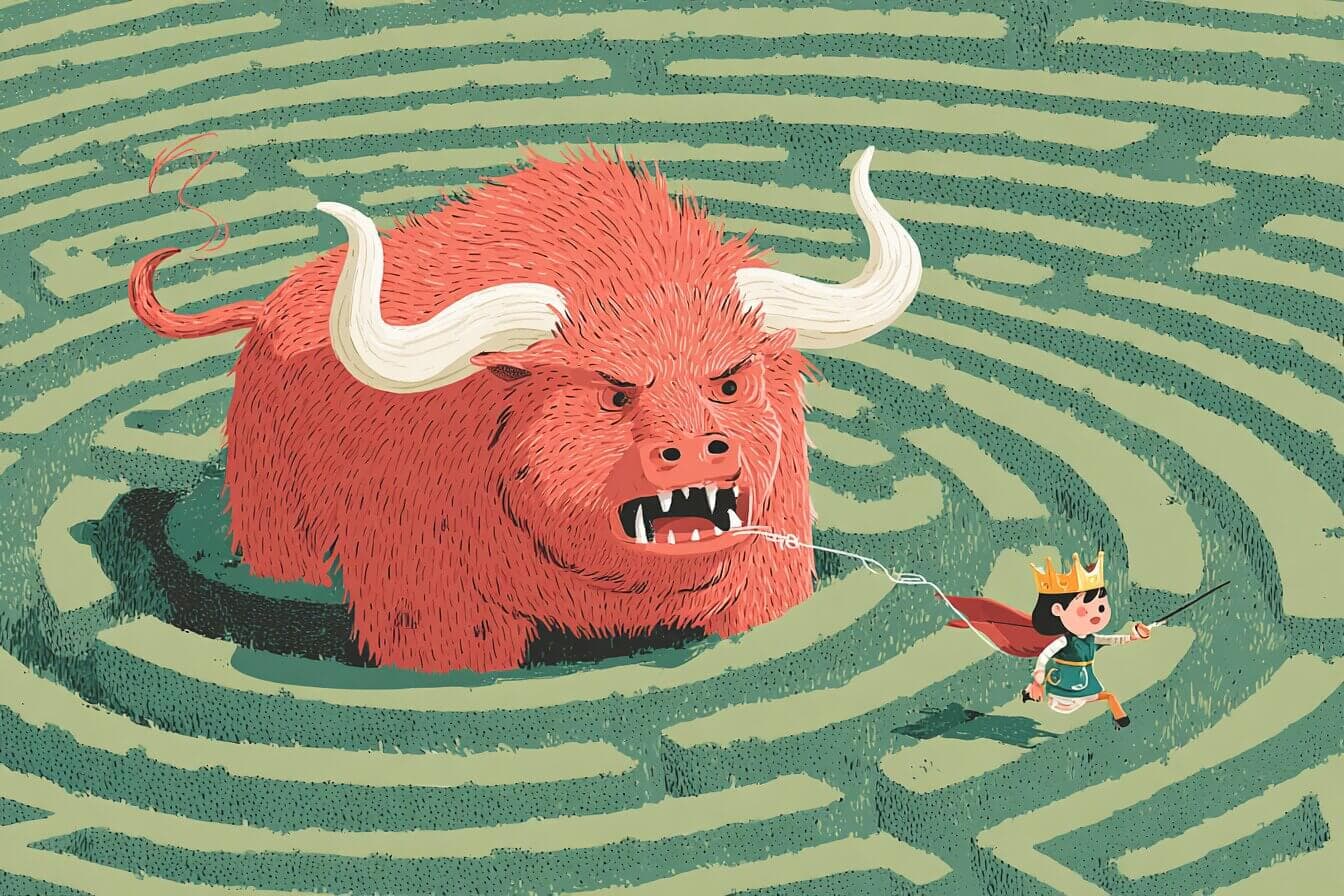
There is something about cool stone corridors and the flicker of torchlight that makes a child curl deeper under the covers, wide-eyed and perfectly still. This gentle retelling follows Prince Leo, a twelve-year-old with no armor and no sword, who enters a shifting maze armed only with a spool of crimson thread and a promise to bring his cousin home through kindness rather than fighting. It is exactly the kind of Theseus and the Minotaur bedtime story that turns ancient myth into something warm and safe enough for the last minutes before sleep. If your child loves the idea but you want to swap the setting or tone, you can create your own version with Sleepytale.
Why Theseus and the Minotaur Stories Work So Well at Bedtime
A labyrinth is, at its core, the feeling every child knows: being somewhere unfamiliar and needing to find the way back. That is why a bedtime story about Theseus and the Minotaur resonates so deeply at night. The thread becomes a promise that you are still connected to home, no matter how many turns the path takes. For a child lying in the dark, that image is as comforting as a nightlight left on in the hall.
These myths also let kids sit with big feelings, fear, loneliness, even sympathy for a creature everyone else calls a monster, inside a structure that always ends with the hero walking back out. The maze resolves. The thread holds. That predictable safety is exactly what young minds need before they close their eyes, because it tells them that confusion is temporary and courage does not have to be loud.
The Prince and the Thread of Courage 6 min 18 sec
6 min 18 sec
Prince Leo was the youngest son of King Apollo, ruler of the shining city of Helios on the edge of the sea.
Every spring the city held a festival of flowers. But this year the palace was quiet, because the king's own niece, Princess Ariadne, had vanished into the old stone maze that lay beneath the throne room.
Within that maze lived the Minostag, a creature with the body of a man and the head of a bull, who had once been a prince himself until pride twisted him into something else entirely.
The Minostag had challenged the kingdom: if anyone could walk the twisting paths and return before the moon rose full, the princess would go free. No one had ever found the way out. The walls shifted like sand when you weren't looking.
Leo stepped forward.
The court gasped. He wore no armor, just a white tunic and a belt of woven gold. He knelt before the throne and promised his father he would bring Ariadne home. His voice carried across the silent hall without trembling, though his hands, clasped behind his back, squeezed tight enough to leave half-moon marks from his fingernails.
At the entrance stairs, Ariadne herself appeared, pale but smiling, and pressed a small wooden spool of crimson silk into his hand. It smelled faintly of roses, the kind his mother used to grow along the southern wall before she died.
She whispered that if he tied one end to the iron ring at the gate and let the thread run through his fingers as he walked, it would guide him back. Like a heartbeat, she said. Always pulling you home.
Leo tucked the spool beneath his belt, hugged her quickly, and descended the spiral steps while the guards closed the bronze doors behind him.
The boom echoed for a long time.
The air smelled of damp earth and forgotten years. His torch painted the stone walls with shapes that almost looked like wings, then claws, then nothing at all. He tied the thread to the ring, tested the knot twice, let out a breath that puffed silver in the cold, and walked in.
Each footstep came back to him from the high ceiling, a second set of steps that matched his own. He talked to himself to shrink the fear down to something manageable, naming constellations he loved. Orion. The Bear. The little cluster near the horizon that his father always called the Scattered Seeds, though no star chart gave it that name.
The corridors branched and branched again. Some tilted upward toward towers he couldn't see. Others dropped into darkness that smelled of deep wells. But the thread slipped smoothly over the dusty floor behind him, and every time he glanced back, there it was. Red against grey.
After what felt like hours, he entered a round chamber.
The walls were painted with stars, old ones, flaking in places where the moisture had gotten in. And there stood the Minostag. Taller than two men. Horns gleaming like polished bronze. His breath came in slow gusts that made the torch flame lean sideways.
He did not roar.
He spoke in a voice like wind through reeds and asked why a child dared walk where grown warriors had turned back. Leo said, simply, that love for his cousin was louder than any fear he had. It wasn't a grand speech. He said it the way you'd tell someone what you had for breakfast, matter of fact, because it was true.
Something shifted in the creature's eyes. The Minostag sat down heavily on a stone ledge, and the movement was so human, so tired, that Leo almost forgot about the horns.
The maze was lonely, the Minostag told him. The walls had grown their shifting tricks from sorrow, not evil. Only a heart unshadowed by greed could solve the riddle of the moving corridors.
Then he held out three crystal orbs. One held dawn. One held dusk. One held the midnight sky.
The prince must choose which light would reveal the true path. But each orb would also show a different future.
Leo weighed them one at a time. Dawn was warm. Dusk was cool. Midnight was cold at first, then not cold exactly, but alive. Tiny points of starlight blinked inside the glass like knowing eyes. He held that one up, and the maze walls went transparent as water.
Through them he saw Ariadne sitting beside a silver spring, weaving garlands of moonflowers, safe but waiting. Beyond her, the single straight path back to the gate.
But the orb showed something else too.
It showed the Minostag, alone. Always alone. Pacing the round chamber until the painted stars faded completely and there was nothing left but dark stone and the sound of his own hooves.
Leo set the orb down carefully.
"Come with me," he said. "We'll walk out together. The kingdom will build you a garden, with roses if you like, and you can hear children singing. You won't be alone anymore."
The creature stared at him for a long time. Then tears rolled down his bull cheeks, and they caught the torchlight like liquid starlight. He shrank. The horns curled into a simple crown of woven ivy. The heavy face softened into that of a young man who looked like he'd just woken from a very long, very bad dream.
They found Ariadne beside the spring. She laughed out loud when she saw them, grabbed both their hands, and the three of them followed the crimson thread through corridors that finally held still. Somewhere in the stone, Leo thought he heard the maze sigh, but it might have been the wind finding its way down from the surface.
When they stepped into the sunlit square, the whole city cheered. King Apollo held his son, then the princess, then the redeemed guardian, and declared that day would forever be the Festival of Threads: for courage, for kindness, and for the paths that lead us home.
That evening, roses bloomed along the palace walls in colors Leo didn't have names for. Children danced wearing tiny crimson ribbons tied around their wrists. Leo sat between Ariadne and their new friend on the warm steps, watching stars appear one by one like eyes blinking open after a long sleep.
Nobody said anything about a lesson or a moral. They didn't need to. The thread was still there, tied to the iron ring below, and it would stay there for anyone who ever needed to find their way back.
The Quiet Lessons in This Minotaur Bedtime Story
This story weaves together empathy, patience, and the courage to see past appearances, all through moments a child can feel rather than lessons they are told. When Leo offers the lonely Minostag a garden instead of a fight, kids absorb the idea that compassion can transform what seems frightening. When he chooses the midnight orb by paying attention rather than guessing, the story rewards careful thinking over haste. And the thread itself, always there, always leading home, gives children a sense of security right before sleep: no matter how confusing tomorrow might feel, there is always a path back to the people who love you.
Tips for Reading This Story
Give the Minostag a slow, deep, slightly weary voice, especially when he sits down on the stone ledge and explains his loneliness. For Leo, keep the tone steady and plain, not heroic, just honest, so the moment where he says "Come with me" lands quietly instead of dramatically. When Leo names the constellations to himself in the dark corridor, slow your pace and lower your volume. That is a good spot to pause and ask your child which stars they would name if they were walking through.
Frequently Asked Questions
What age is this story best for?
Children ages 4 to 9 tend to enjoy it most. Younger listeners connect with the simple thread-following and the creature's transformation, while older kids appreciate Leo's choice between the three crystal orbs and the weight of his decision to invite the Minostag out of the maze. The language is vivid but not frightening, so even sensitive listeners can follow without worry.
Is this story available as audio?
Yes. You can press play at the top of the story to hear it read aloud. The audio version brings the echoing footsteps in the labyrinth and the Minostag's low, reedy voice to life in a way that pulls kids right into the maze. The rhythm slows naturally as Leo and his companions follow the thread home, which makes it especially good for winding down.
Why does this version use kindness instead of a battle?
Traditional retellings often end with Theseus defeating the Minotaur, but this version reimagines the creature as someone suffering from loneliness rather than wickedness. Leo's offer of friendship gives children a resolution that feels safe and hopeful at bedtime, showing that understanding can solve problems a sword never could. It keeps the adventure and tension of the myth while replacing violence with empathy.
Create Your Own Version
Sleepytale lets you reshape this ancient myth into something perfectly suited for your child's bedtime. You can swap the stone labyrinth for a moonlit forest, turn the crimson thread into a silver ribbon, or place your own child in Leo's role as the brave, kind hearted hero. In moments you will have a cozy, personalized tale ready to replay every night.
Looking for more bedtime story classics?

Once Upon A Time Stories
What happens when June opens a golden book with no title? One of the sweetest short once upon a time stories about a forest, a hedgehog, and a blank page.

Fairy Tales Written By Hans Christian Andersen
Anders discovers short fairy tales written by Hans Christian Andersen as his grandmother reads from a soft brown book by lamplight.

Bluebeard Fairy Tale
In this short bluebeard fairy tale, the forbidden room holds not horror but a music box and memories of the people Lord Corvus loved most.

Red Shoes Fairy Tale
What happens when Karen's magical red shoes refuse to stop dancing? Discover this short red shoes fairy tale tonight.
Twinkle Twinkle Little Star Bedtime Story
Lily watches a kind star and floats up to help deliver dreams in this short twinkle twinkle little star bedtime story. A warm, quiet tale for sleepy nights.
Through The Looking Glass Bedtime Story
Step into a calm, magical short through the looking glass bedtime story and drift toward sleep with gentle wonder. Enjoy a soothing retelling that feels cozy from start to finish.