
Through The Looking Glass Bedtime Story
By

Dennis Wang, Bedtime Story Expert
8 min 23 sec
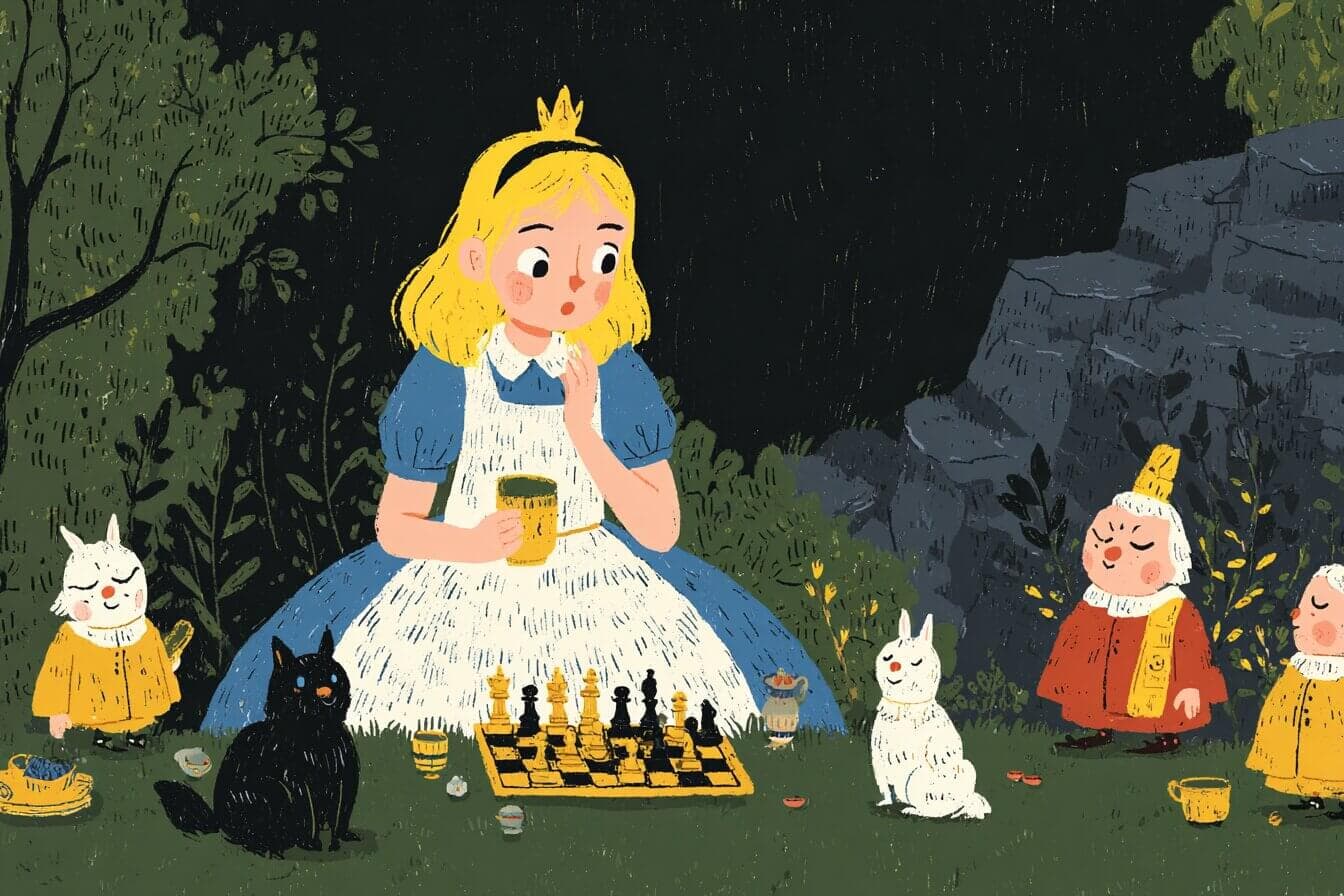
There is something about mirrors at night that makes even grown-ups pause for a second and wonder. This cozy retelling follows Alice as she steps through the glass into a backward world of chess pieces in tiny scarves, bickering roses, and a cloud staircase you climb by walking down. It makes for a lovely through the looking glass bedtime story, full of gentle puzzles and the reassuring loop of leaving home and finding your way back again. If your child would love hearing their own name in Alice's place, or swapping the chess garden for a favorite setting, you can build a personalized version with Sleepytale.
Why Looking Glass Stories Work So Well at Bedtime
Mirror worlds tap into something children already do every night: cross a threshold between waking and sleeping, between the room they know and the dreams they don't. A story set on the other side of a looking glass gives that transition a shape, a door they can picture opening and closing. The gentle strangeness of backward clocks and upside-down staircases lets a child's mind loosen its grip on the day's logic without feeling scared, because the rules are silly rather than threatening.
There is also comfort in the return. A bedtime story about a looking glass adventure always ends back in the bedroom, quilt pulled up, mirror going still. That predictable homecoming mirrors the child's own situation, already safe in bed, already almost asleep. The world on the other side can wait until tomorrow.
Alice Through the Looking Glass 8 min 23 sec
8 min 23 sec
Alice pressed her nose against the mirror and felt it give, soft and cool, like toffee left near a window on a chilly day.
She pushed a little harder. Her fingers slid through.
With one quick breath she stepped all the way in and landed in a room that looked almost like hers, except the clock on the mantel ticked backwards and the pictures on the wall kept winking at her, slow and deliberate, the way a cat does when it thinks you aren't watching.
Behind her the mirror frame crusted over with glittering frost, and her own bedroom faded to a silvery nothing.
A white chess pawn in a red scarf scurried past her ankles.
"Hurry, hurry," it squeaked, not looking up. "The game starts at sunset and we are already three minutes late, which in this world means we are four minutes early, which is somehow worse."
Alice decided that following a tiny panicking chess piece was better than standing still, so she did.
The hallway they entered was lined with books that read themselves aloud in papery murmurs. One thick volume near the floor was halfway through a recipe for cloud soup. Alice caught the words "two handfuls of fog, lightly salted" before the pawn tugged her onward.
At the hall's end she found a garden.
The roses were arguing.
One bloom insisted on being purple. Its neighbor wanted stripes, specifically candy-cane stripes, and would not stop saying so. A small rose near the back, the kind that is always overlooked, had quietly turned a shade of orange nobody asked for and seemed perfectly happy about it.
Alice told them they all looked fine, which was true.
Every rose blushed a different color at once, and the garden went silent for three full seconds, a record.
A White Queen appeared from behind a hedge, patting her pockets with both hands.
She was tall. Then she was small. Then she was tall again, as if she couldn't quite settle on a size the way you can't settle on a comfortable position when you first get into bed.
"I have completely forgotten why I came to greet you," the Queen said cheerfully. "But do tell me your name so I can forget it properly."
Alice curtsied and told her.
The Queen handed her a golden thread, thin as a spider's strand but warm to the touch, and explained that following it would lead to the square where the jolly twins were waiting. "They have a riddle," the Queen added. "I cannot remember what it is, but I recall it being rather good."
The path ahead was divided into squares of grass that gave under Alice's shoes like sponge cake. She could feel the slight spring in each step. The golden thread unspooled ahead of her, catching the strange sideways light.
Tweedledee and Tweedledum stood beneath an umbrella made entirely of paper stars. They wore matching grins. One of them had a jam stain on his collar that the other one did not, which was the only way Alice could tell them apart.
They sang a short song about yesterday's tomorrow. It made no sense and it rhymed perfectly.
"Backwards race!" Tweedledee announced.
"Run as slowly as you can," Tweedledum explained. "Slowest wins, which means fastest wins, which means you should probably just start."
Alice tried walking at a crawl. The world disagreed. She shot forward like the wind and crossed the finish line before either twin had taken a step.
They cheered anyway.
Their prize was a mirror the size of a walnut. Alice peered into it and saw herself laughing, but the laugh hadn't happened yet.
"Future giggles," said Tweedledee, tapping the side of his nose.
Alice tucked it into her pocket carefully, the way you would carry an egg.
"How do I get home?" she asked.
Both twins pointed upward. A staircase of clouds spiraled into the sky, each step fat and pale and slightly damp-looking.
"Climb at noon," said Tweedledee.
"Walk downward to go up," said Tweedledum.
"Don't ask us why."
Alice set off. The clock, wherever it was, was approaching thirteen.
Along the path she met a gnat the size of a pony. It blinked its enormous eyes and offered her a ride without being asked, which Alice appreciated because her legs were getting tired and she did not want to admit it.
From the gnat's back the world unrolled beneath her. Rivers flowed uphill. Rain drifted upward in sparkly arcs and disappeared into the clouds it had come from. A field of sunflowers turned to watch her pass, their big faces curious and unhurried.
The gnat set her down at the foot of the cloud stairs and hummed something that was half lullaby, half the sound of a spoon tapping a glass. Alice's eyelids felt heavy for just a moment.
She placed her hands on the lowest step. It bounced. It smelled like clean laundry, the kind that has been drying in wind.
She remembered the twins' instructions and walked downward.
Each step lifted her higher.
The air turned cool and faintly peppermint. Below, the backward world became a patchwork quilt of bright squares, shrinking, softening.
At the top she found a door shaped like a crescent moon. She turned the handle, and there was her bedroom, solid and warm and wonderfully ordinary.
She stepped through. The mirror turned solid behind her with a quiet click, like a latch catching.
In her pocket the little walnut mirror glowed. She looked into it. Tweedledee and Tweedledum waved at her, their matching grins smaller now but no less wide.
Alice waved back.
She climbed into bed and pulled the quilt up to her chin. The room smelled like her room. The clock ticked forward, one beat at a time, exactly as it should.
Outside, the moon sat low and round in the window, and if it winked, Alice did not see it because her eyes were already closed.
In the backward world, the White Queen suddenly remembered why she had come to the garden in the first place. She had meant to leave Alice a second golden thread, just in case. She tucked it beneath a loose floorboard under the bed, humming something that sounded like a melody you almost recognize but can never quite name.
The chess pieces gathered and set up a new game. The roses voted to go rainbow for the next visit. Tweedledee practiced standing on his head while Tweedledum kept score of something neither of them could explain.
Everything waited.
Alice slept with the tiny mirror warm in her hand, her breathing slow and even. The stars outside rearranged themselves into the shape of a chess knight, standing guard.
The looking glass shimmered once, twice, then went still, its surface reflecting only the quiet room and the sleeping girl who had discovered that backwards can sometimes be the very best way forward.
The Quiet Lessons in This Looking Glass Bedtime Story
This story is full of small moments where Alice chooses curiosity over worry, and each one lands gently enough for bedtime listening. When the roses argue about their colors and Alice simply tells them they all look fine, children absorb the idea that differences do not need to be resolved, just accepted. The backwards race, where trying to go slow sends you flying, plays with the comforting notion that letting go of control can be its own kind of success. And the whole journey loops back to Alice's own bed, her own quilt, her own clock ticking forward again, which gives a child the quiet reassurance that no matter how strange the day felt, home is still exactly where they left it.
Tips for Reading This Story
Give the White Queen a slightly breathless, scatterbrained voice, as if she is always one thought behind herself, and let the chess pawn sound rushed and squeaky, words tumbling over each other. When Alice steps onto the first cloud stair and it bounces, pause and ask your child what they think a cloud would feel like under their feet. Slow your pace noticeably once Alice is back in her bedroom; let the sentences about the clock ticking forward and the quilt pulled up land in near-whisper, matching the rhythm of settling in.
Frequently Asked Questions
What age is this story best for?
Children ages 3 to 8 tend to enjoy it most. Younger listeners love the silly details like the arguing roses and the pony-sized gnat, while older kids appreciate the logic puzzles of walking downward to go up and running slowly to go fast. The vocabulary stays accessible, and the homecoming ending reassures every age group.
Is this story available as audio?
Yes. Press play at the top of the story to hear it read aloud. The audio version brings out the rhythm of the twins' song about yesterday's tomorrow and gives each character, from the squeaky pawn to the forgetful Queen, a distinct voice that makes the backward world feel alive in a way that is especially cozy through headphones at bedtime.
Why does the story use chess pieces as characters?
Lewis Carroll's original novel is structured around a chess game, with Alice moving across the board like a pawn. This retelling keeps that playful framework but simplifies it so the chess pieces feel like friendly guides rather than game mechanics. The little pawn in his red scarf and the puzzled White Queen give children familiar anchor points as they travel through an otherwise topsy-turvy world.
Create Your Own Version
Sleepytale lets you reshape this mirror-world adventure to fit your child's imagination perfectly. Swap Alice for your little one's name, trade the chess garden for a candy kingdom or an underwater palace, or adjust the tone from whimsical to extra cozy for nights when calm is what matters most. In just a few taps you will have a personalized looking glass story ready to read or listen to, as many times as bedtime needs it.
Looking for more bedtime story classics?

Once Upon A Time Stories
What happens when June opens a golden book with no title? One of the sweetest short once upon a time stories about a forest, a hedgehog, and a blank page.

Fairy Tales Written By Hans Christian Andersen
Anders discovers short fairy tales written by Hans Christian Andersen as his grandmother reads from a soft brown book by lamplight.

Bluebeard Fairy Tale
In this short bluebeard fairy tale, the forbidden room holds not horror but a music box and memories of the people Lord Corvus loved most.

Red Shoes Fairy Tale
What happens when Karen's magical red shoes refuse to stop dancing? Discover this short red shoes fairy tale tonight.
Twinkle Twinkle Little Star Bedtime Story
Lily watches a kind star and floats up to help deliver dreams in this short twinkle twinkle little star bedtime story. A warm, quiet tale for sleepy nights.
This Little Piggy Bedtime Story
A giggly parade turns into a cozy wind down in this short this little piggy bedtime story, with balloon apples and pillow forts that float all the way to moonlight.