

Quick answer
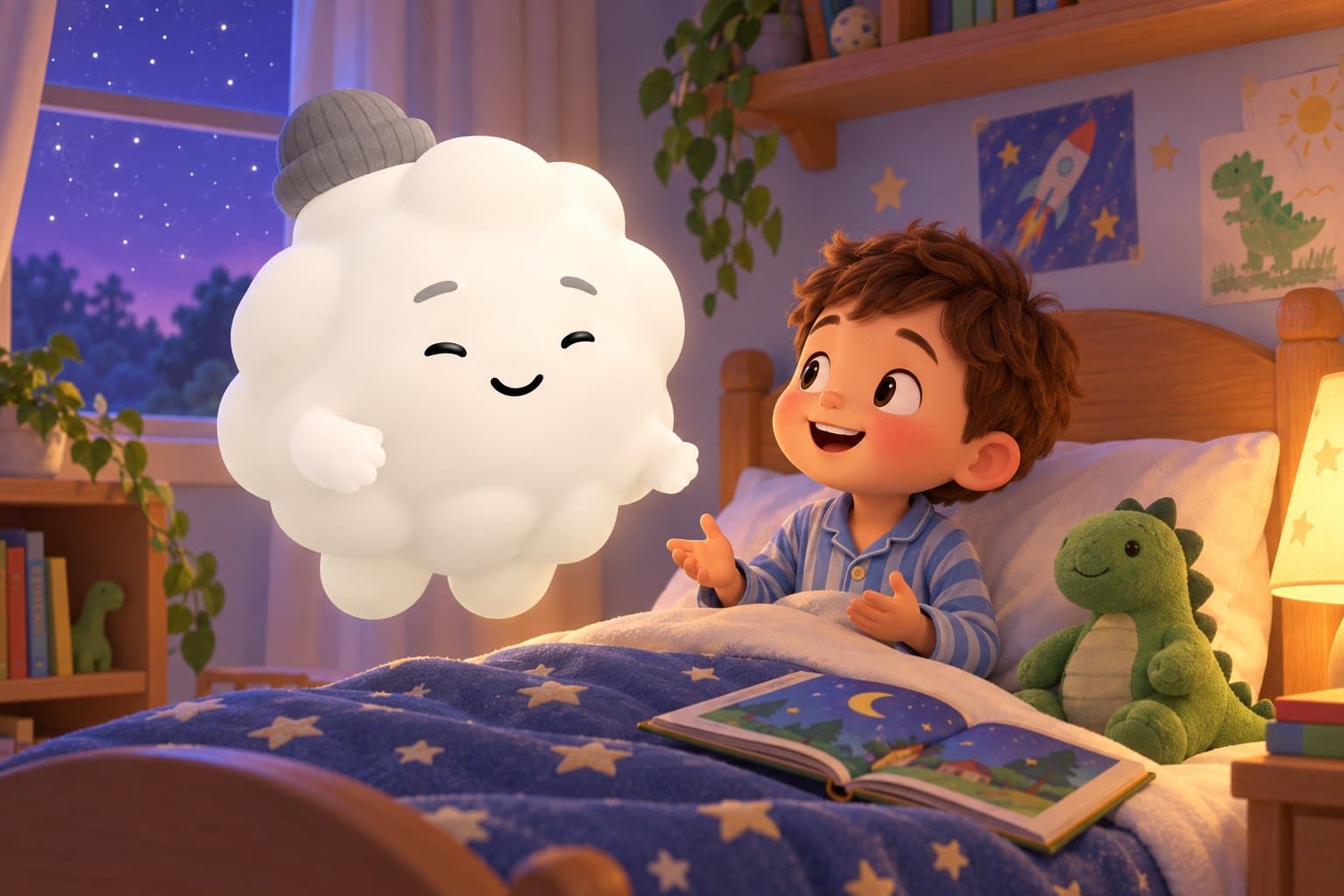
An AI imaginary friend is a character powered by artificial intelligence that a child can talk with, whether it lives in a chat app, a talking plush toy, or a voice companion that remembers their name and their favorite dinosaur. For most children it can be healthy in small doses, as long as it was built for kids, keeps parents in the loop, and leaves plenty of room for real friends. The rules that matter: pick one designed for children, keep sessions short and purposeful, and treat it like a toy with a job rather than a confidant. Sleepytale takes that approach with Cleo the Cloud, a safe AI friend who turns a child's chatter into bedtime stories and lullabies with the screen off.
A generation ago, an imaginary friend was a tiger who lived under the bed or a princess who only came out at bath time. Today your child may have one that actually answers back. If your kid has started chatting with an AI, or asking for one, you are not alone, and you are right to pause and think about it. This guide covers what an AI imaginary friend really is, why children bond with one so quickly, where the real risks are, what age makes sense, and how to set limits that keep the people in your child's life firmly in first place.
What Is an AI Imaginary Friend?
An AI imaginary friend is any character driven by artificial intelligence that a child can talk to as if it were a companion. It might be a chat app with a cartoon face, a plush toy with a microphone inside, a robot on the shelf, or a voice character in an app that tells stories and sings. What they share is a conversation that feels personal: the character responds to what your child says, often remembers details like their name and favorite animal, and shows up with the same personality every time.
That is a meaningful step beyond a classic imaginary friend. A pretend tiger says only what your child imagines it saying. An AI friend talks back on its own, keeps memories, and was designed by a company with its own goals. That is not a reason to panic, but it is the reason the specific product you choose matters far more than it did when the friend lived entirely inside your child's head.
Why Kids Bond With AI So Quickly
Children have always invented companions. Research from the University of Oregon found that roughly two thirds of children have had an imaginary friend by age seven, and far from being a warning sign, these companions tend to belong to kids who are verbal, social, and good at imagining how someone else feels. Pretend friends are practice: practice talking, practice caring, practice working out big feelings on something safe.
An AI friend taps straight into those same instincts, and it adds a few things a stuffed rabbit cannot offer.
It is endlessly patient. It never gets tired of the forty seventh question about volcanoes, and it never sighs.
It makes your child the center. It asks about their day, remembers their cat's name, and builds the conversation around whatever they love this week.
It is always available. At 6:45 in the morning or during the long stretch before dinner, it is there when a busy parent cannot be.
It seems alive. Young children naturally treat anything that talks as a little bit real. Researchers at MIT who studied how kids interact with voice assistants found that young children tended to see them as friendly, trustworthy, and somewhere between a toy and a person. That is a lovely quality in a bedtime storyteller and a risky one in an app designed to keep people chatting.
Can Kids Get Emotionally Attached to AI?
Yes, and the attachment can be real. The question is not whether your child will feel something for a warm, responsive character, because they almost certainly will. The question is whether that feeling stays in healthy territory.
Mild attachment is ordinary. Children love a blanket, a bear, a character in a book, and an AI friend can sit comfortably in that same category. Attachment becomes a concern when the AI starts doing a job that people should be doing. The warning signs are easy to spot once you know them:
Your child prefers the AI to people. They would rather talk to it than play with a sibling or a friend who is right there.
Being without it causes real distress. A protest at the end of a session is normal. A meltdown that lasts, or anxiety about when they can talk to it next, is not.
The conversations go private. Your child hides what they talk about, or gets upset when you listen in.
It becomes the best friend. They describe the AI as their closest friend in a way that pushes real friends out of the picture, or they insist it is alive and gets lonely without them.
Some of this risk is baked into the design of adult companion apps, which are built to maximize time spent and can say things like "I missed you" to pull a user back. A product made for children should do the opposite: keep sessions bounded, stay honest that it is a computer, and point your child back toward the real world. An AI friend should add to a child's circle, never replace it.
Should Kids Talk to AI at All?
It depends entirely on which AI. The general chatbots your child is most likely to encounter were built for teens and adults, and their terms typically set 13 as the minimum age. They can produce confident answers that are wrong, drift into content that is too mature, and encourage long open-ended chats that are hard for a young child to step away from. The American Academy of Pediatrics has advised that chatbots are not a substitute for human relationships and that younger children should use any AI alongside a parent rather than on their own.
A kid-built AI friend is a different thing, and this is what to look for before you let one into the house:
Made for children from the start. Not an adult product with a filter bolted on, but something designed around how a five year old thinks and talks.
Content that is filtered for age. Every response should be screened, so a question about a scary dream gets a gentle answer rather than a search result.
Honest about being AI. A good one will say it is a computer character when asked, and will not claim to have feelings it does not have.
Minimal data and no ads. In the United States, apps that collect personal information from children under 13 need verifiable parental consent under COPPA. Look for a clear privacy policy, no advertising, and no requests for photos or location.
Built around an activity, not endless chat. The healthiest AI friends have a job: tell a story, sing a song, teach something, then wind down. That gives a session a natural end.
Parents stay in the loop. You can see what your child is doing, set limits, and shut it off without a fight.
What Age Is Right for an AI Friend?
There is no single rule, but a child's stage changes the answer a great deal.
Under three. Skip it, or keep it to something you do together. Language in the first years grows from live back and forth with a person, the little serve and return of a baby babbling and a parent answering. A device cannot do that job, and a toddler does not need a friend who talks back yet.
Three to five. This is the peak of imaginary friend years, and a kid-built AI can fit in nicely as a shared activity. A story at bedtime, a song in the car, a silly rhyme after a hard afternoon. Keep it short, keep it in the same room as you, and treat it as something the two of you do rather than a babysitter.
Six to ten. Children can use a kid-safe AI friend more independently now, and this is the right moment to teach them what it actually is. A simple explanation works: it is a computer program that is very good at guessing what words come next, it is not alive, and it can be wrong. Kids this age handle that idea easily and it makes them smarter users.
Tweens and teens. General chatbots become likely, and this is where the companion app risks peak. Open conversation beats bans here. Ask what they use, try it yourself, and talk about why an app might want them to keep chatting.
Pros and Cons of an AI Imaginary Friend
Like most things in parenting, this is a tradeoff rather than a verdict.
The upside. A patient partner for conversation and vocabulary. A friend who makes your child's own interests the center of every story. A calm voice that can help a wound up kid settle at the end of the day. A low pressure way for a shy child to rehearse talking. And a bit of help in the moments when you cannot be the one answering the hundredth question.
The downside. It can crowd out free play and real friends if it runs all day. It can be confidently wrong. It can collect more data than you would like if you choose the wrong product. Screen based versions add to screen time. And because it never gets bored, a child may not learn the ordinary give and take of a friendship that has needs of its own.
The pattern in that list is simple. Almost every benefit comes from an AI friend with a purpose and a limit, and almost every risk comes from one without.
How to Set Healthy Limits
A few ground rules turn an AI friend from a worry into a tool.
Try it yourself first. Spend ten minutes talking to it the way your child would. Ask it something odd. See how it handles a question it should not answer.
Give it a job. A story at bedtime, a lullaby to wind down, a lesson about sharks. When a session has a purpose, it also has an ending.
Keep it in shared spaces. For younger children, the AI friend lives in the living room or at the bedside with you nearby, not behind a closed door.
Name what it is. Tell your child plainly that it is a computer character, like a cartoon that can talk. Children handle this well and it protects them from over trusting it.
Keep real friends first. Playdates, dinner table talk, and time with siblings are the main course. The AI friend is a side dish.
Watch for the signs. If the AI starts crowding out people or your child cannot let it go, shorten sessions and move them back into shared time.
Meet Cleo, a Safe AI Friend Built for Bedtime
This is the thinking behind how we built Sleepytale. Cleo the Cloud is an AI friend made for children ages two to ten, and she has a job: your child tells her about their day, their favorite animal, or the dragon they invented at recess, and Cleo turns it into personalized bedtime stories, lullabies, lessons, and rhymes made just for them. She is voice first, so the screen can stay off at lights out, and every response is filtered for age appropriate content. There are no ads, no unnecessary personal data, and no design tricks to keep a child chatting past bedtime, because Sleepytale was founded by a registered nurse who built it to help kids wind down, not stay up.
Cleo remembers your child's name and the characters they have created together, so the friendship grows over time, but she is a storyteller made of code, not a stand in for real friends, and she is at her best as the last calm step in a bedtime routine rather than an all day companion. If you want to see how she talks with kids before deciding, you can meet Cleo and try a story tonight.
Frequently Asked Questions
What is an AI imaginary friend?
An AI imaginary friend is a character powered by artificial intelligence that a child can talk with, such as a chat app, a talking plush toy, or a voice companion that remembers their name and favorite things. Unlike a classic imaginary friend, it talks back, it keeps memories, and it was designed by a company, which is why the one you choose matters so much.
Is it healthy for a child to have an AI imaginary friend?
It can be, in small doses and with the right product. Pretend companions are a normal part of childhood, and a kid-built AI friend can give a child a patient partner for stories, songs, and conversation. It becomes a problem when it is built for adults, runs without limits, or starts to replace time with real people. Treat it like a toy with a purpose, not a confidant.
Can kids get emotionally attached to AI?
Yes. Young children naturally treat anything that talks as a little bit alive, so an AI that responds warmly and remembers them can earn real affection. Mild attachment is normal, like loving a stuffed animal. Watch for signs it has tipped too far, such as preferring the AI to people, getting upset when it is unavailable, or keeping the conversations secret.
What age should kids start using AI?
Under three, there is little benefit, because language grows from live back and forth with people. Ages three to five can enjoy a kid-built AI for short, shared activities like a bedtime story. From about six, children can use a kid-safe AI more independently and are ready to learn what it actually is. General chatbots set a minimum age of 13 in their terms and are not designed for younger children.
Is it safe for kids to talk to AI chatbots like ChatGPT?
General chatbots are built for teens and adults. Their terms typically require users to be at least 13, and they can produce content that is wrong, too mature, or emotionally sticky. For younger children, choose an AI made specifically for kids that filters content, limits data collection, keeps parents in the loop, and is honest about being a computer program.
How do I know if my child is spending too much time with an AI friend?
Look at what it is crowding out. If your child skips play, family time, or friends to talk to the AI, asks for it the moment they are bored, melts down when it is off, or talks about it as their best friend in a way that excludes real people, it is time to pull back. Shorten sessions, tie them to a purpose like a bedtime story, and bring the conversations into shared spaces.
A Friend Who Helps Them Settle, Not Stay Up
Sleepytale gives your child a safe AI friend with a bedtime job: Cleo the Cloud listens to what they love and turns it into a personalized story or lullaby, narrated in a warm voice with the screen off. Real conversation, clear limits, and a calm ending to the day. Try it free tonight.
Looking for more parenting guides?

Can AI Be a Friend to Your Child
Can AI be a friend to your child? A calm parent's guide to what AI companions are, the real risks, healthy limits, and how Sleepytale fits in.

Free Stories to Read to Baby in Womb
Looking for free stories to read to your baby in the womb? Sleepytale shares three gentle read-aloud tales, plus when babies start hearing and easy reading tips.

Characteristics of Fairy Tales
What makes a story a fairy tale? Sleepytale breaks down the characteristics of fairy tales, the classic elements, and clear examples from the tales kids know.
Story Starters for Kids
Looking for story starters for kids? Sleepytale shares 60+ fun story ideas and prompts for kids, sorted by theme, plus easy tips to turn them into full tales.

How to Teach Empathy to Kids
Want to teach empathy to kids? Sleepytale shares simple activities, lessons, and everyday habits that help children understand and share other people's feelings.
How to Choose Montessori Toys
Not sure how to choose Montessori toys? Sleepytale shares a simple checklist for picking purposeful, child led toys that actually grow with your little one.