
Bedtime Stories For 9 Year Olds
By

Dennis Wang, Bedtime Story Expert
10 min 57 sec
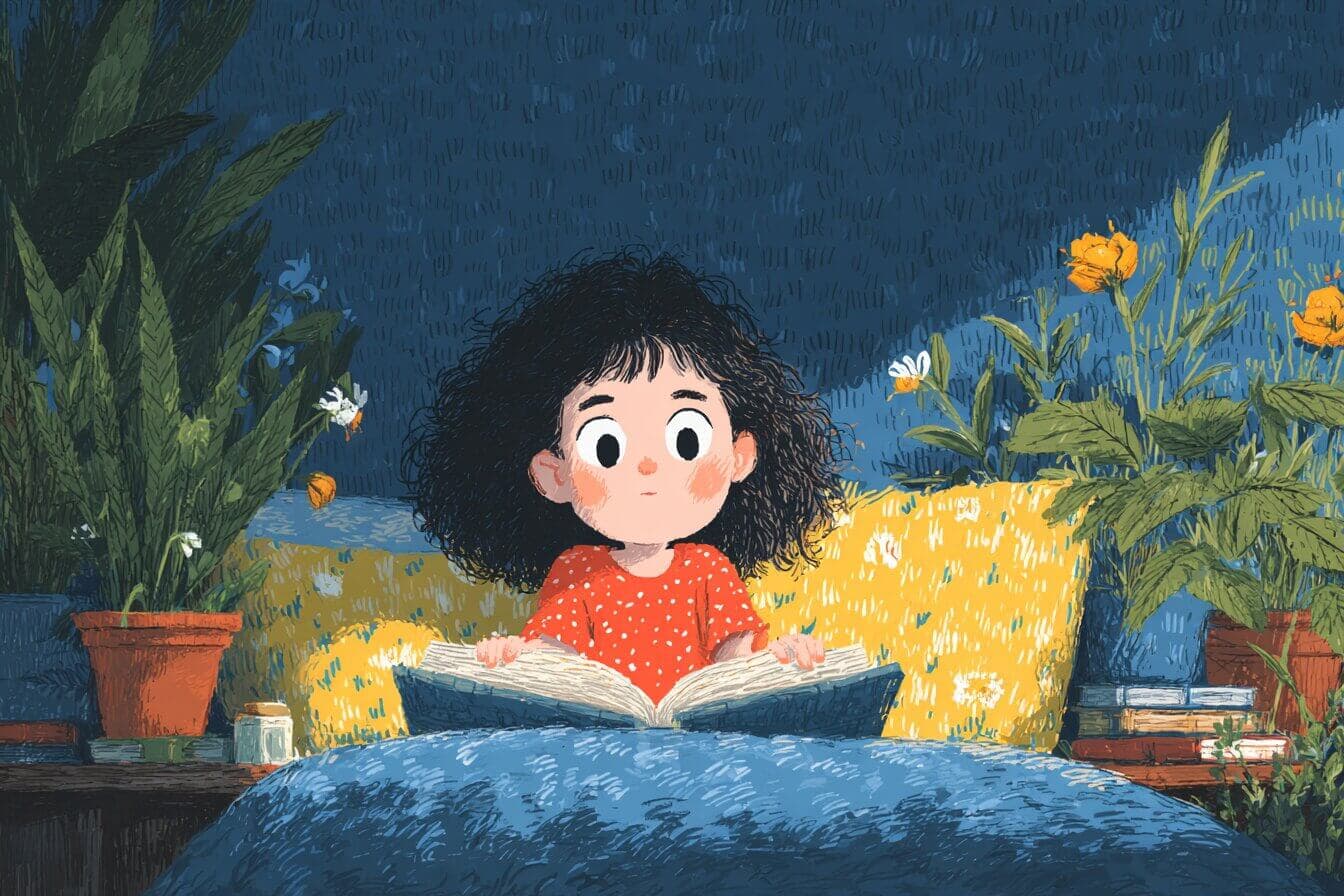
There's something about a mystery hidden inside the walls of an old house that makes the covers feel like a fortress. In this story, a girl named Sage peels back wallpaper in her grandmother's house and finds a leather journal filled with decades of children's discoveries, leading her to a locked blue door on the third floor and a question she has to solve without opening it. It's the kind of bedtime stories for 9 year olds that rewards patience over recklessness, letting curiosity do the heavy lifting. If your child loves puzzles wrapped in atmosphere, you can build a personalized version with Sleepytale.
Why 9 Year Olds Stories Work So Well at Bedtime
Nine year olds live in a fascinating in-between space. They're old enough to follow layered plots, pick up on clues, and feel genuinely invested in how a mystery resolves, but they still feel the pull of a creaky staircase or a door that shouldn't be opened. A bedtime story for this age group works best when it trusts the reader to think, not just listen. That's why discovery tales and quiet suspense land so well right before sleep.
When a character like Sage uses a mirror, a tape measure, and a compass instead of just barging through, something clicks for kids at this age. They're starting to love that kind of problem solving in their own lives. The brain gets a gentle workout, the tension resolves into something calm, and sleep comes easier after a story that respects how capable these kids really are.
The Blue Door on the Third Floor 10 min 57 sec
10 min 57 sec
Sage pressed her ear to the wallpaper.
Nothing.
Just the hush of Grandma's house, the tick of the kitchen clock two floors down, and the fridge doing that low thrum it always did after dark. Every night since they'd arrived for summer break, though, she heard the faint rasp of paper rubbing paper. Like someone turning pages inside the wall.
She fetched the desk lamp, dragged the cord across the braided rug, and ran the bulb along the faded roses on the wallpaper. A seam showed. Hairline crack, right beside the doorframe, the kind of thing you'd never notice unless you were looking for it.
She picked at it.
The paper lifted in one dry sheet, and behind it, jammed between the studs like someone had shoved it there in a hurry, sat a book. Leather spine. No title. Dust puffed when she cracked it open, and she sneezed so hard her eyes watered.
The first page read, in careful pencil: "Eleanor, age 9, 1910." Underneath, Eleanor had drawn a grasshopper and written, "They chirp by rubbing wings together. I tried. Nothing happened."
Sage grinned.
She flipped through. Each page was a different handwriting, a different year. "Harold, 1913," listed constellations with little arrows showing how to find them. "Ruby, 1921," pressed a buttercup between the pages and noted, "Yellow means friendship in flower language." Facts, questions, little discoveries. Kids being curious in the margins of history while this house just stood here holding their secrets.
She read until her neck cramped. 1929, 1932, 1938. The entries grew shorter as paper got scarce.
Then she reached 1943.
The ink was shaky. "Margaret, age 11. Third floor cold tonight. Heard planes over the lake. Mother says blackout curtains must stay shut. I found the blue door Father mentioned. Whatever you do, don't open, "
The sentence stopped. Blank paper followed, page after page.
Sage's pulse thumped behind her ears. She counted forward: empty. Backward: full. Something had interrupted Margaret mid-warning.
"Lights out, kiddo," Grandma called up the stairs.
Sage slid the journal under her pillow. She tried to sleep. Couldn't. The house creaked overhead like slow, deliberate footsteps.
Third floor. Blue door. Don't open.
Next morning she tried to sound casual. "What's on the third floor?"
Grandma, cracking eggs into a bowl, paused with one hand still in the air. "Just storage. Attic trusses. Why?"
"I heard noises."
"Squirrels in the eaves," Grandma said. Her smile wobbled, just a fraction, and she went back to the eggs.
After breakfast Sage climbed the narrow back stairs. Past the second floor landing the air cooled, and the stairwell smelled of pine cleaner and something metallic she couldn't name. At the top, a single bulb hung from a chain. She pulled it.
A corridor stretched ahead, walls unfinished, insulation tufting out like dirty clouds. One door stood out: painted robin's egg blue, brass knob dulled to the color of a penny left in a puddle.
She stepped closer. The floorboard beneath her foot sank with a soft squeak, and she froze.
Behind the door, silence. Not regular silence. The thick kind, the kind that feels like it's pushing back.
She touched the knob. Cold.
She thought of Margaret's half sentence. Don't open. Kids throughout the decades had written in that journal, learning, sharing, surviving years that were harder than anything Sage had faced. If Margaret had left a warning, it mattered.
Her hand dropped. She backed away, heart sprinting, and went outside to sit under the maple where the air didn't feel so close.
That afternoon she went through the journal page by page, slower this time, scanning for clues. Some entries mentioned hidden places: a loose brick behind the lilac bushes, a tunnel under the porch that was probably just a crawlspace with ideas above its station. Each discovery taught something practical. How ants follow scent trails. Why the moon looks bigger near the horizon. How to spell "encyclopedia" using a song that didn't quite rhyme but worked anyway.
She kept circling back to Margaret's page.
Don't open. But no explanation why.
Sage needed more data, the way scientists do. She needed to see the other side of that door without disobeying.
Evening came purple and breezy. Grandma dozed in the rocker with a crossword half-finished on her lap. Sage carried the hand mirror from the bathroom upstairs, feeling a little ridiculous.
She knelt before the blue door and angled the mirror beneath the gap at the bottom. Dark. She flicked her flashlight beam across the glass.
Reflected back: a second door. Red. Same height, same knob. A door behind the door.
She squinted. Between them, a sliver of space like the gap in a double-hulled boat. The blue door wasn't an entrance. It was a barrier.
Her skin prickled.
She pressed her ear to the wood. A faint hum, low and steady, like the bass note of something large vibrating far away. The house had hives in the walls once, Grandma had mentioned that. Maybe the bees had come back. But the sound felt electric, not insect. It had a rhythm that was too even, too patient.
She returned the mirror and hurried downstairs.
That night she read every page she'd skipped, hunting for any mention of bees, electricity, secret rooms. She learned how to make a compass with a needle and a leaf floating in water. She learned you can estimate temperature by counting cricket chirps and adding forty. Practical facts. Kid wisdom, accumulated across a century.
Nothing about red doors or humming.
She slept poorly. In her dream she stood in the corridor while the blue door slowly swung inward. Beyond it, the red door waited. Between them, the narrow space pulsed with warm air. She stepped inside. The blue door shut. The red door stayed locked.
Caught between, like the journal between walls.
She woke before sunrise, decision made. She wouldn't open the door. But she'd map the house, measure distances, and find where the red door might actually lead.
Scientific method.
With a tape measure borrowed from Grandma's sewing basket and her notebook, she charted each room below the third floor, measuring twice and writing down numbers until her hand ached. The blue door sat directly above the linen closet on the second floor. No corresponding red door below, no hidden panel, nothing.
The red door must open somewhere else entirely. Maybe outside the house.
She remembered Harold's star charts. Directions. Latitude.
She found the old compass in the junk drawer, the one with the cracked glass that still worked fine, checked north, and climbed out the dormer window onto the roof. The shingles were dew-damp and gritty under her palms.
She inched along the ridge, pulse loud in her ears, until she spotted it: a small red hatch flush against the roofline, painted to match the bricks. Invisible unless you already knew.
A second entrance.
Her breath caught. She sat there for a while, just looking at it, while a crow landed on the chimney and stared at her like she was trespassing.
Margaret's warning wasn't about opening the blue door into danger. It was about opening it and letting something out. Something that lived between doors, in that thin humming space where the house held itself together.
She climbed back inside, heart steady now. She knew what to do.
She fetched the journal, turned to the first blank page after Margaret's unfinished sentence, and wrote: "Sage, age 11. Found the red hatch on the roof. Sound between walls is a machine. Learned that some doors keep things balanced. Decided not to disturb. Instead, I'll add my fact: if you hum at 528 hertz, water forms perfect hexagons. Maybe the house is humming to stay whole."
She tucked the journal behind the wallpaper for the next kid. Smoothed the roses back into place.
Then she yanked the chain, bulb dimming, and left the third floor quiet.
Behind the blue door, the hum softened. Not stopped. Just eased, the way breathing slows when you finally feel safe.
Downstairs, Grandma poured orange juice.
"Sleep okay?"
"Yep," Sage said. She bit into toast and stared at the ceiling. No footsteps. Just the ordinary creaks of an old house holding its secrets together, one fact, one child, one year at a time.
The Quiet Lessons in This 9 Year Olds Bedtime Story
This story carries a lesson about restraint that lands differently than most adventure tales. When Sage chooses not to open the blue door and instead maps the house with a tape measure and compass, kids absorb the idea that thinking carefully is its own kind of bravery, not a lesser version of it. The journal itself weaves in a quieter theme about generational kindness: each child, from Eleanor's grasshopper sketch to Sage's note about hexagons, leaves something behind for a stranger they'll never meet. These ideas settle well at bedtime because they leave a child feeling that curiosity doesn't have to be reckless to be real, and that caution can be a gift you offer to someone who comes after you.
Tips for Reading This Story
When you reach Margaret's unfinished entry, let your voice trail off at "don't open" and hold silence for a full breath before turning the page. Give Grandma a warm, slightly gravelly tone, especially on "Squirrels in the eaves," and let just a sliver of hesitation show before she smiles. During the mirror scene, drop to a near whisper as Sage angles the flashlight, and when the red door appears in the reflection, pause and ask your child what they think is behind it before reading on.
Frequently Asked Questions
What age is this story best for?
This story works best for children ages 8 to 11. Sage's approach to the mystery, measuring rooms, using a compass on the roof, reasoning through what the two doors mean, appeals to kids who enjoy logical thinking and puzzles. The suspense stays gentle enough that younger readers won't feel anxious, but the layered clues keep older listeners genuinely guessing.
Is this story available as audio?
Yes, just press play at the top of the page to hear the full story read aloud. The audio version does especially nice things with the quieter moments, like the hum behind the blue door and Margaret's unfinished warning trailing off into silence. Hearing Sage's rooftop discovery narrated aloud gives it a tension that makes the whole mystery feel closer.
What is the journal Sage finds behind the wallpaper?
The journal is a leather-bound book hidden between the wall studs of Grandma's house, started by a girl named Eleanor in 1910. Over the decades, different children recorded facts, drawings, and observations on its pages, from pressed flowers and constellation charts to cricket chirp experiments. Sage becomes the newest contributor when she adds her own note about sound frequencies and water, then tucks the journal back for the next curious kid to discover.
Create Your Own Version
Sleepytale lets you turn your child's ideas into a personalized story in moments. Swap Grandma's old house for a lighthouse on a cliff, replace the hidden journal with a coded treasure map, or change the mysterious blue door to a glowing hatch in a ship's hull. In just a few clicks, you'll have a calm, layered tale ready to read tonight.
Looking for more bedtime stories for kids by age?

Scary Stories For Kindergarteners
Are you looking for short scary stories for kindergarteners? Wisp is a tiny trembling ghost who learns to name the shadows a windowsill.

Audiobooks For Kindergarteners
A tugboat named Biscuit navigates fog by following buoy bells, making short audiobooks for kindergarteners feel like a lullaby the water.

Short Newborn Bedtime Stories
Are you searching for short newborn bedtime stories where the moon watches over a sleeping baby all night?

Baby Bedtime Stories
Enjoy a cozy night with short baby bedtime stories like The Waiting Hug, featuring a stuffed rabbit's patient wait for one perfect embrace.

Short Stories For 8th Graders
Maya spent three years saying hello to every face in her hallway, and one quiet boy replied with dragons. Discover short stories for 8th graders here.

Kindergarten Stories
A lost red crayon waits under a bookshelf until a boy named Mateo draws a smiling sun in one of the sweetest short kindergarten stories for bedtime.