
Bedtime Stories For 15 Year Olds
By

Dennis Wang, Bedtime Story Expert
8 min 1 sec
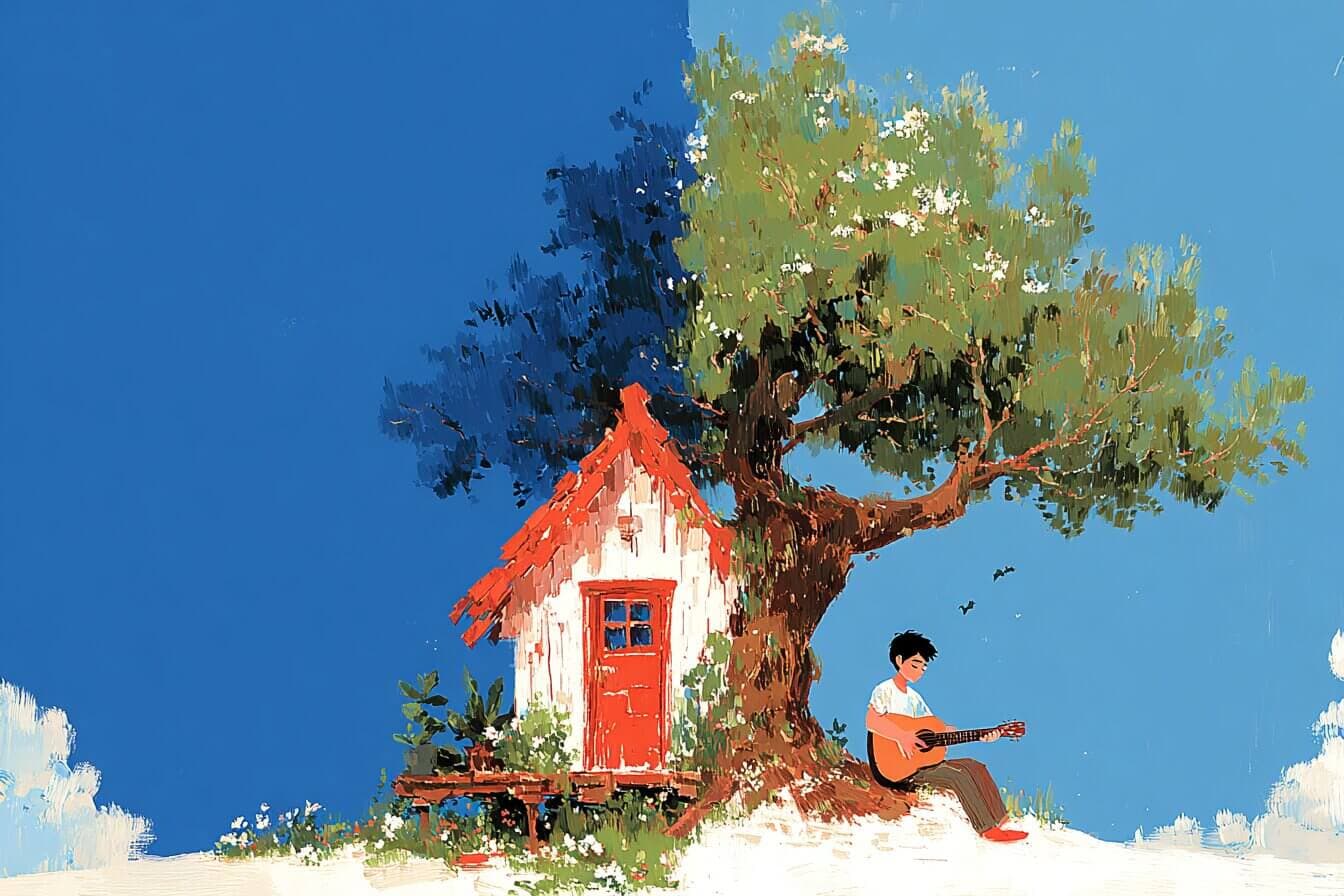
There's something about late summer nights that makes even fifteen-year-olds want to slow down, close their eyes, and let a story carry them somewhere quiet. This one follows Ethan, a teen who stumbles onto a hidden treehouse studio in the branches of his grandmother's maple tree and discovers he might be able to write a song after all, if he's willing to listen as much as he plays. It's the kind of bedtime stories for 15 year olds that trades the usual high stakes for something gentler: warm wood, humming walls, and the courage it takes to open your mouth and sing. If you'd like a version shaped around your own teen's world, you can create one with Sleepytale.
Why Treehouse Stories Work So Well at Bedtime
There's a reason treehouses show up again and again in the stories kids remember. A treehouse is separate from the rest of the house, up off the ground, wrapped in leaves. It feels like a pocket of safety that belongs only to the person who climbed the ladder. For a teenager lying in bed, that image maps neatly onto the moment right before sleep, when the noise of the day finally drops away and the room becomes entirely theirs.
A bedtime story about a treehouse also gives older kids permission to feel small again without feeling childish. The climb up, the closed door, the sense of discovering something private: these details mirror the way sleep itself works, a slow narrowing of attention until the world outside fades and only the quiet inside remains. For teens who spend their days navigating crowded hallways and group chats, that kind of focused stillness can feel like a relief.
The Treehouse That Sang Back 8 min 1 sec
8 min 1 sec
Ethan found the treehouse on the first Monday of summer vacation.
He'd been chasing a soccer ball that hooked left off his foot, bounced twice across the yard, and disappeared under a curtain of ivy hanging from Grandmother Maple's lowest branches. He pushed the leaves aside expecting mud and found, instead, a wooden ladder spiraling up the trunk.
Each rung felt warm under his palms, the way a mug feels after someone else has just set it down. At the top, a platform. On the platform, a house no bigger than a garden shed, with a crooked cedar door and a roof shaped like an upside-down boat. A brass key hung from a nail beside the doorframe, tarnished at the edges. Ethan turned it. The door creaked and gave.
Inside: one cracked stool, a spider web strung in the exact shape of a treble clef, and dust moving through a single stripe of light.
He stepped forward. The floorboards hummed.
Not the way old wood groans when you shift your weight. Actually hummed, a low, warm tone, like someone holding a note in their chest. The walls slid apart and rearranged themselves, puzzle pieces finding new positions. The stool stretched taller. The spider web dissolved into silver glitter that re-formed into a microphone on a stand so polished Ethan could see his own surprised face in it. Soundproof foam squares unfolded from the walls, glowing a soft, steady blue.
A mixing board rose from the floor, its buttons blinking in no particular pattern, and a pair of headphones the color of the sky ten minutes after sunset draped themselves over Ethan's ears before he could object. Outside the window, fireflies drifted past. Inside, they became tiny glowing notes that circled his head in slow loops, waiting.
His heart was going fast, but the room didn't feel dangerous. It felt like crawling into a sleeping bag that's already warm.
He sat. He tapped the microphone once with his index finger.
The treehouse answered with a chord, open and patient, the kind of sound that doesn't rush you to respond.
"I need a song," Ethan said, quieter than he meant to. "For the summer talent show."
The walls brightened. A synthesizer materialized under his hands. He had never written music. He barely sang in the shower. But his fingers landed on a key, and the note painted a streak of peach across the air. Another key: lavender. Another: gold.
He played a wrong note somewhere in the third measure, a clunky thud that turned the air a murky green, and he flinched. But the treehouse didn't correct him. It just folded the green into the next chord, made it part of the harmony, and suddenly the mistake sounded intentional, like a shadow that makes the bright parts brighter.
Together they built a melody. It felt like bare feet on cool grass. Like the first jump off the dock when the water hasn't warmed up yet and your stomach drops for one perfect second. Like the final school bell on the last day before summer, when the hallway erupts and someone's shoe squeaks on the tile and you don't know why that sound makes you happy but it does.
Ethan sang about sunscreen, watermelon triangles with the seeds still in, bike tires on gravel, fireworks blooming over the baseball field. Every time he stopped, unsure, the treehouse filled the gap with cricket rhythms and wind-chime solos, showing him that silence can be part of the song, that a rest isn't a mistake.
When the last chord faded, the room seemed to exhale. A tiny silver disc popped out of the mixing board's side slot with a soft click, like a toaster. On its surface, the word SUMMER glowed in firefly light.
Ethan slipped it into his pocket. He climbed down. The ivy swung shut behind him like a curtain after a play.
That night he played the song on the kitchen radio, the old one with the cracked dial that his mom kept meaning to replace. His dad stopped washing dishes. His little sister sat on the counter and forgot she wasn't supposed to sit on the counter. Even his grandmother, who had heard a lot of songs in her life, pressed her lips together and blinked hard at the ceiling.
Nobody said anything for a few seconds after it ended. The fridge hummed. Then his mom said, "Play it again," and her voice cracked right in the middle of "again," and Ethan did.
The next morning he ran back to Grandmother Maple. The ladder was gone. Smooth bark where the rungs had been, not even a mark. He pressed his palm flat against the trunk and felt it, faint as a second heartbeat: the same rhythm as the song. The treehouse was resting. Waiting for the next person who needed a room rebuilt.
All summer, whenever Ethan felt the specific loneliness that hits at two in the afternoon when everyone else seems busy, he hummed his melody. And somewhere, always, something hummed back. He could never prove it. He just knew.
On the night of the talent show, the auditorium lights were brutal, the kind that make your skin look like paper and your hands look like they belong to somebody else. Ethan stood at the edge of the stage and his throat closed up. He could hear three hundred people shifting in their seats.
Then he pictured the glowing notes circling his head. The warm rungs. The foam squares pulsing blue.
He opened his mouth, and the song came out the way water comes out of a faucet you've turned all the way, steady and full and not trying to impress anyone. He just sang. The audience clapped in time during the bridge, which he hadn't expected, and it almost threw him off, but he let it fold in the way the treehouse had folded in his wrong note, and it worked.
Somewhere in the rafters, a spider lowered a thread. Probably just a spider doing spider things. But the thread caught the stage light and glinted, and Ethan would have sworn it curved into a treble clef before it disappeared.
They called his name. He won.
He accepted the ribbon, shook hands with the judges, smiled for a photo. Then he slipped outside into the sweet, thick night air, pressed his fingers to the nearest oak, which was not Grandmother Maple but was still a tree, and whispered, "Thank you for the room."
A breeze moved through the leaves. It carried the faintest trace of peach, lavender, and gold, already fading, already promising another door next summer if he was willing to climb.
The Quiet Lessons in This Treehouse Bedtime Story
This story is really about what happens when you let yourself be bad at something long enough to get somewhere interesting. When Ethan hits that clunky wrong note and the treehouse folds it into the harmony instead of erasing it, kids absorb a small but real idea: mistakes don't have to be subtracted, they can become part of whatever you're building. The story also sits with loneliness without rushing to fix it. Ethan hums alone at two in the afternoon, and the hum comes back, but it doesn't erase the feeling, it just keeps him company. At bedtime, that kind of honesty is more reassuring than a tidy resolution, because teenagers know the world isn't tidy, and a story that quietly admits that earns their trust right before sleep.
Tips for Reading This Story
Give the treehouse a voice by dropping your own voice low and warm whenever it hums or plays a chord, almost like you're singing a single note under your breath. When Ethan hits the wrong note and the air turns murky green, pause for a beat and let your teen wonder if something went wrong before you read on. During the kitchen scene, slow down on the line about the fridge humming and Mom's voice cracking; that stillness is the emotional center, and rushing past it loses the moment.
Frequently Asked Questions
What age is this story best for?
It's written with 13 to 16 year olds in mind. The talent-show nerves, the specific afternoon loneliness Ethan feels, and the way the story treats mistakes as something to fold in rather than erase all speak directly to the teenage experience. Younger teens will connect with the magical discovery; older teens will appreciate that the story doesn't spell out its meaning.
Is this story available as audio?
Yes. Press play at the top of the story to listen. The audio version is especially good here because the shifting textures, the hum of the floorboards, the cricket rhythms during the recording session, and the silence after the kitchen playback all land differently when you hear them rather than read them. The pacing of Ethan's talent show performance also builds naturally in spoken form.
Can a treehouse really be soundproofed?
In real life, yes, though it takes effort. People use dense foam panels, mass-loaded vinyl, and sealed windows to dampen outside noise in elevated structures. Ethan's treehouse takes some creative liberties with self-assembling foam and a mixing board that grows from the floor, but the core idea of a private space high in a tree where sound behaves differently is grounded in something real, and that blend of the plausible and the magical is part of what makes the story feel trustworthy.
Create Your Own Version
Sleepytale lets you reshape this story into something that fits your teenager's world. Swap the treehouse for a rooftop studio or a basement practice room, trade the microphone for a sketchbook or a camera, or change Ethan into a different character with their own quiet worry to work through. In a few steps you'll have a calm, personal story you can return to whenever the night calls for one.
Looking for more bedtime stories for kids by age?

Scary Stories For Kindergarteners
Are you looking for short scary stories for kindergarteners? Wisp is a tiny trembling ghost who learns to name the shadows a windowsill.

Audiobooks For Kindergarteners
A tugboat named Biscuit navigates fog by following buoy bells, making short audiobooks for kindergarteners feel like a lullaby the water.

Short Newborn Bedtime Stories
Are you searching for short newborn bedtime stories where the moon watches over a sleeping baby all night?

Baby Bedtime Stories
Enjoy a cozy night with short baby bedtime stories like The Waiting Hug, featuring a stuffed rabbit's patient wait for one perfect embrace.

Short Stories For 8th Graders
Maya spent three years saying hello to every face in her hallway, and one quiet boy replied with dragons. Discover short stories for 8th graders here.

Kindergarten Stories
A lost red crayon waits under a bookshelf until a boy named Mateo draws a smiling sun in one of the sweetest short kindergarten stories for bedtime.