
Bat Bedtime Stories
By

Dennis Wang, Bedtime Story Expert
8 min 46 sec
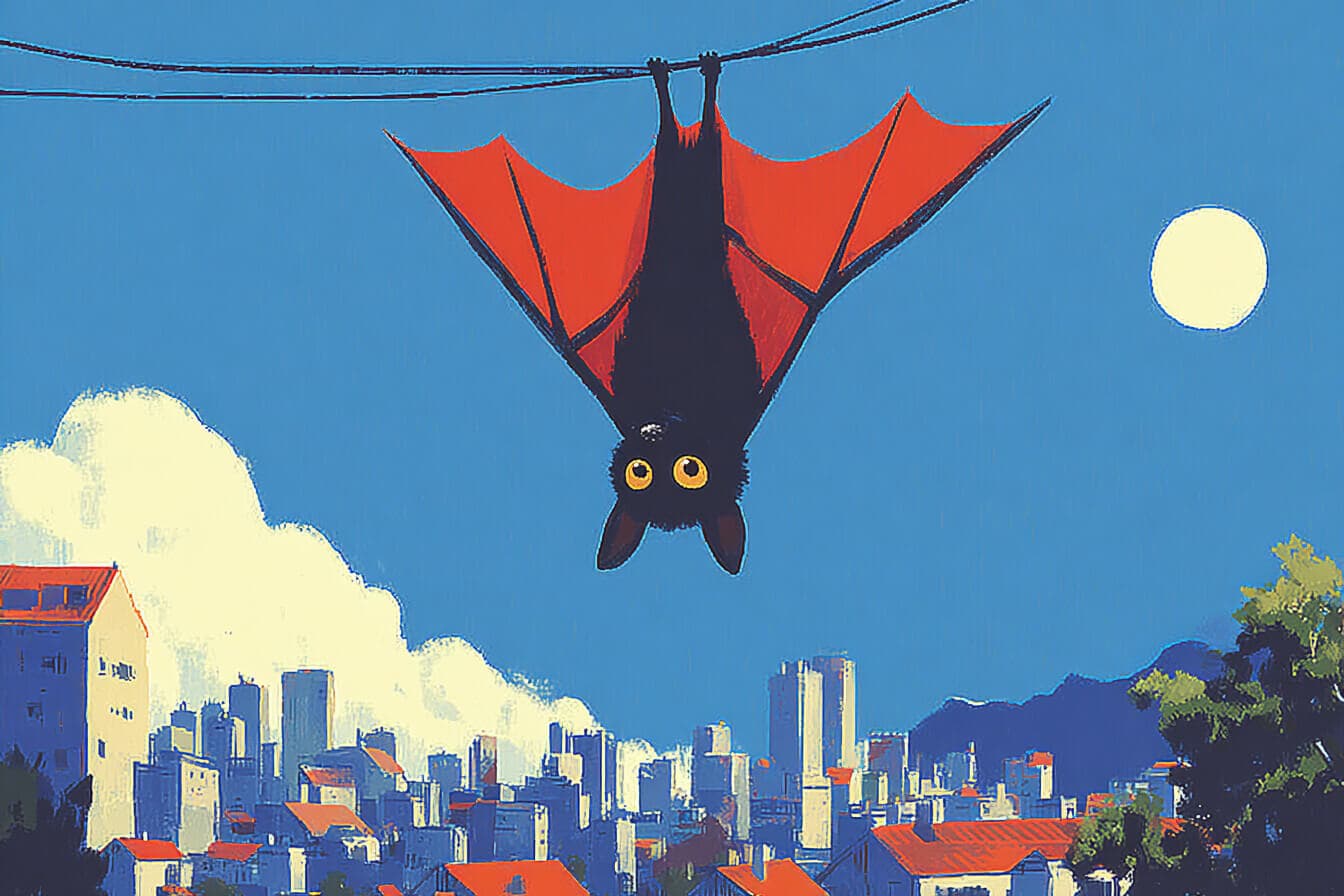
There's something about the hush of evening, that moment when the sky turns dusky purple and the first little wings start flitting between the trees, that makes kids lean in closer. This story follows Bruno, a bat who hangs upside down from a banyan tree and discovers that his odd way of seeing the world is exactly what his neighbors need. It's one of our favorite bat bedtime stories for the way it turns small worries into small triumphs, all at a pace that feels like a slow exhale. If your child wants a version with their own name, their own park, or their own lost treasure, you can build one in minutes with Sleepytale.
Why Bat Stories Work So Well at Bedtime
Bats live in that in-between hour when daytime noise fades and the world goes quiet, which is exactly where a child's mind is right before sleep. A story about a bat doesn't start with alarm clocks and bright mornings. It starts in the soft, dim space kids already inhabit when they climb under the covers. That familiar twilight feeling helps a child's body relax into the narrative instead of winding up.
There's also something reassuring about a character who sees the world differently and is valued for it. A bedtime story about a bat who helps his friends by looking at things upside down tells kids that their own quirky way of noticing things matters. It's a gentle idea to carry into sleep, the sense that being different is its own kind of useful, and that the night is full of small kindnesses happening just out of sight.
Bruno the Upside Down Problem Solver 8 min 46 sec
8 min 46 sec
Bruno the bat loved to hang upside down from the highest branch of the oldest banyan tree in Sunnyvale Park.
While other bats slept through the day, Bruno stayed awake, watching.
From his perch, everything looked wonderfully strange.
Trees grew downward. Birds flew in reverse. People appeared to walk on the sky, their shoes pressing into the clouds. The banyan bark under his toes had a particular roughness, like the spine of a very old book, and he liked to curl his claws into it while he thought.
This odd angle helped Bruno notice things others missed, and over time it made him the best problem solver in the park.
One morning, golden light filtering through the leaves, Bruno heard distressed chirping from below. A family of sparrows fluttered around their nest, which had slipped to the edge of a thin branch. The babies huddled together, very still.
Bruno tilted his head.
From his inverted position he could see what the sparrows couldn't: the nest had caught on a small twig that acted like a hook, keeping it from falling. He could also see that the mother sparrow had been trying to build a backup nest nearby, but the wind kept stealing her materials before she could weave them in.
"Hey," Bruno called down. "Don't move that nest yet. You've got a hook holding it, right at the seven o'clock position. See it?"
The mother sparrow squinted. "I, no, wait. Oh! There it is."
Bruno explained how they could thread long grass through the existing nest, looping it around the sturdier twigs he could spot from below. The sparrows flew back and forth, gathering and weaving. Within an hour the nest sat firm, and the babies were chirping again, loud enough that Bruno folded one ear flat and pretended to wince.
The grateful family offered him berries. He ate three, then quietly dropped two back when they weren't looking because he really preferred moths.
As the afternoon warmed the park, more animals appeared beneath the banyan.
A squirrel couldn't reach acorns stored too high in a neighboring oak. A butterfly's wing was torn, grounding her. Even the old tortoise had wandered too far from the pond and lost her bearings among the roots.
Each time, Bruno's upside down view revealed something invisible from the ground.
For the squirrel, a series of small branches formed a staircase when viewed from below, each one just a hop apart. The butterfly's wing could be temporarily braced with a sticky dab of leaf sap Bruno spotted on a branch nobody else had glanced at. For the tortoise, Bruno traced a clear corridor between the roots, smooth and wide enough for her shell, that led straight to the sound of trickling water.
Word got around.
Animals began visiting daily, and Bruno set up what he called his "upside down help station," which was really just himself, hanging in the same spot as always, with a small notebook wedged between two branches. He drew pictures of problems and their solutions, tiny diagrams that made the raccoon kits giggle because his handwriting looked wobbly and reversed, which, being upside down, it was.
He found that teaching others to tilt their own heads worked even better than solving things for them. One lesson multiplied into many.
Then, one afternoon, a girl named Maya visited the park with her family. She had lost a silver bracelet somewhere along the trail. She retraced every step, checked every bench, kicked through every pile of leaves.
Nothing.
Somebody pointed her toward the banyan tree. Maya looked up at a bat hanging by his toes and thought, briefly, that this was the strangest help desk she had ever seen.
"Where exactly did you walk?" Bruno asked. "And what were you doing with your hands?"
Maya described her route, the playground, the water fountain, the bush with the yellow flowers where she had stopped to smell them. As she spoke, Bruno noticed something glinting low inside that bush, near the roots. From his angle, the bracelet's surface caught the sunlight and bounced it upward in tiny, irregular flashes, like a firefly stuck on one note.
He guided her to the exact spot.
Maya crouched down, pushed aside a handful of leaves, and there it was, slightly muddy, still clasped shut. She made a sound that was half laugh, half yelp, and she held the bracelet up so it caught the light again.
"How do you always know where to look?" she asked.
"I don't," Bruno said. "I just look from where nobody else stands. Or hangs, I guess."
He taught her to tilt her head and imagine viewing things upside down, sideways, even backward. It was a small technique, the kind of thing that sounds silly until it works. Maya started finding lost items at home, solving puzzles at school by flipping the paper over, and eventually she talked her classmates into forming a group they called the Angle Club, which was mostly an excuse to hang upside down on the monkey bars during recess.
Back in the park, Bruno kept teaching.
He showed young raccoons how to view their foraging routes from above to spot the safest paths. He taught the owls to consider daytime light when planning nighttime flights. Even the fish in the pond learned to look up at the surface and read the shapes of the world above the water, though their reports were unreliable because everything looked wobbly to them.
One evening, purple clouds piling up fast, a summer storm hit the park harder than anyone expected.
The main bridge across the creek blew down. Animals on one side couldn't reach food. Animals on the other side couldn't reach shelter. Panic spread in quick, chattering waves.
Bruno flew out immediately, hanging from a low branch over the creek.
From below, the damage looked different than it did from the bank. The fallen bridge had formed a rough dam, backing water into a shallow pool. And there, exposed in the creek bed, lay a line of large flat stones, invisible when the water ran normally but now standing just above the surface like a set of uneven stairs.
He gathered the beavers.
"See those stones? They're your foundations. You don't have to start from scratch."
The beavers worked through the night, packing mud and sticks and leaves around each stone until a sturdy arch rose over the creek, wider and stronger than the old bridge. Bruno hung nearby, calling out adjustments. "A little left. No, your other left. That's still the same left, Gerald."
Dawn came slow and pink. The animals crossed the new bridge in a cautious single file that quickly turned into a noisy parade. Someone started clapping, though it was hard to tell who since most of them didn't have hands.
The mayor of Sunnyvale, a wise old owl named Alderman, declared a day in Bruno's honor. Animals from neighboring parks visited. Bruno shared his simple idea: when a problem looks impossible from where you stand, move. Look from underneath, from behind, from the angle nobody thought to try.
He ran little workshops on what he called upside down thinking. Most of the participants couldn't actually hang upside down, so they tilted their heads or lay on their backs in the grass, which worked almost as well and was considerably more comfortable.
Children who visited the park loved practicing, and the park eventually installed a small upside down viewing platform, padded and safe, where anyone could hang for a minute and see the trees growing into the sky and the clouds resting on the ground.
Over time, Sunnyvale became the place where problems were solved by looking at them differently. Scientists visited. Architects sketched ideas. A teacher brought her whole class and let them spend an hour just staring at the world from underneath a picnic table.
Bruno's notebook grew thick. Its pages curled at the edges and smelled like bark and rain.
Young animals would ask him how he discovered his talent, and Bruno always said the same thing: "Everyone sees the world their own way. The trick isn't having a special view. It's being willing to share it."
Seasons turned. Leaves fell and grew back. The banyan tree spread its branches a little wider each year.
And every evening, as the park settled into its dusky quiet and the first stars blinked on, Bruno hung from his favorite branch with his wings folded close. The creek murmured below. Somewhere a sparrow tucked its head under its wing. The bracelet on Maya's wrist, if she happened to be walking the trail, caught the last light and sent one small flash upward through the leaves, where only a bat looking down from exactly the right angle would ever see it.
The Quiet Lessons in This Bat Bedtime Story
This story weaves together empathy, creative thinking, and the courage to share what you see, even when your view looks strange to everyone else. When Bruno calls down directions to the panicking sparrow family, children absorb the idea that staying calm and offering help, even small help, can steady a whole group. His awkward moment of secretly returning the berries he doesn't like shows kids that kindness doesn't require perfection, just good intentions. And Maya's decision to teach her classmates what she learned from a bat reminds listeners that the best ideas grow when you pass them along. These are gentle themes to settle into right before sleep, the reassurance that tomorrow's problems might just need a different angle and that the people around you are willing to help you find it.
Tips for Reading This Story
Give Bruno a calm, slightly scratchy voice, the kind that sounds like he's been awake all day thinking, and let Maya's lines come out quicker and brighter by contrast. When Bruno says "That's still the same left, Gerald" during the bridge scene, pause just a beat before "Gerald" for the comedy to land. At the very end, when the bracelet sends its flash of light up through the leaves, slow your reading down to almost a whisper and let the image sit for a moment before closing the book.
Frequently Asked Questions
What age is this story best for?
Children ages 3 to 7 tend to connect with it most. Younger listeners enjoy the sparrow rescue and the repeated pattern of animals arriving with problems, while older kids latch onto Maya's bracelet mystery and the idea of the Angle Club. The vocabulary stays simple, but the concept of seeing things from a new perspective gives slightly older children something to chew on.
Is this story available as audio?
Yes. Press play at the top of the story to listen. The audio version works especially well here because Bruno's problem-solving scenes unfold like little puzzles, each one building on the last, and hearing them read aloud gives kids time to picture the upside down view before the solution arrives. The bridge-building scene at night, with the beavers working and Bruno calling out directions, has a rhythm that sounds almost like a lullaby when narrated at a steady pace.
Why is a bat a good character for a children's story?
Bats are naturally curious to kids because they are familiar enough to recognize but unusual enough to feel exciting. Bruno's habit of hanging upside down gives the story a built-in twist that children find funny and memorable, and it lets them practice the idea that "different" can be genuinely helpful. It's also a gentle way to replace any nervousness about bats with warmth and affection, since Bruno spends the entire story quietly helping his neighbors.
Create Your Own Version
Sleepytale lets you build a personalized bat story that fits your child's world exactly. Swap the banyan tree for a cozy attic, replace the lost bracelet with your child's favorite stuffed animal, or add a second bat friend who learns the upside down trick alongside them. In a few minutes you'll have a calm, clever bedtime story you can replay whenever the evening calls for it.
Looking for more animal bedtime stories?
Polar Bear Bedtime Stories
A shimmering palace appears the sea ice, and a small wish turns into shared laughter. Drift into short polar bear bedtime stories with a bright, gentle twist.
Bear Bedtime Stories
Drift off with short bear bedtime stories that feel warm and soothing, plus a simple way to create your own cozy version in Sleepytale.
Tropical Fish Bedtime Stories
Sunlight paints golden paths across a coral reef as a brave little fish leads a pattern parade. Drift into short tropical fish bedtime stories with gentle pride and calm sea sounds.
Pufferfish Bedtime Stories
Drift under turquoise waves with short pufferfish bedtime stories where a jumpy little fish turns surprise bounces into a brave stage dance. A conch charm makes the twist feel tender.
Piranha Bedtime Stories
Drift into the Amazon with short piranha bedtime stories where a toothy fish hosts a leafy picnic and wins hearts one crunch at a time.
Pigeon Bedtime Stories
Ease into comfort as Pablo delivers tiny folded notes tied with a sky blue ribbon to lift lonely hearts. Settle in with short pigeon bedtime stories that bring warmth, hope, and easy sleep.