
Pigeon Bedtime Stories
By

Dennis Wang, Bedtime Story Expert
7 min 55 sec
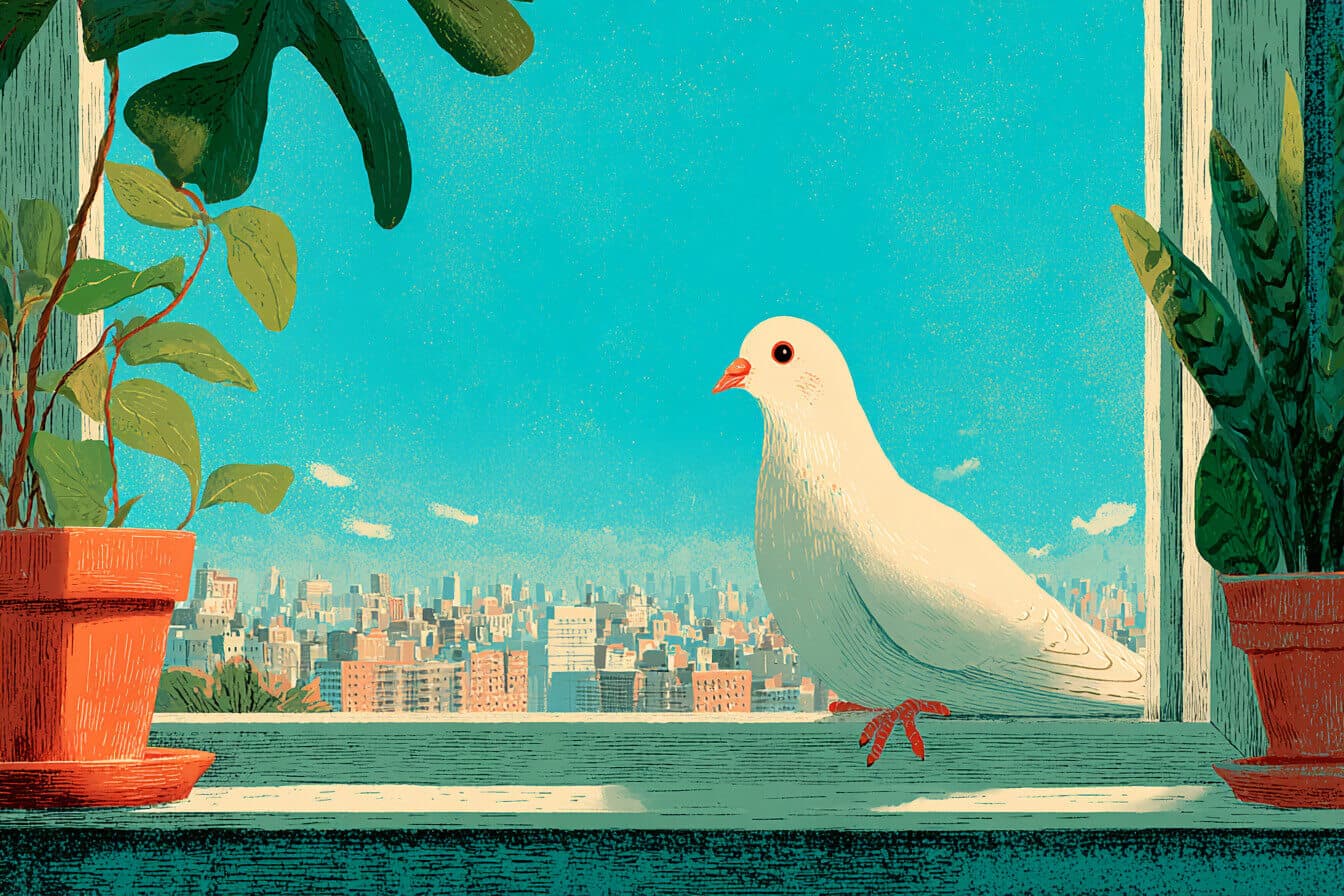
There's something about the soft coo of a pigeon settling on a ledge that makes the whole city feel quieter, like the evening is finally slowing down. In this story, a plump gray messenger bird named Pablo flies through rain and fading light to deliver his last few handwritten notes to people who need them most. It's one of those pigeon bedtime stories that wraps small kindnesses around your child like a blanket, one gentle scene at a time. If you'd like to customize the setting, characters, or mood to fit your little one perfectly, you can create your own version with Sleepytale.
Why Pigeon Stories Work So Well at Bedtime
Pigeons are city creatures, familiar and unhurried. Kids see them on sidewalks, on park benches, bobbing along as if they have nowhere urgent to be. That gentle, everyday quality makes a pigeon the perfect guide for winding down. There's no roaring or chasing involved, just a soft flutter and a quiet errand, and for a child fighting the last wiggles of the day, that calm rhythm is exactly the right speed.
A bedtime story about a pigeon also taps into something children understand instinctively: the idea that small things matter. A folded note, a single coo, a ribbon tied around a leg. These tiny details give a child's mind something specific and peaceful to picture as their eyes get heavy, rather than anything loud or overstimulating. Pigeon stories at night meet kids right where they are, close to the ground, in a world that feels safe and knowable.
Pablo's Tiny Notes of Big Smiles 7 min 55 sec
7 min 55 sec
High above the city streets, a plump gray pigeon named Pablo fluttered from window to window, carrying tiny folded papers tied to his left leg with a sky blue ribbon.
Each paper held a single sentence in careful pencil: "You matter," or "Someone is glad you exist," or "The world is nicer because you are in it."
Pablo had been delivering these miniature messages for three seasons now.
It started by accident. He once dropped a crumpled candy wrapper near a sad old man sitting on a bench, and the man picked it up, squinted at it, and mistook it for a note. He smiled. Pablo's chest went warm in a way he didn't quite understand, so he stood there on the pavement blinking for a long time. From that day on, he collected kind words from wherever he could find them.
He listened outside school windows. He perched near park benches where grandparents talked to toddlers. He eavesdropped on bakeries, which, if you've never tried it, is the best kind of eavesdropping because everything people say near fresh bread tends to come out softer. He gathered enough gentle sentences to fill a small satchel, then flew, wings cutting clean morning air, to drop them where they were needed most.
One Tuesday, he spotted a boy sitting alone on an apartment stoop, cheeks streaked with old tears. The boy clutched a broken toy truck and stared at the passing cars as if waiting for someone who never arrived.
Pablo circled once. Twice.
Then he swooped low and released a tiny paper that fluttered like a white petal and landed on the boy's sneaker.
The boy unfolded it slowly, read "You are someone's favorite story," and looked up just in time to see Pablo disappear beyond the rooftop. A shy smile tugged at his mouth. It was the first one in many days, and it sat a little crooked on his face, the way smiles do when they're out of practice.
Pablo, watching from a gutter pipe above, bobbed his head with satisfaction and set off to find the next lonely heart. His route took him past laundromats where the dryers hummed a low, sleepy note, past flower stands that smelled like rain even when it hadn't rained, past bus stops where people stood in silent clusters staring at their shoes.
At each place, he searched for shoulders that drooped or eyes that blinked too often. He had learned to read the small signs of loneliness the way sailors read clouds.
When he found them, he delivered his cargo of words. One note landed on a librarian's open dictionary, right on the word "luminous." Another slipped into the coat pocket of a nightshift security guard who wouldn't find it until 2 a.m., which, Pablo thought, was probably the exact right time.
Each time, the smallest lift of eyebrows or curve of lips told him his mission still mattered. Yet the city was vast, and his own heart sometimes felt as small as the papers he carried.
One gray afternoon, storm clouds pressed low and heavy.
Rain began to drum on the vents where pigeons usually roosted.
Pablo tucked his wings and perched beneath the awning of a closed bakery, shivering. He had used almost all his notes, and the sidewalks were emptying fast. He worried that no one would be out to receive his last three messages. The worry sat in his stomach like a pebble.
Just then he noticed a woman in a green raincoat standing at the bus stop across the street. She held no umbrella, and her hair stuck to her face in wet strands. Around her, other commuters had stepped back under the overhang, leaving her alone at the curb like she'd volunteered for it.
Pablo launched into the rain.
He swooped low and released a paper that landed on her shoulder. She picked it up with trembling fingers. "Your kindness is stronger than any storm," it read.
The woman pressed the paper to her chest, closed her eyes, and took a long breath that lifted her whole frame. When the bus arrived, she stepped aboard standing straighter, and Pablo felt that familiar warmth spread through him again. The rain eased. Twilight painted the puddles copper and gold, and for a moment the whole street looked like it had been dipped in something precious.
Two notes remained.
He flew to a rooftop garden where a teenage girl sat on a bench, sketchbook closed on her lap. Streetlights flickered on below, but she stared at the blank page as if her pencils had forgotten how to draw. Pablo fluttered down beside a terra cotta pot of basil, close enough that he could smell the sharp green of it.
He tucked his second to last note into the wire spine of her sketchbook. "The world needs the colors only you can see," it said.
Later, from a gutter spout two rooftops away, he watched her open the book, read the line, and begin to draw sweeping violet sunsets that spilled right off the edge of the page.
The final note felt special. Almost warm against his leg.
Pablo sensed it was meant for someone he had not yet met, someone whose loneliness might be deeper than a rainy afternoon. He flew higher, above the neon signs, until the city looked like a circuit board of tiny lights. There he spotted a small figure on the observation deck of an old clock tower that had been closed for repairs. No one should have been up there.
Curious and concerned, Pablo glided in circles, finally landing on a rusted railing. A girl of about ten sat on a blanket, surrounded by stuffed animals arranged like an audience. She spoke quietly to them, her words swept away by wind.
Pablo hopped closer.
She looked thin and pale in the moonlight, and her eyes held a weariness that didn't belong to childhood. He cooed softly, the way pigeons do when they're not sure what else to offer.
The girl turned, startled, then smiled when she saw him. "Hello, little bird," she whispered. "I come up here to tell stories to my friends. The moon listens too."
Pablo's heart fluttered. He stepped nearer, untied the final paper with his beak, and nudged it toward her.
She unfolded it carefully. "Someone is sharing this moment with you right now," it read.
Her eyes widened, filling with tears that caught the city lights. She looked around the empty deck, then back at Pablo.
"Is it from you?" she asked.
He bobbed his head.
She laughed, a sound like small bells knocking together in a drawer, and wiped her cheeks. "Thank you," she said. "I was afraid the night didn't notice me."
Pablo wanted to stay, but dawn was still hours away and the tower was cold. He tucked his head under a wing, intending to rest just a moment. When he awoke, the girl had wrapped the blanket around them both. She was whispering a story about a pigeon who carried hope across the sky, and her voice was steady and warm, and Pablo realized she'd been telling it for a while.
He felt the last loneliness inside him melt like frost on a window when the sun finally reaches it.
When sunrise painted the horizon peach, he helped her down from the tower, carrying the edge of the blanket in his beak while she held his feathers and laughed at how ridiculous they must look. They landed near a community center where volunteers were setting out breakfast tables.
The director, a kind man with a booming laugh, recognized the girl and hurried over. "Mira! We've been looking everywhere for you!" he exclaimed.
Mira hugged Pablo once, pressing her cheek against his feathers. Then she ran inside, turning to wave before the door closed.
Pablo, lighter in every way, soared upward.
He had delivered every message. But more than that, he had learned that kindness, like birdsong, finds its way back to the one who sends it out. From that day on he continued his rounds, but now the city felt smaller, warmer, held together by invisible threads of words and wings.
Children began leaving birdseed messages on their windowsills: "Thank you, Pablo," or "Come rest here." Pablo never wrote back. He simply kept flying, because he knew that somewhere, someone was waiting for a tiny paper that said, "You are not alone."
And whenever he spotted a lonely heart, he dove, delivered, and watched a smile bloom like the first crocus pushing through a crack in the concrete. Every evening he returned to the clock tower, where Mira now waited with a pocketful of seeds and a new story to share with the moon.
The Quiet Lessons in This Pigeon Bedtime Story
This story is woven through with ideas about paying attention, offering what you have even when it feels small, and the courage it takes to approach someone who might be hurting. When Pablo launches into the rain to reach the woman at the bus stop, children absorb the idea that showing up for others matters more than perfect conditions. Mira's willingness to wrap the blanket around a bird she just met shows how receiving kindness and giving it back can happen in the same breath. These themes land gently at bedtime because they reassure a child that small, quiet acts of care are enough, a comforting thought to carry into sleep.
Tips for Reading This Story
Try giving Pablo a soft, breathy coo whenever he reacts to something, especially when he bobs his head or lands on a new railing. When Mira whispers "Hello, little bird," slow your voice way down and let a pause sit after it so your child can picture the moment on the tower. During the rain scene, you might lightly tap the edge of the book or bed to mimic the drumming on the vents, and when Pablo launches into the storm, pick up the pace for just a sentence or two before settling back into a quieter rhythm.
Frequently Asked Questions
What age is this story best for?
It works well for children ages 4 to 8. Younger listeners will love following Pablo from stop to stop, and the repetition of delivering notes gives them a rhythm to anticipate. Older kids, closer to Mira's age, may connect more deeply with the clock tower scene and the idea of feeling unseen.
Is this story available as audio?
Yes, you can press play at the top of the story to listen. The audio version brings Pablo's route to life in a lovely way, especially the contrast between the quiet rooftop garden scene and the rainy bus stop. The pacing of the narration gives each note delivery its own small moment of suspense before the recipient reads the message.
Why does Pablo deliver written notes instead of just cooing at people?
In the story, Pablo discovers by accident that a piece of paper can be kept, reread, and held close in a way that a sound cannot. The woman in the green raincoat presses her note to her chest, and Mira unfolds hers carefully, which shows how a written kindness becomes something a person can carry with them long after the pigeon has flown away.
Create Your Own Version
Sleepytale lets you build a personalized bedtime story inspired by this one in just a few minutes. You could swap the city for a village by the sea, change Pablo into a dove or a homing pigeon pair, or replace the paper notes with tiny painted feathers. You can also adjust the tone to be sillier, shorter, or even quieter, whatever helps your child drift off feeling warm and noticed.
Looking for more animal bedtime stories?
Polar Bear Bedtime Stories
A shimmering palace appears the sea ice, and a small wish turns into shared laughter. Drift into short polar bear bedtime stories with a bright, gentle twist.
Bear Bedtime Stories
Drift off with short bear bedtime stories that feel warm and soothing, plus a simple way to create your own cozy version in Sleepytale.
Tropical Fish Bedtime Stories
Sunlight paints golden paths across a coral reef as a brave little fish leads a pattern parade. Drift into short tropical fish bedtime stories with gentle pride and calm sea sounds.
Pufferfish Bedtime Stories
Drift under turquoise waves with short pufferfish bedtime stories where a jumpy little fish turns surprise bounces into a brave stage dance. A conch charm makes the twist feel tender.
Piranha Bedtime Stories
Drift into the Amazon with short piranha bedtime stories where a toothy fish hosts a leafy picnic and wins hearts one crunch at a time.
Panther Bedtime Stories
Drift into moonlit hush with short panther bedtime stories as Penelope tiptoes to a star mirror pool and back, guarding tiny dreams along the way.