
The Wizard Of Oz Bedtime Story
By

Dennis Wang, Bedtime Story Expert
9 min 28 sec
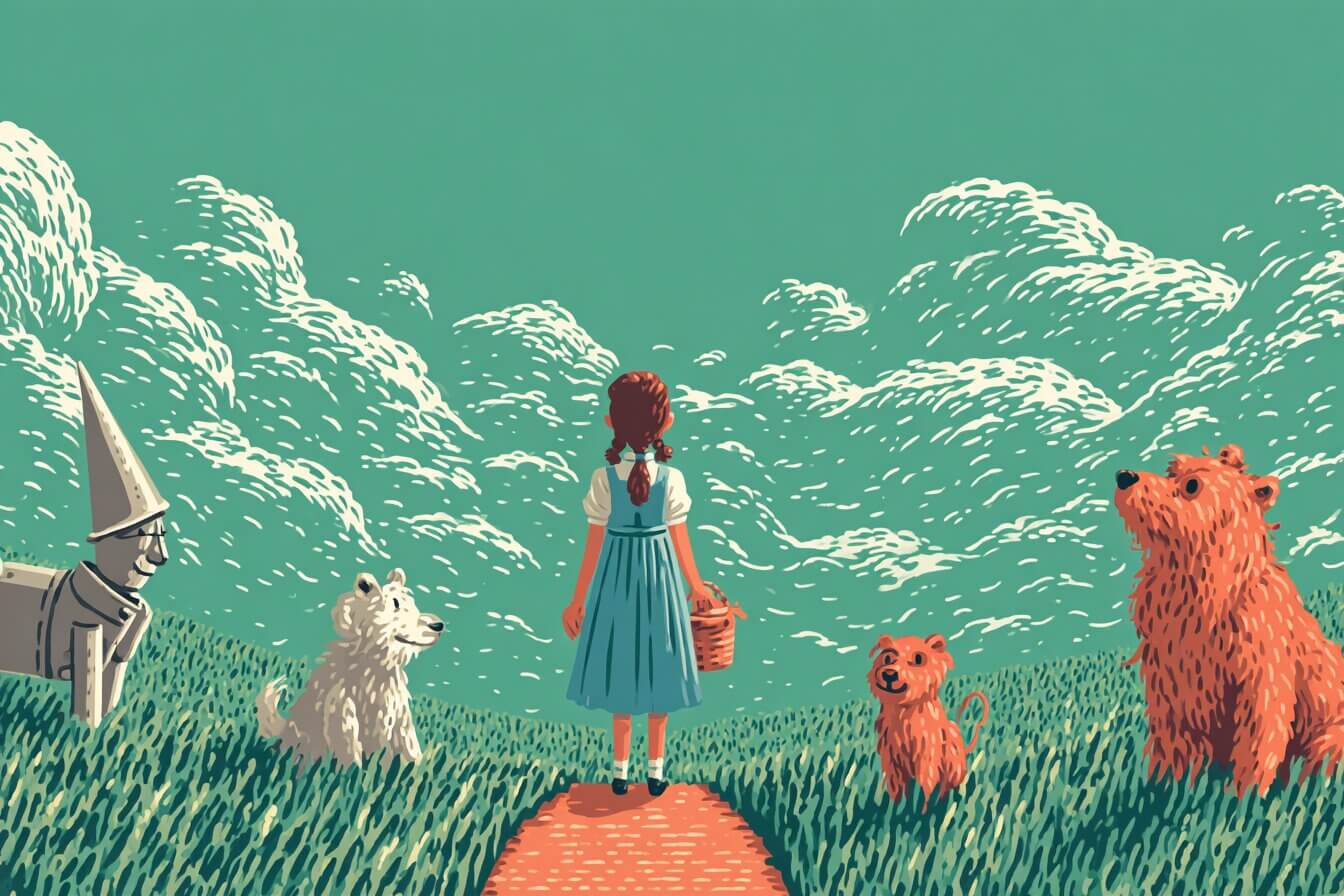
There is something about a storm rolling in just before bed that makes kids pull the blanket a little higher and lean in closer to listen. In this tale, Dorothy and Toto get swept from gray Kansas into a shimmering land where a scarecrow, a tin woodcutter, and a timid lion join her walk down a yellow brick road toward home. It is one of the gentlest versions of a Wizard of Oz bedtime story you will find, full of singing flowers, kind choices, and a journey that loops safely back to a familiar yard. If your child wants to star in the adventure themselves, Sleepytale lets you build a personalized version in minutes.
Why Wizard of Oz Stories Work So Well at Bedtime
The Wizard of Oz has always been a story about wanting to feel safe, and that is exactly where a child's mind goes when the lights dim. Dorothy never stops believing she can get home. Her companions each carry a quiet worry they learn to set down along the way. Those themes mirror the small anxieties kids process before sleep: wondering if they are brave enough, kind enough, smart enough. A bedtime story about the Wizard of Oz wraps those feelings in color and adventure, then tucks them neatly back into a familiar bed.
The yellow brick road itself works like a lullaby structure. It is one step after another, predictable but never boring, with gentle stops along the way. Kids know where Dorothy is headed even when the scenery changes, and that sense of direction is deeply calming. By the time she clicks those shoes, listeners already feel like they are home too.
The Rainbow Road to Whimsy 9 min 28 sec
9 min 28 sec
Dorothy Gale had lived all her short life on the flat gray plains of Kansas, where the wind whispered through wheat and the sky stretched like a faded quilt above the farmhouse. The porch screen had a tear in the lower corner that Toto squeezed through every single morning, no matter how many times Aunt Em pinned it shut.
One warm afternoon Dorothy chased the shaggy terrier across the yard while Aunt Em hollered about supper getting cold. The air smelled of coming rain, that heavy green smell that sits low in your throat.
A growl rolled across the fields. Clouds stacked into a spinning column, and before Dorothy could scoop Toto into her arms, the sky scooped them both. Boards fluttered. The roar filled her ears. The farmhouse lifted like a paper lantern caught in a giant's breath, and Dorothy pressed her face into Toto's fur and simply held on.
Then, quiet.
She opened the door and stepped onto grass that shimmered every color she had ever imagined and several she was pretty sure did not exist back in Kansas. A brook babbled nearby, running in perfect loops of ruby, sapphire, and gold. Flowers sang in tiny chiming voices, not quite words, more like someone humming a song they had forgotten the lyrics to.
Toto barked at a butterfly the size of a dinner plate. It drifted past trailing sparks of lemon light, entirely unbothered.
Dorothy knelt and touched the grass. Each blade held a single dewdrop, and inside each dewdrop she could see a whole tiny world turning. She stayed there longer than she meant to, just looking.
A path of yellow bricks curled away through the meadow toward distant towers that rose like birthday candles against a turquoise sky. Dorothy stood, brushed her knees, and followed it.
She found the scarecrow first. He was perched on a pole above a patch of pumpkins that would not stop giggling, and he looked thoroughly annoyed about it. He twisted toward her with a creak of straw. "Do you happen to know the way to cleverness?" he asked. "I have been hanging here for weeks and I still cannot figure out what those pumpkins find so funny."
Dorothy invited him down. He landed in a heap, stood up crooked, and grinned anyway.
Together they walked until the bricks led them to a tin woodcutter frozen mid swing, tears of rust streaking his metal cheeks. He could see the beauty around him, he said, the light on the brook, the curl of a fern, but he could not feel any of it. He wanted a heart.
Dorothy found an oil can wedged between two roots. She worked each joint slowly, starting at his jaw so he could talk, then his shoulders, then his fingers. When his left elbow finally popped free, he let out a sound halfway between a laugh and a sob and said, "That one always sticks."
The three of them soon heard whimpering from a lilac thicket. A lion the size of a pony was crouched behind a bush of daisies that kept patting his mane and telling him to cheer up, which only made things worse.
"I want to roar like thunder," he whispered. "But every time I try, it comes out like a hiccup."
Dorothy patted his nose. It was softer than she expected, like old velvet. He rose on wobbly legs and fell into step beside them, flinching a little every time a daisy giggled.
The five travelers followed the yellow bricks through forests where the trees told knock-knock jokes, some of them genuinely terrible. They crossed a desert of sugar sand that hummed lullabies beneath their feet. They walked over a bridge woven from moonlight, which swayed in a way that made the lion grip the railing and stare straight ahead.
They helped squirrels gather clouds for winter blankets. They returned a baby star to its mother sky, and the mother star blinked twice, which Dorothy decided meant thank you. They taught a grumpy river to laugh by tickling its banks with willow branches, which was the scarecrow's idea and honestly the best one he had ever had.
Each time they helped someone, the colors around them deepened. Not brighter exactly, but richer, like a painting that had been given another coat.
At last they reached the gates of the Emerald City, where a guard shaped like a question mark asked three riddles before letting them pass. The scarecrow got two right. Dorothy got the third. The lion just stared and the guard waved him through out of sympathy.
Inside, the wizard appeared as a giant bubble that reflected their own faces back at them, slightly distorted, the way a spoon bends your reflection. He did not give speeches. He gave tasks.
The scarecrow solved a puzzle of floating teacups, rearranging them by weight and color until they formed a perfect spiral. He stepped back and blinked, surprised at himself.
The tin man shared his oil with a squeaky gate that sighed with gratitude and swung open to reveal a courtyard full of sleeping kittens. He stood there watching them breathe for a long time and did not say a word.
The lion roared. It was not thunder, not quite, but it was loud enough to frighten his own shadow clean off the wall. When the shadow crept back a moment later, the lion laughed so hard he sat down.
Dorothy held Toto. She looked at the bubble, at her friends, at the yellow road still visible through the gate behind them. She had been carrying home inside her the whole walk. She just had not checked her pockets.
The wizard clapped once, sharp as a crack of thunder, and a pair of silver shoes appeared at Dorothy's feet, sparkling.
Hugs took a while. The scarecrow's was lumpy. The tin man's was careful. The lion's was enormous and slightly damp.
Dorothy clicked the shoes.
She woke on the Kansas grass with Toto licking her cheek. Aunt Em was calling supper again, or maybe still. The sky was washed clean, pale and wide, and the torn screen door banged once in a leftover breeze.
She ran inside. But in her pocket she found a single emerald leaf that shimmered when she smiled. She set it on her windowsill next to a jar of wheat stalks, where it caught the last light of the evening and held it.
The Quiet Lessons in This Wizard of Oz Bedtime Story
This version of Dorothy's journey is really about three things kids carry to bed every night: self-doubt, the wish to belong, and the comfort of realizing you already have what you need. When the scarecrow solves the teacup puzzle and blinks in surprise, children absorb the idea that being smart does not always feel the way you expect it to. The lion laughing at his own runaway shadow shows that courage is not the absence of fear but the willingness to find humor in it. And Dorothy discovering home was in her pocket all along offers a gentle reassurance right before sleep: the people who love you are still there, even after the wildest adventures.
Tips for Reading This Story
Give the scarecrow a dry, slightly scratchy voice, and let the tin man speak slowly, as if each word needs oiling too. When Dorothy kneels to look at the dewdrops, pause and ask your child what tiny world they would want to see inside one. At the line where the lion's roar scares his own shadow, ham it up with a big roar of your own, then drop to a whisper for the laugh that follows.
Frequently Asked Questions
What age is this story best for? This version works well for children ages 3 to 8. Younger listeners enjoy the singing flowers, the giggling pumpkins, and Toto's reactions, while older kids pick up on the scarecrow's dry humor and the idea that each friend already carried what they were searching for.
Is this story available as audio? Yes. Press play at the top of the story to hear it read aloud. The audio version brings out details that reward listening, like the rhythm of the sugar-sand lullabies, the different textures of each character's goodbye hug, and the single quiet clap of the wizard that shifts the whole mood of the scene.
Why does Dorothy find an emerald leaf instead of ruby slippers at the end? This retelling uses silver shoes and an emerald leaf to stay closer to the original book while giving Dorothy a small, tangible reminder of her journey. The leaf shimmering when she smiles is a gentle way to show that the magic was never really about the shoes. It was about what she noticed and who she helped along the way.
Create Your Own Version
Sleepytale lets you reshape Dorothy's adventure to fit your child's world. Swap Kansas for a seaside cottage, trade the yellow bricks for a rainbow road, or add your child's favorite stuffed animal as a travel companion. You can adjust the tone, the length, and even the ending, so every night's journey feels like it was written just for your family.
Looking for more bedtime story classics?

Once Upon A Time Stories
What happens when June opens a golden book with no title? One of the sweetest short once upon a time stories about a forest, a hedgehog, and a blank page.

Fairy Tales Written By Hans Christian Andersen
Anders discovers short fairy tales written by Hans Christian Andersen as his grandmother reads from a soft brown book by lamplight.

Bluebeard Fairy Tale
In this short bluebeard fairy tale, the forbidden room holds not horror but a music box and memories of the people Lord Corvus loved most.

Red Shoes Fairy Tale
What happens when Karen's magical red shoes refuse to stop dancing? Discover this short red shoes fairy tale tonight.

Twinkle Twinkle Little Star Bedtime Story
Lily watches a kind star and floats up to help deliver dreams in this short twinkle twinkle little star bedtime story. A warm, quiet tale for sleepy nights.
Through The Looking Glass Bedtime Story
Step into a calm, magical short through the looking glass bedtime story and drift toward sleep with gentle wonder. Enjoy a soothing retelling that feels cozy from start to finish.