
The Prince And The Pauper Bedtime Story
By

Dennis Wang, Bedtime Story Expert
9 min 11 sec
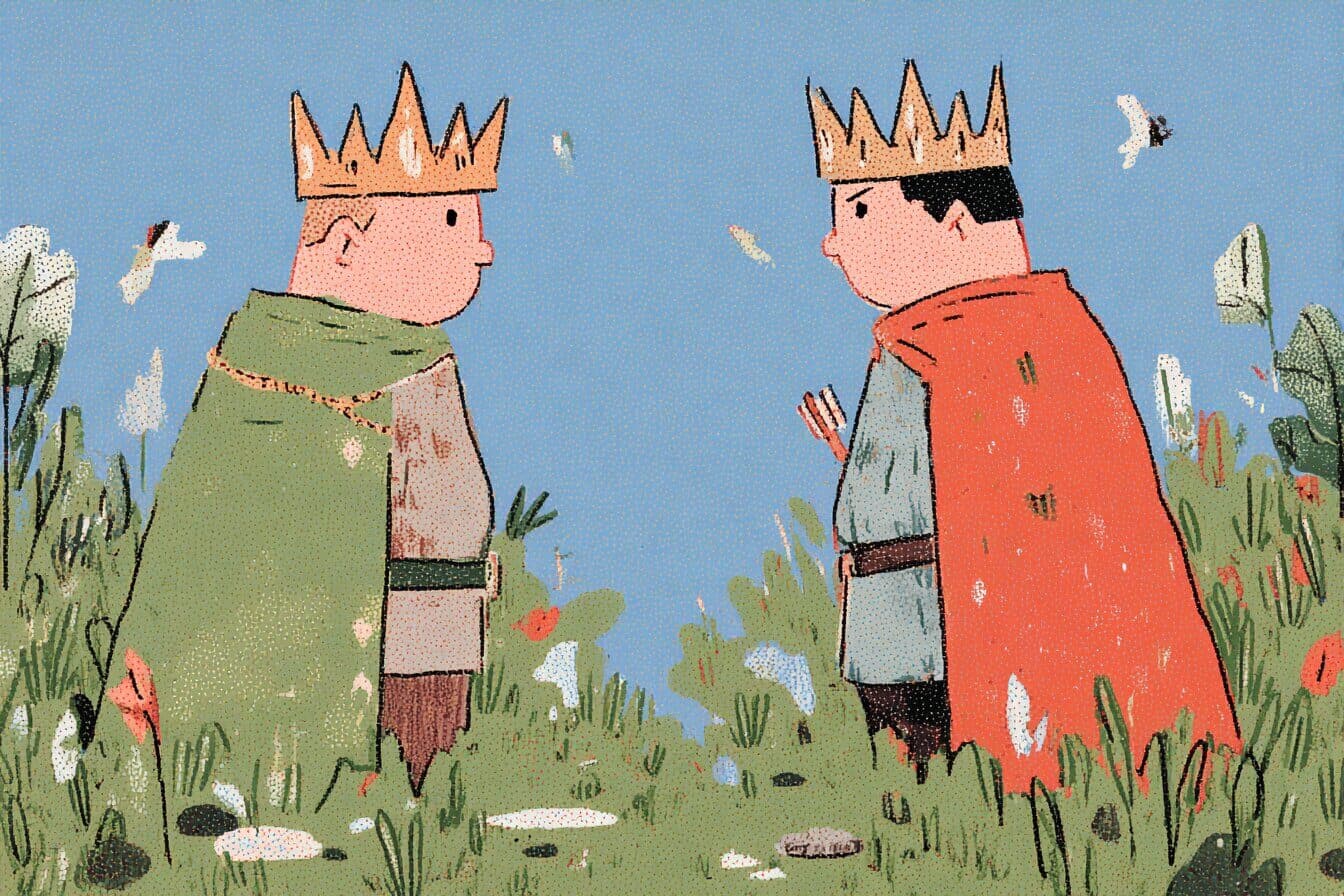
There is something magnetic about the idea of slipping into someone else's shoes, especially for a child lying in the dark wondering what the world looks like from the other side of a castle wall. In this prince and the pauper bedtime story, a restless prince named Julian and a barefoot bread seller named Toma swap lives for a day, only to discover that getting back is harder than getting out. Their adventure winds through moonlit alleys, crowded throne rooms, and one very opinionated monkey before settling into the kind of warmth that makes eyelids heavy. If you want to reshape the tale with your child's name or favorite setting, Sleepytale lets you build a custom version in minutes.
Why Prince and Pauper Stories Work So Well at Bedtime
Kids are natural identity explorers. All day long they try on roles, pretending to be teachers, astronauts, cats, parents. A story about two boys who literally trade lives taps straight into that impulse, but it does so inside a safe, bounded frame: we know the swap will end, we know the boys will find their way home. That certainty is exactly what a child's brain craves before sleep, the thrill of "what if" wrapped in the promise of "everything will be okay."
Prince and pauper tales also carry a quiet lesson in empathy without ever lecturing. When a child hears about Julian scrubbing flour off the baker's floor, or Toma struggling to hold a quill, they absorb the idea that every life has hard parts worth respecting. That kind of emotional processing, gentle and story shaped, is one reason a bedtime story about a prince and a pauper tends to linger in a child's memory long after the lamp goes out.
The Prince and the Pauper's Day of Wonder 9 min 11 sec
9 min 11 sec
Once upon a bright morning in the kingdom of Lumeria, Prince Julian stood at his palace window with his forehead pressed against the glass. The glass was cool and smelled faintly of rain. He had golden curls, velvet clothes, and every toy a boy could want, but none of that stopped the fidgety feeling in his legs, the kind that says you need to be somewhere else without telling you where.
Down in the market square, a boy named Toma was arranging bread crusts on a wooden tray and calling prices to anyone who passed. He wore patched clothes and no shoes. His feet were brown and tough as saddle leather, and he knew every alley shortcut, every loose cobblestone, every cat that lived behind the cheese shop.
When the prince rode through the market that afternoon, the two boys locked eyes and froze. They looked exactly alike, same nose, same jaw, same stubborn little crease between the eyebrows. Julian leaned down from his horse.
"Would you trade places?" he whispered. "Just for one day."
Toma thought about it for roughly half a second. "Done."
They slipped behind the fountain, swapped clothes in a fumbling rush, and went their separate ways. Julian skipped barefoot through the alleys, burning his soles on sun-warmed stone, tasting roasted chestnuts from a paper cone and learning to juggle apples from a girl who charged him two pennies for the lesson. He dropped every apple at least twice. Toma, meanwhile, sat tall on the velvet throne, tasting sugared berries and nodding at courtiers whose names he did not know and whose questions he answered with what he hoped was a wise expression.
At sunset they hurried back to the fountain.
But a sudden trumpet blast tore through the square, and palace guards came rushing in. Toma, still dressed as prince, was swept inside the gates before he could open his mouth. Julian, looking like a ragged street boy, was chased away by the baker who wanted his missing loaves returned.
"I belong inside!" Julian shouted at the closing gate.
Nobody believed him. A dusty boy in torn sleeves claiming to be royalty just earned a few pitying looks and one offer of soup.
Night fell. The gates clanged shut. Both boys lay awake with pounding hearts, realizing this might not be a one-day game after all. Julian curled up under a market cart, watching a stray cat wash its face in the moonlight. Toma lay rigid in the silk canopy bed, listening to silver clocks chime every hour, each chime making the room feel larger and emptier.
Morning arrived, and with it, real work.
Julian fetched water for the baker, kneaded dough until his arms trembled, and swept floors until clouds of flour dusted his hair white. The baker's daughter, who was seven and missing a front tooth, handed him a warm roll without a word. He ate it so fast he nearly choked.
Toma had to memorize royal names, sit still through lessons on geography and Latin, and pretend he knew how to sign important papers with a quill. The quill kept splattering. He hid three ink stains under his sleeve.
Both boys tried to send secret notes across the city. Palace pigeons flew to the wrong roofs. Street urchins lost the messages during a game of tag. A goat ate one.
Days passed. Each sunrise brought fresh surprises.
Julian learned to bargain for day-old bread, to whistle cheerful tunes when his stomach growled, and to thank strangers for a heel of cheese or a place by the fire. He noticed things he had never seen from the palace window: the way the cobbler sang while he worked, the way neighbors left bowls of water out for stray dogs, the way people without much still shared what they had.
Toma learned to speak softly when advisors were frightened, to ask for help instead of guessing, and to sit with a problem until it made sense instead of running off to play. He also learned that being a prince was lonelier than it looked.
One evening a traveling fair arrived, filling the square with jugglers, fire breathers, and fortune tellers. Julian watched from the crowd, his eyes wide. Toma sat beside the queen on a velvet platform, trying to look relaxed while his stomach did flips.
A performing monkey escaped its leash.
It leaped onto Toma's shoulder and chattered directly into his ear, loud and insistent, as if delivering important news. The courtiers gasped. The queen leaned close.
"My son once told that monkey secrets only he would know," she said quietly.
Toma's cheeks flushed. He patted the creature and, because he had no better plan, whispered back the only secret he had found while exploring the palace: a rhyme about hidden marbles under the rosebushes. He had stumbled on the marbles by accident, tripping over a root and landing face-first near a loose stone.
The queen's eyes went soft with understanding. She said nothing. She watched.
Across the square, Julian felt a strange tug in his chest, as if someone had tied a thread to his ribs and was pulling gently. He left the baker's stall, followed the pull through twisting lanes, and arrived at the palace gate just as twilight turned the sky the color of lavender and old silver.
The queen stood there, the monkey on her arm like a furry sentinel. She looked at the dusty boy in front of her. She looked at the nervous boy on the platform behind her. She smiled.
"It seems Lumeria has two sons tonight," she said.
Julian stepped forward, bowed low, and told the whole truth. Stars blinked awake above them, one by one, as if leaning in to listen. The guards murmured. The courtiers whispered. The queen raised her hand and the square fell silent.
Toma climbed down from the platform. He lifted the tiny golden crown from his head and held it out.
Julian took it. Then he placed it right back on Toma's dark curls.
"This boy has served Lumeria well," he said. "Let him keep the honor of a royal friend."
The queen agreed. She declared that every month the boys would swap places for a full day, so the prince would remember his people and the pauper would learn to lead with kindness. No one had ever heard of such an arrangement. Nobody objected.
Bells rang. Fireworks bloomed overhead, red and gold and green, scattering sparks that floated down like slow confetti. Julian invited Toma's family to live in a sunny cottage near the palace gardens, where roses climbed stone walls and a robin had built a nest above the door that nobody wanted to disturb.
Together the two boys planted apple trees in the market square and built a library for every child, stocking it with adventure books and atlases and one enormous picture dictionary that became everyone's favorite. They shared stories under starlit tents, and sometimes they just sat quietly, which is its own kind of friendship.
Years passed. Travelers came from distant lands to meet the prince and pauper who looked alike and ruled together in laughter and argument and forgiveness.
On warm evenings they still sneaked outside the palace, not to swap places, but to share honey cakes with street friends and listen to crickets sing from the cracks in the old fountain.
The kingdom prospered, not because it had a perfect prince, but because it had two boys who learned that every life holds hidden weight and hidden wonder, and that understanding someone else's day is the beginning of something better than gold.
Whenever the moon rose full and silver, Julian and Toma would meet at that same fountain, link arms, and stand there for a minute saying nothing. Then one of them would laugh, and the other would follow, and they would walk back through the quiet streets beneath the same bright stars that watched over kings and bakers alike.
The Quiet Lessons in This Prince and Pauper Bedtime Story
This story threads together empathy, humility, and the courage to tell the truth, all without stopping to lecture about any of them. When Julian eats the baker's daughter's warm roll so fast he nearly chokes, kids absorb what real hunger feels like without anyone saying the word. When Toma hides his ink stains under his sleeve, children recognize the universal anxiety of pretending to know what you are doing. The moment Julian puts the crown back on Toma's head shows that generosity can be quiet and specific, not grand. These are the kinds of reassurances that settle well at bedtime, the idea that honesty gets rewarded, that hard days end, and that the people who see the world from both sides make the best friends.
Tips for Reading This Story
Give Julian a slightly formal, careful voice that loosens up as he spends time in the market, and let Toma sound easygoing at first but more serious once he sits on the throne. When the monkey leaps onto Toma's shoulder, make the chattering noises as silly as you can; this is the moment most kids will laugh, so let it breathe. At the very end, when the two boys stand at the fountain saying nothing, slow your voice down and leave a real pause before "then one of them would laugh." That silence is where the story lands.
Frequently Asked Questions
What age is this story best for? Children ages 4 to 9 tend to connect with it most. Younger listeners love the monkey scene and the idea of two identical boys swapping clothes behind a fountain, while older kids pick up on the harder parts, like Julian sleeping under the market cart or Toma fumbling with the quill. The plot moves clearly enough for preschoolers but carries enough emotional texture to hold a second or third grader's attention.
Is this story available as audio? Yes. Press play at the top of the story to hear it read aloud. The audio version works especially well here because the pacing shifts between Julian's lively market scenes and Toma's quieter palace moments create a natural rhythm that carries listeners toward sleep. The trumpet blast and the monkey chatter are fun to hear voiced, and the final fountain scene lands with a warmth that suits a drowsy room.
Why do the boys look exactly alike in the story? The identical appearance is a classic storytelling device that makes the swap believable and fun for kids. In this version, it also serves a deeper purpose: because Julian and Toma look the same on the outside, the story invites children to notice what is different on the inside, their skills, fears, and the things each boy learns. It is a gentle way to show that who you are has more to do with what you do than how you look.
Create Your Own Version
Sleepytale lets you reshape this tale to fit your child's world. Swap Lumeria for your own neighborhood, replace the fountain with a favorite park bench, or turn the monkey into your family's pet. You can change the names, adjust the tone from adventurous to extra cozy, and add details that make your child smile, all in a few minutes, ready to read or listen to whenever bedtime rolls around.
Looking for more bedtime story classics?

Once Upon A Time Stories
What happens when June opens a golden book with no title? One of the sweetest short once upon a time stories about a forest, a hedgehog, and a blank page.

Fairy Tales Written By Hans Christian Andersen
Anders discovers short fairy tales written by Hans Christian Andersen as his grandmother reads from a soft brown book by lamplight.

Bluebeard Fairy Tale
In this short bluebeard fairy tale, the forbidden room holds not horror but a music box and memories of the people Lord Corvus loved most.

Red Shoes Fairy Tale
What happens when Karen's magical red shoes refuse to stop dancing? Discover this short red shoes fairy tale tonight.

Twinkle Twinkle Little Star Bedtime Story
Lily watches a kind star and floats up to help deliver dreams in this short twinkle twinkle little star bedtime story. A warm, quiet tale for sleepy nights.
Through The Looking Glass Bedtime Story
Step into a calm, magical short through the looking glass bedtime story and drift toward sleep with gentle wonder. Enjoy a soothing retelling that feels cozy from start to finish.