
The Monkey And The Crocodile Bedtime Story
By

Dennis Wang, Bedtime Story Expert
8 min 9 sec
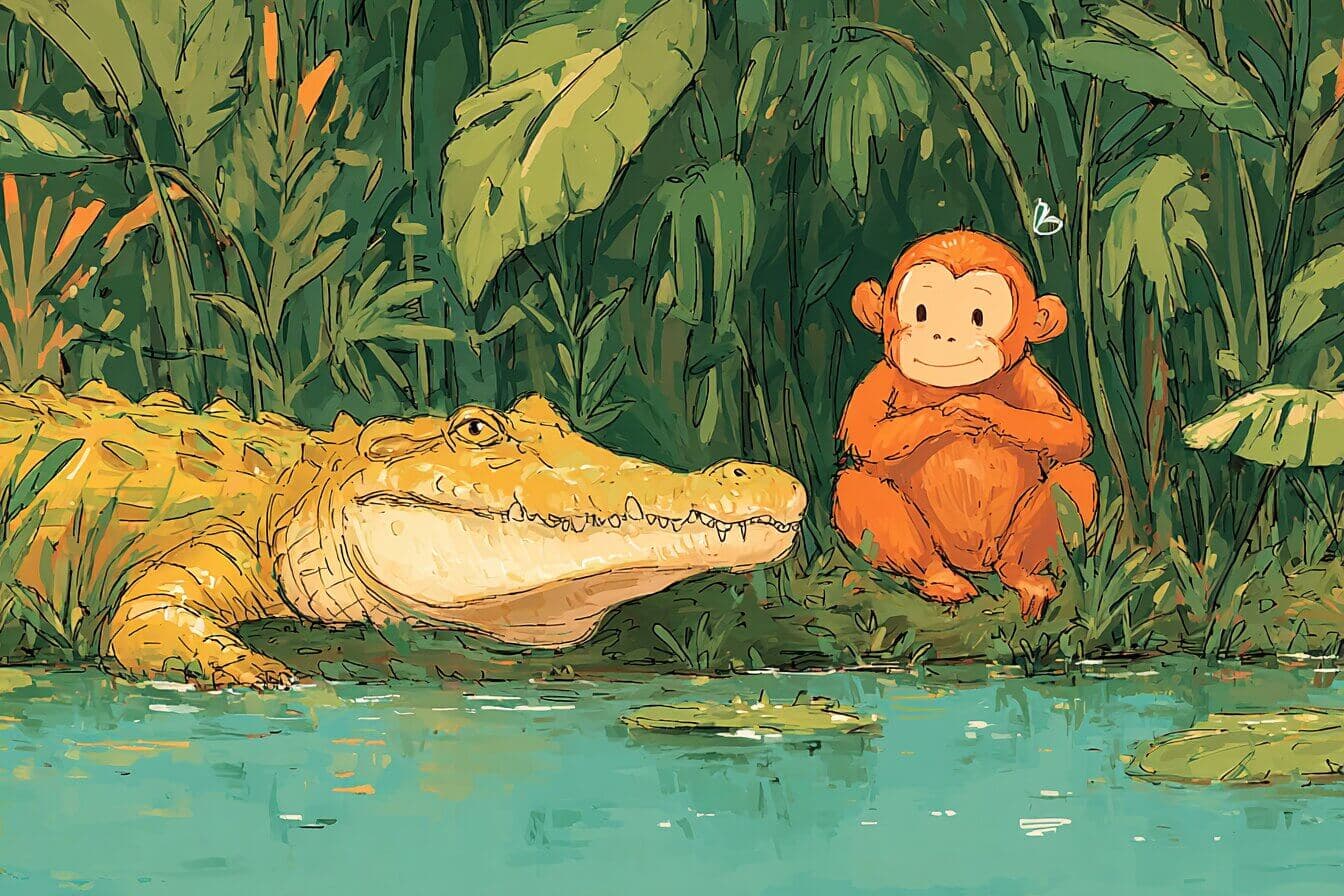
There is something about a slow river at dusk, the frogs just starting up and the water catching the last pink light, that makes kids go quiet in the best way. This tale follows Miko, a clever monkey with a love of counting, and Kibo, a polite crocodile who surfaces one morning with a surprising request, and together they stumble into a friendship that is equal parts brain and heart. It is our favorite kind of the monkey and the crocodile bedtime story, gentle and a little bit tricky, with a breathing exercise woven right into the ending. If your child would love hearing their own name in a version like this, you can create one with Sleepytale.
Why Monkey and Crocodile Stories Work So Well at Bedtime
There is a reason kids have loved this pairing for centuries. A monkey up in the branches and a crocodile down in the water gives children two very different worlds to picture, and that contrast keeps them curious without winding them up. The river setting does half the work on its own: moving water, soft splashing, the hum of insects along the bank. It is practically a sound machine built into a story.
A bedtime story about a monkey and a crocodile also lets children safely explore the idea of trust. Who can I rely on? What do I do when someone asks for something I cannot give? These are big feelings for small people, and wrapping them in a tale about animals on a riverbank makes them easier to sit with. By the time the story ends, the tension has dissolved, and all that is left is the slow breathing and the stars.
Miko the Marvelous Monkey 8 min 9 sec
8 min 9 sec
High in the canopy of the Kapok Tree, Miko the monkey practiced his morning somersaults.
One, two, three. He counted each flip the way some people count coins, like every number was worth keeping.
He landed on a wide branch that overlooked the slow brown river below. From up here the crocodiles looked like drifting logs, and Miko often wondered what they talked about down there, if they talked at all.
Today the river spoke first.
"Good morning, agile friend," said a voice, polite as a poem read too carefully. "I am Kibo the crocodile, and I have been watching your leaps."
Miko's tail curled. No monkey in the troop had ever mentioned chatting with a crocodile. But curiosity won out, the way it usually did with Miko.
"Good morning, Kibo." He bowed so low a leaf tickled his nose. "What brings a river guardian into conversation with a treetop acrobat?"
Kibo's smile showed more gum than teeth, which was reassuring.
"I admire your clever tricks. The river can be lonely when fish speak only in bubbles."
Miko scratched his chin. "Tell you what. I will trade you a tale for a fact. Tell me something about the river I cannot see from up here."
Kibo said the river mirrored the sky so perfectly that fish sometimes tried to swim into clouds. Miko, delighted, told the story of the night he counted one hundred fireflies and accidentally invented a dance.
So began a daily exchange. Knowledge for knowledge, laughter for laughter.
Weeks passed like pages in a picture book nobody wanted to finish.
Miko learned that crocodile mothers carry hatchlings to water in their jaws, strong enough to crush bone yet gentle enough not to scratch a single scale. Kibo learned that monkeys use different hoots for "food," "danger," and "let's play," which he found wonderfully efficient.
One afternoon Kibo appeared agitated, swirling little whirlpools with his tail.
"My wife, Kazi, feels unwell," he said quietly. "She believes only a monkey's heart can cure her."
Miko's ears drooped.
He valued his heart exactly where it was, tucked beneath fuzzy ribs and busy thoughts and a pulse that still sped up whenever he spotted a ripe mango. Still, friendship meant helping. He tapped his temple the way his mother used to do when she was about to solve something.
"Dear Kibo, I would gladly help. But a heart is easier to carry when it stays inside its owner." He paused. "Let me visit Kazi and offer her a riddle instead. If I fail, you may reconsider."
Kibo looked ashamed, which was hard to read on a crocodile but showed mostly around the eyes. He agreed.
Miko climbed onto Kibo's broad back, whispering thanks for each smooth stroke through the cool water. The current smelled like wet clay and old leaves, and Miko noticed a dragonfly keeping pace with them, as though it wanted to see how this turned out.
On the far bank, Kazi waited. Her eyes glinted.
Miko bowed politely, noting the way she clutched a crumpled leaf like a prescription she had written herself. "Honored Kazi," he began, "before we proceed, may I teach you a counting game? Hearts are heavy, but numbers are light."
"Speak quickly, monkey." Her voice scraped like scales on stone.
"I will count to five. If you can repeat the count backward before I finish, my heart is yours. If not, you accept my gift of wisdom instead."
Kazi snapped her jaws once. The challenge stirred something in her, though, and she nodded.
Miko started. "One."
Kazi echoed. "Five."
"Two."
"Four."
"Three."
Kazi frowned. She needed to say three and then two and then one, but somehow the order tangled up like wet vines. While she puzzled, Miko reached into his satchel and pulled out a handful of crimson river berries, the kind that stain your fingers for a day and taste like someone mixed sunshine with something slightly sour.
"These berries carry the sun's energy," he said. "Eat three each sunrise and your own heart will grow stronger than any borrowed one."
Kazi stared at the berries. Their color was almost unfair, a red so deep it looked like it held a secret. She accepted.
Days later her strength returned. She sent Kibo to the Kapok Tree with a necklace of freshwater pearls, each one slightly different, the way real things always are.
Miko accepted. But he also asked for one more lesson: how crocodiles stay so patient while hunting.
Kibo demonstrated slow breathing, counting heartbeats until the world felt still. Miko practiced, one, two, three, all the way to ten, then backward, the same trick he had played on Kazi, only now the trick was on restlessness itself.
Back in the treetops, Miko taught the young monkeys to count their breaths when storms frightened them. He told them about crocodile mothers and their gentle jaws, proving that strength guided by kindness keeps everyone safe. The troop listened with wide eyes, and soon every monkey learned to greet crocodiles with respect rather than fear.
Miko's circle of friends widened like ripples on water.
Parrots wanted counting songs. A sleepy sloth asked for a lullaby that included facts about stars. Miko, ever eager, composed verses about how starlight travels years to reach our eyes, so when we wish upon a star we are actually wishing into the deep past. The sloth fell asleep halfway through, which Miko took as a compliment.
One evening Kibo appeared beneath the Kapok Tree looking worried again. A floating log had jammed the river's narrow channel, and fish could no longer reach the reeds where baby crocodiles learned to hunt.
Miko thought hard. Then he fashioned a lever from a long stick and taught Kibo the principle of fulcrums, drawing a diagram in the mud with his finger. Together they pried the log free and water rushed through, carrying fish like silver confetti.
Kazi, watching from the bank, shook her head slowly. Cleverness paired with kindness could move more than muscle alone. She invited Miko to a river feast of sweet water grasses and crunchy river snails.
Miko brought bananas and berry juice. Every creature shared, and nobody counted hearts. They counted blessings instead.
During the feast Miko proposed a game: each guest would teach something useful before the sun touched the horizon.
The parrot taught how to say "hello" in four bird dialects.
The firefly taught how it makes light by mixing oxygen with a chemical called luciferin, a word that sounded magical enough to be a spell.
Kazi taught how to float without sinking by keeping lungs full of calm air.
Miko taught how to remember numbers by picturing them as shapes: one like a stick, two like a swan, three like twin nuts, four like a chair, five like a flag.
By the time the sun blushed peach and slipped behind the trees, everyone had learned something new and felt fuller than any stomach could measure.
That night Miko sat on his favorite branch, counting stars. He did not say anything wise to himself. He just counted.
He practiced the crocodile breathing Kibo had taught him. One, two, three, up to ten, then backward, until his eyelids felt heavy as river stones. Somewhere below, the water kept moving.
When dawn painted the sky mango pink, Miko awoke with a plan. He would build a swing from the treetops down to the river so shy forest children could meet Kibo and Kazi without fear.
He gathered vines, tested knots, calculated lengths. He remembered that the shortest distance between two friends is a sturdy hello.
Soon monkeys, birds, and even a small deer took turns gliding down, squealing as they swooped over the water and back to safety. Kibo and Kazi surfaced gently, offering rides on their strong backs, teaching that trust, like counting, grows one careful step at a time.
Miko watched from his branch. The river kept whispering, and he kept turning its whispers into lessons. Below him the swing creaked and the water sparkled and somewhere a parrot was counting in a language nobody else understood yet.
And his heart stayed right where it belonged.
The Quiet Lessons in This Monkey and Crocodile Bedtime Story
This story is really about what to do when someone you trust asks for something you cannot give. When Miko chooses a riddle and a handful of berries instead of anger or flight, children absorb the idea that you can say no and still be generous. There is also the thread of curiosity as a form of bravery; Miko talks to Kibo in the first place because he would rather learn something new than stay safe and bored. And the breathing exercise at the end is not decoration. It gives kids a tool they can actually use under the covers, counting up to ten and back down, turning the story's rhythm into their own slow drift toward sleep.
Tips for Reading This Story
Give Kibo a low, unhurried voice that sounds like it is coming from just above the waterline, and let Kazi rasp a little, almost like she is clearing her throat. During the counting riddle, slow way down and actually pause between each number so your child can try counting backward too. When Miko pulls out the crimson berries, cup your hand as if you are holding something precious and describe the color as if you have never seen anything so red.
Frequently Asked Questions
What age is this story best for?
Children ages 3 to 7 tend to enjoy it most. Younger listeners love the counting game between Miko and Kazi and the silly image of fish swimming into clouds, while older kids pick up on the fulcrum lesson and the idea that you can refuse a request without losing a friend.
Is this story available as audio?
Yes. Press play at the top of the story to hear it read aloud. The river scenes and slow breathing exercise near the end sound especially good in audio, and the counting riddle between Miko and Kazi builds a rhythm that keeps kids engaged without revving them up right before sleep.
Why does Miko offer berries instead of his heart?
Miko figures out that Kazi does not actually need a monkey's heart; she needs something that makes her own heart stronger. The crimson river berries are rich in vitamins, and three each sunrise do the trick. It is a gentle way of showing children that the best solutions often look nothing like the original demand.
Create Your Own Version
Sleepytale lets you reshape this river friendship into something completely your own. Swap the Kapok Tree for a mangrove lagoon, replace the berries with mango slices or honey nuts, or add a parrot sidekick who counts in funny accents. In a few moments you will have a cozy, personalized story ready to read aloud or play on repeat for a peaceful night.
Looking for more bedtime story classics?

Once Upon A Time Stories
What happens when June opens a golden book with no title? One of the sweetest short once upon a time stories about a forest, a hedgehog, and a blank page.

Fairy Tales Written By Hans Christian Andersen
Anders discovers short fairy tales written by Hans Christian Andersen as his grandmother reads from a soft brown book by lamplight.

Bluebeard Fairy Tale
In this short bluebeard fairy tale, the forbidden room holds not horror but a music box and memories of the people Lord Corvus loved most.

Red Shoes Fairy Tale
What happens when Karen's magical red shoes refuse to stop dancing? Discover this short red shoes fairy tale tonight.

Twinkle Twinkle Little Star Bedtime Story
Lily watches a kind star and floats up to help deliver dreams in this short twinkle twinkle little star bedtime story. A warm, quiet tale for sleepy nights.
Through The Looking Glass Bedtime Story
Step into a calm, magical short through the looking glass bedtime story and drift toward sleep with gentle wonder. Enjoy a soothing retelling that feels cozy from start to finish.