
The Little Red Hen Bedtime Story
By

Dennis Wang, Bedtime Story Expert
10 min 48 sec
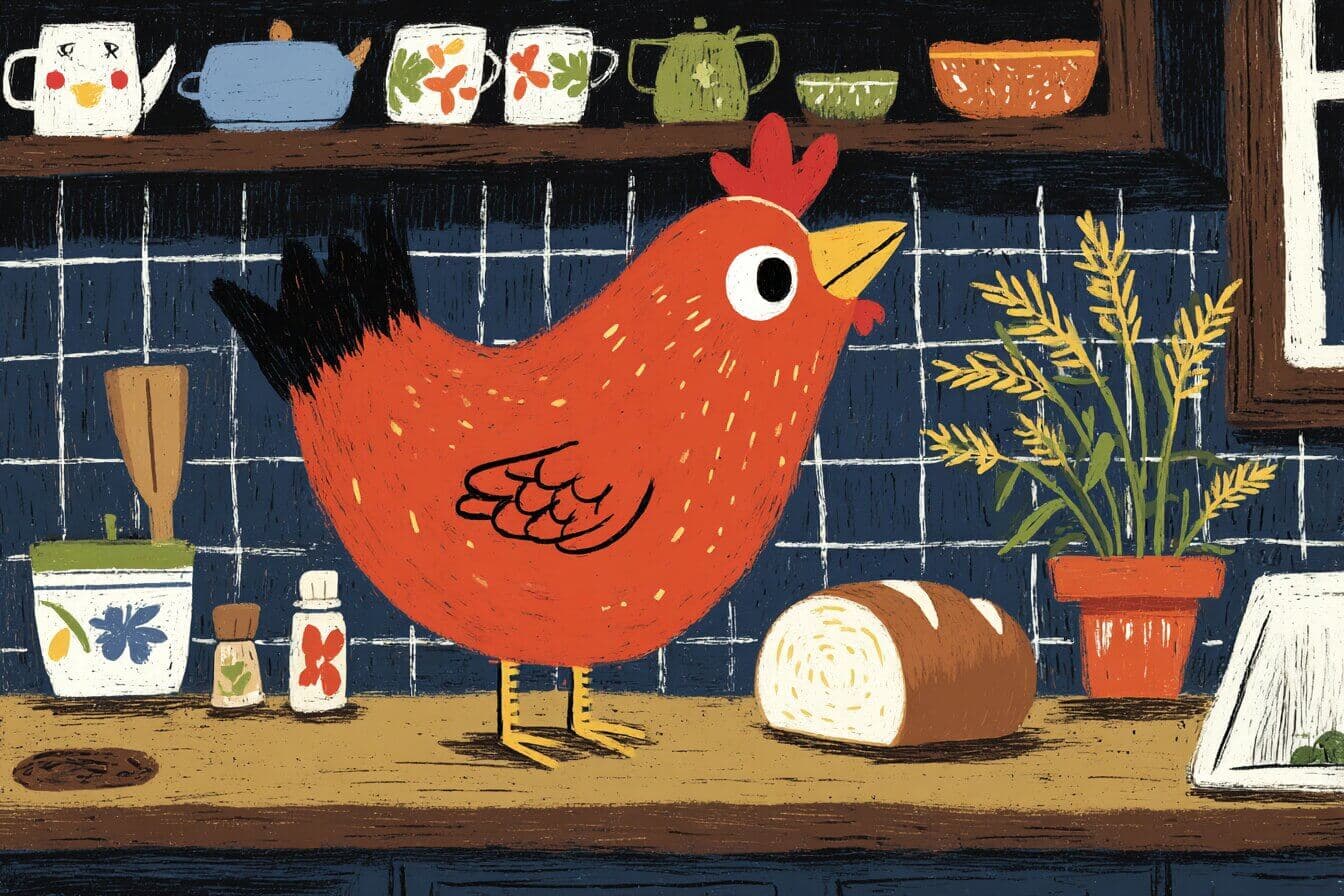
There is something about the smell of warm bread and a quiet farm that makes children's eyelids grow heavy in the best possible way. In this retelling, a determined little hen named Henny sets out to learn how a single wheat seed becomes a loaf, doing the work herself when every friend on the farm is "too busy." It is exactly the kind of the little red hen bedtime story that wraps patience and persistence in a cozy blanket of golden fields and fresh crumbs. If you would like to shape your own version with different animals, settings, or a gentler pace, you can create one for free with Sleepytale.
Why Little Red Hen Stories Work So Well at Bedtime
The Little Red Hen is one of those tales children never seem to outgrow, and there is a good reason it feels so right before sleep. The story follows a single, repeating rhythm: ask for help, get turned down, keep going anyway. That predictable loop is calming for young minds because they always know what comes next, which is exactly the kind of certainty kids crave when the lights go low.
A bedtime story about the little red hen also lets children sit with a gentle tension, wondering whether the friends will come around, without ever feeling scared. The stakes are bread, not danger. And when the loaf finally appears, warm and golden, the resolution feels as satisfying as pulling a blanket up to your chin. It is a story shaped like a deep breath: steady effort in, sweet reward out.
Henny and the Harvest Helpers 10 min 48 sec
10 min 48 sec
In the middle of Sunny Patch Farm, where the grass carried a faint peppermint smell after morning dew, lived a small red hen named Henny.
She wore a tiny yellow straw hat that tilted slightly to the left no matter how many times she straightened it, and she spoke in bright, quick clucks that sounded a lot like laughter.
Every day she watched the farmer scatter wheat seeds across the dark soil.
Every day she wondered how those specks, no bigger than a freckle on a ladybug, could turn into tall golden stalks. It bothered her in the good kind of way, the kind that makes you lie awake thinking instead of sleeping.
One spring morning she marched to the duck pond and asked Quacker the drake if he knew the secret.
Quacker paddled in a lazy circle and said, "Too busy swimming, Henny. Ask someone else." He did not even look up.
So Henny trotted to the pigpen and posed the question to Pinky the piglet, who was belly-deep in mud, eyes half shut with satisfaction.
"Too busy keeping cool," Pinky mumbled. "Ask someone else."
Henny tried Curly the kid goat next. Curly was headbutting a tin can that clanged like a bell each time he connected. "Too busy leaping," he said between clangs. "Ask someone else."
Henny's feathers drooped.
But her curiosity did not.
She trotted to the farmer's porch, hopped onto a stack of seed catalogues, stood on tiptoe, and nosed open a dusty library book titled "The Life of Wheat." The pages smelled like old leaves and pencil shavings. The pictures showed roots drinking rain, leaves soaking up sunshine, and seeds storing energy the way a squirrel stores acorns.
Henny's heart beat faster.
She hopped down and scratched a diagram in the porch dust with one claw: seed plus soil plus water plus sun equals bread. She stared at it for a long moment, then clucked softly to herself, because she had stumbled onto the first secret of learning: if nobody helps, a book can still be a friend.
She tucked that thought beneath her wing like a precious egg and hurried to the supply shed.
Inside, wedged behind a watering can, she found a child's forgotten sandbox shovel, orange plastic with a chipped handle. She gripped it in her beak and marched to an empty sunny patch near the fence, humming a little tune that went "wheat, wheat, wheat" over and over until the barn cat appeared.
Whiskers yawned so wide Henny could see every one of his teeth. "Why are you working alone in this heat?"
Henny set the shovel down and explained her plan.
"Come help," she said.
Whiskers licked a paw slowly, considering. "Sounds like effort, little hen. Wake me when the bread is baked." He curled back into a patch of shade and closed his eyes.
Henny shook her head. She kept digging, loosening clod after clod until the earth felt soft as cake flour between her toes. A worm poked its head out, looked startled, and disappeared again.
Now she needed seeds. She fluttered up to the farmer's workbench and searched every crack until she found a single wheat kernel wedged in the grain of the wood. She carried it back to her plot like it was made of glass.
She poked a hole with her beak, dropped the kernel in, covered it, and pressed the soil firm with one flat foot.
The book said seeds need a drink. So she marched to the duck pond, scooped her tiny shovel full, and carried it back step by careful step, water sloshing over the edges. By the time she arrived, half the water was gone. She poured what was left and decided that half a drink was better than none.
Every day she returned. Water, weed, watch. Water, weed, watch.
One morning a green blade poked through. Then another. Then a whole cluster stood swaying like they were waving hello. Henny measured their height against her own tail feathers, marking the count on a flat stone with a pebble.
When the stalks reached ten feathers tall, golden kernels formed, plump as buttons on a coat.
Henny danced a circle so fast her hat flew off.
She had learned another secret: patience plus care equals growth. Simple as arithmetic, hard as waiting.
But harvesting wheat with only a beak and a toy shovel? That seemed impossible. She tried biting a stalk. It tasted like damp paper and refused to snap. She tried pushing, but the stalks just bent and bounced right back, almost teasing her.
She visited Quacker, Pinky, and Curly one more time.
Quacker splashed. Pinky snorted. Curly leaped.
"Too busy, Henny. Ask someone else."
Her heart sank. But she remembered the book.
Back on the porch she turned pages until she found a drawing of ancient farmers using sharp stones to cut grain. She searched the farm lane, kicking pebbles aside, until she spotted a triangular flint shaped like a shark tooth half buried in the dirt. She practiced on grass stems until her cuts were clean and swift.
Bundle by bundle, she sliced the wheat and stacked it into a miniature stook that looked like a tiny tepee. The setting sun painted it gold and orange. Henny sat beside it for a while, catching her breath, listening to crickets tune up for the evening.
She carried the wheat to the old millstones behind the barn, spread the heads flat, and stomped gently so the kernels popped free. Some shot sideways and she had to chase them, which made her laugh at herself.
She gathered the kernels in her hat, which served nicely as a basket, and set them on the kitchen windowsill where warm air from the stove dried them overnight.
Next morning she ground the kernels between two smooth creek stones, pressing and turning until rough flour appeared. It smelled like summer, like cut grass and sunshine mixed together.
She added a drip of honey she had found pooling beside a beehive, a splash of pond water, and a pinch of salt borrowed from the cow's mineral block. She mixed the dough with her feet, giggling at the squish between her toes, a feeling that was disgusting and wonderful at the same time.
When the dough felt stretchy, she shaped it into a round loaf, pressed a heart on top with the tip of her beak, and set it on a flat stone to rise.
The smell traveled. It crept past the barn, curled around the pigpen, and drifted across the pond.
Quacker waddled over first. "Is baking hard?" he asked, his voice smaller than usual.
Pinky appeared next, nose twitching. "Will the stone get hot?"
Curly trotted up last. "Will it taste like sunshine? I bet it tastes like sunshine."
Henny looked at them for a long moment. Then she smiled.
She asked them to help carry the stone to the rock garden, explaining that the sun's heat through a glass pane could bake bread slowly. Together they lifted, grunting and laughing. Pinky's hooves slipped once and they nearly dropped the whole thing, but Quacker wedged his flat foot underneath just in time.
They set the dough stone beneath a glass pane the farmer used for starting seeds, and they waited.
Hours slid past. The loaf turned golden. The smell grew so thick you could almost lean on it.
Finally Henny lifted the glass and tapped the crust.
A hollow thump. Done.
She carried the bread to the picnic table and set it beside a dish of strawberry jam she had mashed that morning from berries that were a little overripe, which made the jam sweeter.
Quacker, Pinky, and Curly sat in a half circle, eyes wide.
Henny sliced the loaf with her flint. The center was fluffy and warm, and steam rose in a thin curl. She passed pieces around without a word.
Quacker tasted his and quacked so loud a crow startled out of the oak tree. Pinky squealed. Curly did a leap that cleared the bench.
"How?" Quacker asked, crumbs on his bill. "How did one seed turn into this?"
Henny told them. The book. The shovel. The waiting. The flint. All of it.
The animals went quiet for a moment, the kind of quiet that means something is sinking in.
Then Quacker said he would help next time. Pinky offered her mud-cooling spot for storing dough on hot days. Curly promised to leap for encouragement whenever it was needed, which made everyone laugh, because that was exactly the kind of help only Curly could give.
Henny clucked softly and pulled her hat back on, tilted to the left as always. The sun was dropping behind the barn, and the picnic table was covered in crumbs, and somewhere a cricket started its song a beat too early.
From that evening on, whenever someone at Sunny Patch Farm needed help figuring something out, they found their way to Henny, the small red hen who knew that every question is a seed and every friend who finally shows up is jam on the bread.
The Quiet Lessons in This Little Red Hen Bedtime Story
This story is built around persistence, curiosity, and the complicated feelings that come with doing something alone when you wish you had company. When Henny keeps returning to the same three friends and gets turned down every time, children absorb something real about disappointment, and about choosing to keep going anyway. The moment she laughs at herself chasing runaway kernels shows kids that effort does not have to be grim; it can be silly and satisfying at the same time. And when the animals finally gather around the table, nobody scolds them for being late to help. That quiet grace is a reassuring note to end on before sleep, the idea that tomorrow you can show up differently, and the door will still be open.
Tips for Reading This Story
Give Henny a cheerful, slightly breathless voice, like someone who talks fast because she has too many ideas, and let each of the three friends have a distinct lazy drawl when they say "Too busy, Henny." When you reach the moment where Pinky nearly drops the stone and Quacker saves it with his flat foot, speed up just a little to build the fumble, then slow right back down for the long waiting scene under the glass pane. At the part where Henny taps the crust and hears the hollow thump, pause for a beat and let your child listen to the silence before you say "Done."
Frequently Asked Questions
What age is this story best for?
Children between about three and seven tend to enjoy it most. Younger listeners love the repetition of Henny visiting each friend and hearing "Too busy," while older kids pick up on the step-by-step process of turning a seed into bread. The concrete details, like grinding kernels with creek stones and pressing a heart into the dough, give every age something to picture.
Is this story available as audio?
Yes. You can press play at the top of the story to hear it read aloud. The repeating rhythm of Henny asking for help and getting turned down works especially well in audio because kids start anticipating each friend's excuse before it comes. The baking scene, where the smell drifts across the whole farm, also lands beautifully when a narrator can slow the pace and let the warmth build.
Why does Henny share the bread even though no one helped her?
Henny's choice to share is one of the things that makes this retelling different from some older versions where the hen eats alone. Here, the point is not punishment but invitation. When the animals taste the bread and finally understand what went into it, they volunteer to help next time on their own, which feels truer to how friendships actually work with young children.
Create Your Own Version
Sleepytale lets you reshape this farmyard tale into something perfectly suited to your child's bedtime. Swap Henny's wheat for blueberries or oats, trade the farm for a rooftop garden, or turn the animal friends into siblings, classroom buddies, or woodland creatures. In just a few taps you will have a calm, personalized story with gentle pacing and warm details you can revisit whenever the night needs softening.
Looking for more bedtime story classics?

Once Upon A Time Stories
What happens when June opens a golden book with no title? One of the sweetest short once upon a time stories about a forest, a hedgehog, and a blank page.

Fairy Tales Written By Hans Christian Andersen
Anders discovers short fairy tales written by Hans Christian Andersen as his grandmother reads from a soft brown book by lamplight.

Bluebeard Fairy Tale
In this short bluebeard fairy tale, the forbidden room holds not horror but a music box and memories of the people Lord Corvus loved most.

Red Shoes Fairy Tale
What happens when Karen's magical red shoes refuse to stop dancing? Discover this short red shoes fairy tale tonight.

Twinkle Twinkle Little Star Bedtime Story
Lily watches a kind star and floats up to help deliver dreams in this short twinkle twinkle little star bedtime story. A warm, quiet tale for sleepy nights.
Through The Looking Glass Bedtime Story
Step into a calm, magical short through the looking glass bedtime story and drift toward sleep with gentle wonder. Enjoy a soothing retelling that feels cozy from start to finish.