
The Happy Prince Bedtime Story
By

Dennis Wang, Bedtime Story Expert
5 min 52 sec
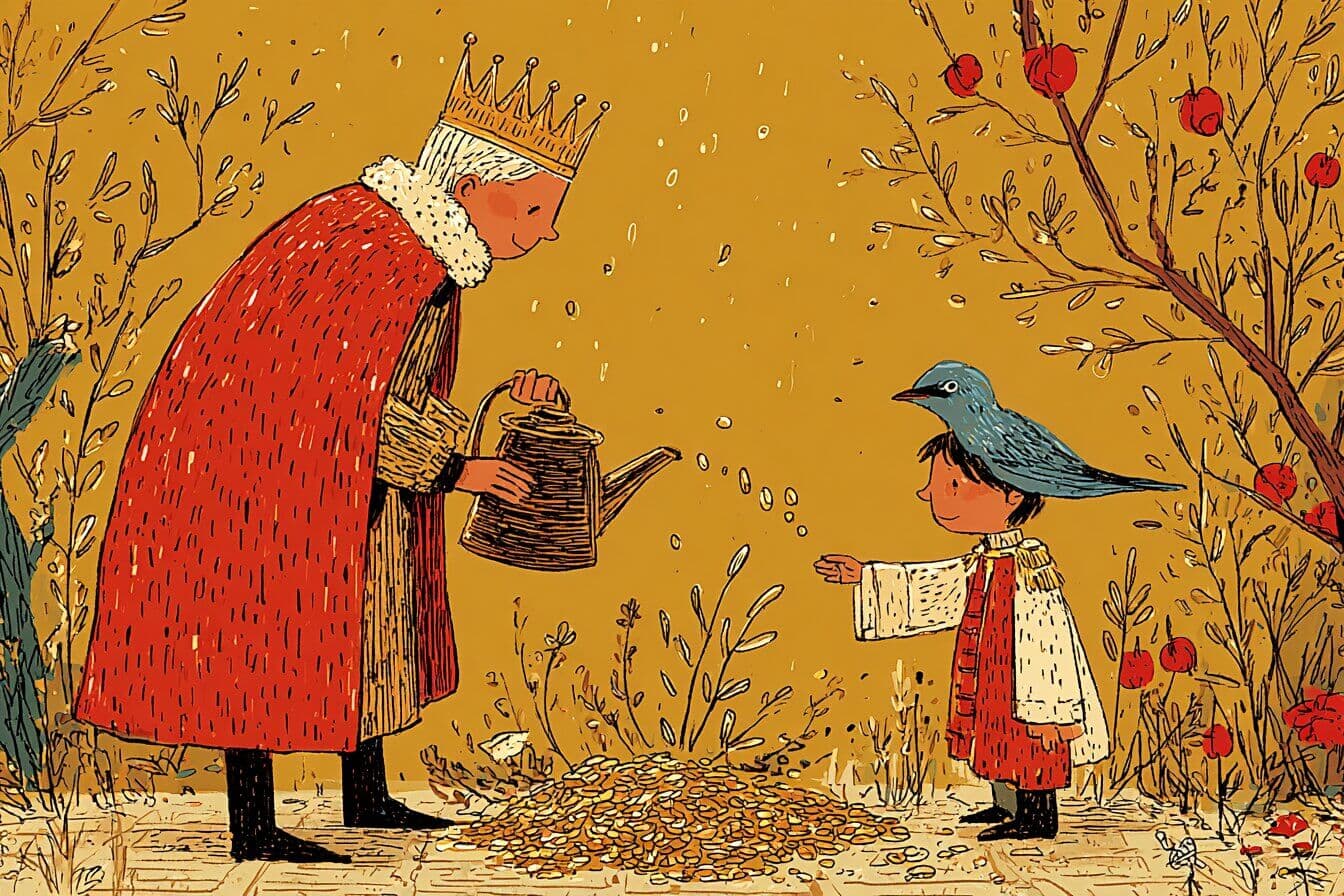
There is something about a statue watching over a sleeping city that feels like a guardian you never knew you had. In this gentle retelling, a golden prince who cannot move and a small swallow who refuses to leave team up to deliver secret kindnesses through the cold streets below. It is our favorite kind of the happy prince bedtime story, one where generosity moves quietly from rooftop to doorstep without ever raising its voice. If you would like a version shaped around your own child's name or favorite details, you can create one inside Sleepytale.
Why Happy Prince Stories Work So Well at Bedtime
The Happy Prince taps into something children already understand: the urge to help when someone looks cold or hungry. That instinct is especially alive at bedtime, when kids are winding down and their empathy runs close to the surface. A story about a prince and a swallow sending gifts through the dark feels like a promise that someone is watching out for the world while they sleep. The slow, repetitive rhythm of one delivery after another mirrors the calming pattern of a lullaby.
A bedtime story about the Happy Prince also gently introduces the idea that giving something away can make you feel richer, not poorer. Children do not need that spelled out; they feel it in the way the prince's voice grows warmer even as his gold peels away. That quiet contradiction stays with them as their eyes close, leaving a sense of safety and purpose that is perfect for drifting off.
The Kindness of the Golden Prince 5 min 52 sec
5 min 52 sec
High above the city square, a golden statue of a prince stood on a tall column where pigeons never landed because the gold was too slippery for their feet.
His eyes were sapphires. His belt was set with rubies. His sword hilt held a stone so red it looked like a drop of jam caught in sunlight.
Children pointed up at him on their way to school, and some of them waved.
He could not wave back.
But the prince was not just a statue.
When the sun dropped behind the rooftops and the lamplighter made his rounds, the prince could see and hear everything in the city below. He heard arguments spilling from kitchen windows. He heard lullabies. He heard the particular silence of someone too tired to cry.
One chilly autumn evening, a small swallow landed on his shoulder.
The bird had put off his journey to Egypt because he loved circling the cathedral spires, but now his feathers were ruffled and his eyes were half shut.
"Good evening," said the prince, and his voice sounded like someone tapping a fingernail on a tiny bell.
The swallow nearly fell off.
"You can speak?"
"I can," the prince said. "Ever since they covered me in this gold. It itches sometimes, if you want to know the truth."
The swallow did not know what to say to that, so he tucked his beak under his wing and said nothing.
"I need your help," the prince went on. "I see their troubles from up here, but I cannot move. Not even a finger. Do you know how maddening that is?"
The swallow peeked out. Below them, a seamstress sat by a single candle, pushing a needle through cloth. Her fingers were red and clumsy with cold. Two streets over, a boy stood outside a bakery. He was not begging. He was just standing there, breathing in the smell of bread as though breathing could fill a stomach.
"Take the ruby from my sword," said the prince. "Bring it to the seamstress. She will think it fell from the sky. She can sell it and buy firewood and supper."
The swallow looked at the ruby. It was bigger than his head.
He gripped it in his claws, wobbled once, and flew.
Down through the narrow streets he went, past laundry lines and chimney smoke, until he found the seamstress's window cracked open at the top. He dropped the gem into her lap and was gone before she gasped.
The next night, the prince asked the swallow to take one of his sapphire eyes to the boy outside the bakery.
"Your eye?" the swallow said.
"I have two," said the prince, as if that settled everything.
The swallow carried the sapphire down, and the boy bought bread. Not just for himself. He bought six rolls and handed them out on the corner like a tiny mayor holding office hours.
Each night after that, the swallow delivered another piece of the prince's gold or jewels to someone in need. A leaf of gold to a woman patching her roof. A chip of sapphire to an old man whose blanket was thinner than newspaper. The prince grew duller with every gift, but his voice somehow sounded warmer.
"Does it hurt?" the swallow asked once, perched on the prince's now bare shoulder.
The prince took a long time to answer.
"Less than watching and doing nothing."
Winter arrived early. Snow covered the rooftops and filled the gutters, and the swallow felt his wings growing heavy, as though someone had sewn small stones into his feathers.
"Little friend," said the prince, "you must fly south. The warm air is waiting for you."
The swallow shook his head.
"Not yet."
He stayed. He carried the last sheets of gold leaf to hands that needed them, and at night he pressed himself against the prince's chest, where the lead heart underneath still held a faint warmth.
One morning the mayor walked through the square, sipping coffee from a paper cup, and stopped.
"What happened to the golden statue? It looks like a drainpipe."
He ordered it taken down.
Workers climbed the column with ropes and pulleys. When they lifted the prince away, they found the swallow curled against his chest, still as a stone, frozen in the night.
Nobody said anything for a moment. The foreman took off his cap.
They melted the prince's lead heart and the swallow's small body together and cast a new statue, plainer than the first. It stands in the square today. It is not golden. Children still point at it, though.
If you look closely, you can see the prince holding the swallow against his chest. And if you happen to pass on a quiet night, when the lamplighter has gone home and the pigeons are asleep, you might hear two voices murmuring, planning where to send the next gift.
The seamstress, who never did learn where the ruby came from, opened a small shop and taught three girls to sew.
The baker started leaving rolls on the windowsill at closing time, no questions asked.
The old man, warm now in a proper coat, sat on a bench and told stories to any child who wandered by.
On the anniversary of that first ruby, children began placing small things at the base of the statue.
A scarf for someone cold.
A coin for someone hungry.
A wooden bird, painted yellow, for no particular reason at all.
In spring, swallows returned and nested in the crook of the prince's elbow. They sang until the streetlamps came on, and then they were quiet.
The statue's face, chipped by weather and leaned on by generations of children waiting for their parents, still seemed to be smiling. Not a wide smile. Just the beginning of one, as though it knew something and was deciding whether to tell.
The Quiet Lessons in This Happy Prince Bedtime Story
This story explores generosity, loyalty, and the ache of seeing a problem you cannot fix alone. When the prince admits that watching and doing nothing hurts more than giving away his own sapphire eyes, children absorb the idea that acting on compassion, even when it costs something, brings a kind of relief. The swallow's refusal to leave, night after cold night, shows loyalty not as a grand declaration but as a quiet, stubborn choice. And the seamstress, the baker, and the old man each passing kindness forward afterward lets children see that one generous act can ripple outward without anyone keeping score. These are reassuring ideas to carry into sleep: tomorrow you can help, and you do not have to do it perfectly or alone.
Tips for Reading This Story
Give the prince a calm, low voice with just a hint of humor, especially when he says "I have two" about his eyes. Let the swallow sound a bit breathless and flustered, like a small bird who keeps agreeing to things before thinking them through. When the foreman takes off his cap after finding the swallow, pause for a beat and let the silence sit; children will feel the weight of that moment without you explaining it.
Frequently Asked Questions
What age is this story best for?
Children ages 4 to 9 tend to connect most deeply with this version. Younger listeners love the swallow's nightly flights and the tangible gifts (a ruby, a sapphire, sheets of gold), while older children pick up on the prince's frustration at being stuck on his column and the bittersweet ending where the two friends are melted together.
Is this story available as audio?
Yes. You can press play at the top of the story to hear it read aloud. The contrast between the prince's bell-like calm and the swallow's surprised chirping comes alive in audio, and the repeating rhythm of each nighttime delivery has a lullaby quality that works especially well when you are not holding the screen yourself.
Does this version follow Oscar Wilde's original tale?
It keeps the core characters, the golden prince and the loyal swallow, along with the same arc of giving away jewels and gold to help the city's poor. Some details are softened and the ending focuses on the tradition of leaving gifts at the statue's base, making it gentler for younger listeners while preserving the heart of Wilde's story.
Create Your Own Version
Sleepytale lets you reshape this classic into a bedtime tale that fits your family perfectly. You could move the statue to a harbor town, swap the swallow for a paper boat that drifts through canals delivering gifts, or change the jewels into jars of honey and hand-knitted scarves. In a few moments you will have a personalized story ready to read or play at bedtime, with all the warmth of the original and none of the details that do not suit your child.
Looking for more bedtime story classics?

Once Upon A Time Stories
What happens when June opens a golden book with no title? One of the sweetest short once upon a time stories about a forest, a hedgehog, and a blank page.

Fairy Tales Written By Hans Christian Andersen
Anders discovers short fairy tales written by Hans Christian Andersen as his grandmother reads from a soft brown book by lamplight.

Bluebeard Fairy Tale
In this short bluebeard fairy tale, the forbidden room holds not horror but a music box and memories of the people Lord Corvus loved most.

Red Shoes Fairy Tale
What happens when Karen's magical red shoes refuse to stop dancing? Discover this short red shoes fairy tale tonight.

Twinkle Twinkle Little Star Bedtime Story
Lily watches a kind star and floats up to help deliver dreams in this short twinkle twinkle little star bedtime story. A warm, quiet tale for sleepy nights.
Through The Looking Glass Bedtime Story
Step into a calm, magical short through the looking glass bedtime story and drift toward sleep with gentle wonder. Enjoy a soothing retelling that feels cozy from start to finish.