
Telescope Bedtime Stories
By

Dennis Wang, Bedtime Story Expert
9 min 50 sec
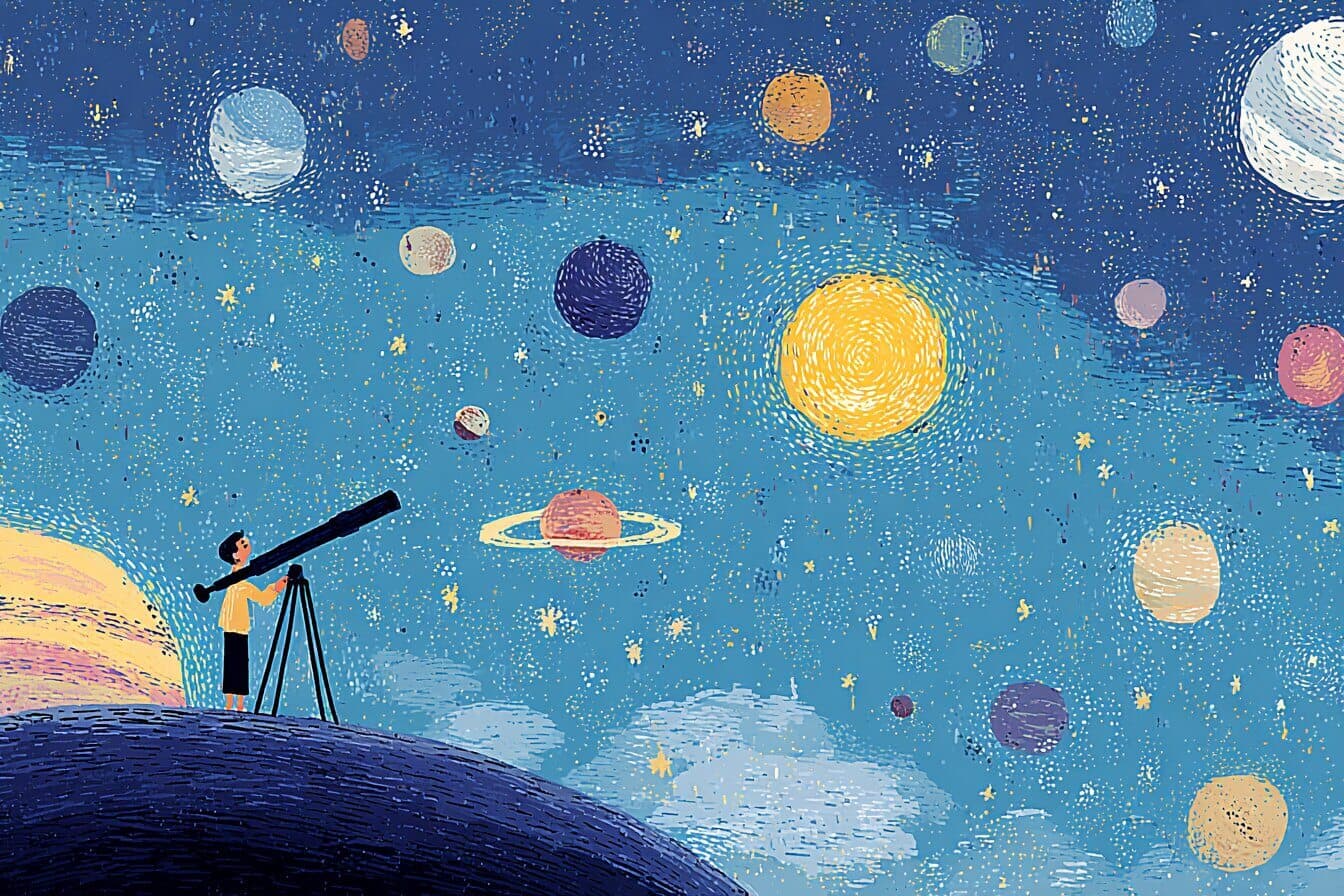
There is something about peering through a lens at bedtime that turns the whole sky into a secret meant just for you. In this story, a girl named Mira receives her grandpa's small brass telescope and follows a single blue star into an impossible, shimmering world she never expected. It is the kind of telescope bedtime story that wraps wonder around a child like a blanket, making the dark feel full instead of empty. If your little one would love a version with their own name, their own porch, and their own star to chase, you can create one tonight with Sleepytale.
Why Telescope Stories Work So Well at Bedtime
Telescopes do something unusual for a bedtime prop: they make the darkness itself feel inviting. Instead of asking a child to close their eyes and ignore the night, a telescope story says the night has things worth finding. That shift matters. Kids who feel uneasy about lights going off can picture themselves choosing to look into the dark, scanning it for gentle surprises rather than hiding from it. The act of focusing on one small point of light mirrors the way a sleepy mind narrows down before drifting off.
A bedtime story about a telescope also carries a natural slowness. You steady the instrument, you wait, you adjust, you look again. There is no rushing. That pace invites deep breathing without ever mentioning it, and for a child curled up under covers, the rhythm of searching, finding, and settling on a single star maps perfectly onto the rhythm of falling asleep.
The Telescope That Touched the Stars 9 min 50 sec
9 min 50 sec
Mira pressed her eye to the small brass telescope her grandpa had placed in her hands that morning.
The metal was cooler than she expected, almost like holding a glass of water against her cheek, and she squinted into the tiny round lens with one eye shut tight and the other trying to relax.
At first, nothing. Just darkness and her own eyelash blurring the edge of the view.
Then, as if someone had scattered salt across black paper, a spray of silvery lights appeared. Grandpa had told her these were stars, but up close they looked more like fireflies that had forgotten how to move.
She gasped. The telescope wobbled and the stars swirled, spinning like sprinkles dropped into cookie batter.
Grandpa caught the barrel with one hand and steadied it against the porch railing. He did not say "be careful." He just held it still and waited.
He whispered that each star held a secret world, and tonight she could pick one to visit in her imagination.
Mira tightened her fingers around the brass, swept the sky slowly, and stopped when a soft blue star sat perfectly in the center of the lens. It looked patient, like it had been waiting there specifically for her to notice.
The telescope hummed.
Warm light spilled over her knuckles, amber and slow, and the porch beneath her feet seemed to dissolve into a mist that smelled faintly of vanilla and something else she could not name, something green and nighttime.
She felt herself lifting, lighter than a dandelion seed.
The blue star grew until it filled the entire lens like a glowing marble. Grandpa's voice floated after her, not worried, just reminding her to remember every detail so she could tell him later.
Mira promised silently and stepped forward.
Solid ground met her shoes, which surprised her. She had expected clouds or nothing.
A friendly breeze arrived carrying the sound of tiny bells chiming in rhythm with her heartbeat, which was a strange thing to notice and an even stranger thing to trust, but she trusted it anyway.
She lowered the telescope and looked around.
A smooth silver plain curved upward in every direction like the inside of a bowl turned gently outward. Overhead, constellations hung so low she could almost scoop them, and each cluster seemed to be telling a story she understood without needing words. One group looked like a dog mid-leap. Another looked like a hand reaching for a cup.
A small figure made entirely of starlight skipped toward her. It left a trail of glitter behind it that spelled hello in looping letters, then dissolved before the letters finished drying.
Mira waved.
"Is this the blue star's world?" she asked out loud, because whispering felt wrong here.
The figure nodded and formed arms that gestured for her to follow.
They walked together past crystal flowers that chimed when moonlight touched their petals, each one producing a single clear note, and past ponds that reflected not the sky above but memories. Mira stopped at one and saw herself learning to ride her bike, wobbling and wobbling and then not wobbling. In another pond she saw the first time she tasted mint ice cream and how her nose had scrunched.
One pond showed the day she planted sunflower seeds with Dad, her hands too small for the trowel so she used a spoon instead.
Each memory sat in its water like a stone you could pick up and hold.
The starlight guide did not speak but somehow communicated that every experience, the good ones and the tricky ones, became part of a pattern larger than any single life. Mira stored the idea carefully. It felt like something she would want to unwrap again later when she was older.
They reached a hill topped by a telescope much larger than Grandpa's, built from what looked like woven moonbeams, though up close the material was more like glass thread, and it hummed a low note, almost too low to hear.
The guide invited her to look through it.
Mira climbed soft silver steps and pressed her eye to the eyepiece.
There hung Earth.
White clouds swirled over oceans of deep blue and continents of green and rust. Cities twinkled. And there, on a tiny porch she could somehow identify from millions of kilometers away, Grandpa sat on the swing looking up, smiling as if he knew exactly where she was.
Something tight and warm filled her chest. Part joy, part homesickness, part something she did not have a word for yet.
She stayed at the eyepiece a long time.
The guide showed her a small wheel on the side of the telescope. Each click revealed another planet. Red deserts where dust devils performed slow waltzes. A purple gas giant wearing rings of ice like bracelets. A tiny rocky world where flowers grew in total darkness, feeding on music instead of sunlight, which made Mira laugh because it seemed ridiculous and also completely right.
"Does anyone live there?" she asked, pointing at the purple giant.
The guide directed her attention to a speck of light crossing the rings. Through the lens she saw a ship shaped like a hummingbird, piloted by creatures of light who collected sounds to trade across galaxies. They had jars and jars of sounds: thunder from a water planet, laughter from a school, the particular creak of a screen door on a summer night. They waved at her. She waved back.
Friendship across impossible distance. It seemed so easy from up here.
Time behaved strangely. She felt she had wandered for hours, yet also no time at all, as if hours and minutes had stepped aside to let her explore without the pressure of a clock.
The guide led her to a library built from meteorites. Books were carved into stones that glowed warm orange when touched. Mira opened one and words floated up like butterflies, rearranging themselves into pictures that taught her how stars are born from clouds of gas and dust, how they burn for billions of years, and how they eventually give everything back.
She learned that the calcium in her bones and the iron in her blood were made inside ancient suns.
She sat with that for a moment.
A part of her had always belonged to the sky. She was not just Mira. She was a walking piece of star.
Closing the book, she noticed a small star fragment tucked between the pages, still warm, pulsing like a heartbeat. The guide indicated it was a gift, something to bring home. She picked it up. It weighed almost nothing and its glow synced with her own pulse, matching beat for beat like a conversation.
They walked back toward the silver plain where her journey had begun.
Along the way she thanked the starlight beings. They formed a bright arch overhead, a farewell tunnel of shimmering light, and she walked beneath it feeling the colors change on her skin.
At the edge of the plain, Mira lifted the telescope to her eye once more. Through the lens she saw the porch swing swaying softly in the night breeze.
She took a deep breath of the vanilla scented air.
Stepped forward.
The starlight faded to a gentle glow behind her eyelids, and she felt the wooden boards of the porch beneath her shoes again. A cricket was singing somewhere near the drainpipe. She had not noticed it before she left.
The telescope in her hands felt warmer now, as though it remembered where it had been.
Grandpa wrapped a blanket around her shoulders and guided her to the swing. "So?"
Words tumbled out like marbles spilling across a floor: purple gas, libraries carved in stone, a hummingbird ship, flowers that ate music, and the ponds that held her memories like polished coins.
He listened with his eyebrows up and his hands folded, proud that his small brass gift had opened such a large door.
When she showed him the star fragment, he placed it in a glass jar from the kitchen shelf. It kept pulsing, soft and steady, like a captured firefly with nowhere else it wanted to be.
They agreed to keep the telescope by the window so she could visit new worlds every clear night.
Years later, Mira would learn the scientific names for everything she saw. Plasma, electromagnetic spectrum, stellar nucleosynthesis.
But she never forgot the feeling of being personally welcomed by the dark.
She grew up to build telescopes that could see farther than Grandpa's ever could, and she kept that small brass one on her desk, slightly dented, the eyepiece worn smooth by years of looking.
Every lecture she gave ended the same way: wave at the stars sometime. You might be surprised who waves back.
The Quiet Lessons in This Telescope Bedtime Story
This story weaves together curiosity, patience, and the gentle idea that everything unknown becomes less scary when you choose to look at it closely. When Mira holds the wobbling telescope and waits instead of giving up, children absorb the value of steadying yourself through uncertainty. The moment she discovers her own bones contain ancient starlight teaches a quiet kind of self-worth, the sense that you already belong to something enormous just by existing. And her willingness to wave at strangers across impossible distances shows kids that openness and kindness can reach further than they think. These are reassuring ideas to carry into sleep, the kind that make tomorrow feel a little braver than today.
Tips for Reading This Story
Give Grandpa a low, unhurried voice, and let his silences do some of the work, especially when he steadies the telescope without saying "be careful." When Mira steps onto the silver plain for the first time, slow your pace way down and drop your volume so the bells chiming with her heartbeat feel real. At the part where she sees the hummingbird ship and waves, pause and let your child wave too if they want to.
Frequently Asked Questions
What age is this story best for?
It works well for children ages 4 through 8. Younger listeners love the sensory details like the crystal flowers chiming and the star fragment that pulses in Mira's hand, while older kids connect with the idea that their bones are made of ancient stars. The gentle loop from porch to star world and back gives even restless listeners a satisfying sense of arrival.
Is this story available as audio?
Yes. Press play at the top of the story to hear it read aloud. The audio version captures the slow rhythm of Mira's journey especially well, particularly the moment when words float up from the meteorite books like butterflies. Grandpa's quiet encouragement and the bells chiming with Mira's heartbeat translate beautifully into narration, making it easy for kids to close their eyes and follow along.
Can a telescope story actually help a child feel less afraid of the dark?
Absolutely. Mira's adventure reframes darkness as a place full of things worth discovering rather than something to avoid. When she looks through the lens and finds the blue star waiting patiently for her, the dark goes from empty to inviting. Revisiting that idea night after night can help a child associate bedtime with exploration instead of worry.
Create Your Own Version
Sleepytale lets you reshape this stargazing adventure to fit your child's world. Swap the porch for a rooftop or a camping blanket, trade the blue star for a comet or a crescent moon, or replace Mira and Grandpa with your own family names. In a few taps you will have a cozy, personalized story ready to replay whenever the night sky calls.
Looking for more educational bedtime stories?
Folklore Examples
Discover short folklore examples through a library night where Anansi the spider, a loyal crane, and a clever hare teach timeless lessons.
Children's Fable
A fast fox loses to a steady turtle in this short children's fable about patience, ripe pears, and the quiet power of one step at a time.
Science Stories For Kids
Leo and his mom explore twinkling stars with a flashlight and a jar of water in one of our coziest short science stories for kids.
Small Stories With Moral
A girl gives her red umbrella to a classmate in the rain, one of the best short small stories with moral for bedtime.
Short Christian Stories With Moral Lessons
Discover short christian stories with moral lessons like Pastor Eli's unplanned outdoor sermon that teaches kids faith grows in unexpected places.
Quick Stories With Moral Lesson
Marcus copies a science test but discovers short quick stories with moral lesson show that honest effort feels better than a perfect stolen score.