
Solar System Bedtime Stories
By

Dennis Wang, Bedtime Story Expert
5 min 22 sec
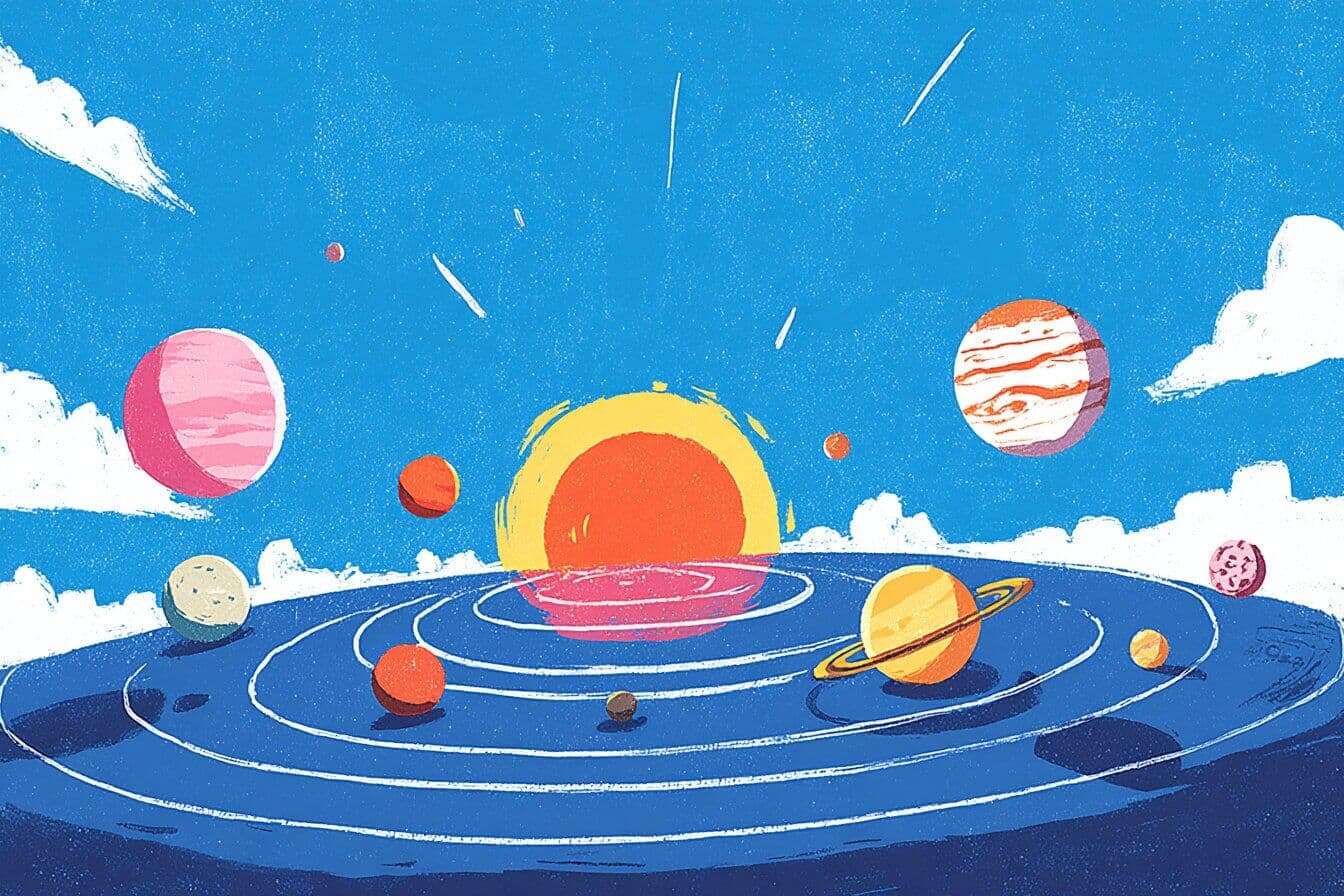
There is something about the dark beyond the window that makes kids want to know what is out there, spinning quietly while they fall asleep. In this story, Sol the Sun hums a tune that wakes the planets one by one for a gentle cosmic waltz, with Voyager drifting through to deliver a golden record of Earth songs. It is the kind of solar system bedtime story that turns big, dizzying distances into something warm and close enough to hold. If your child has a favorite planet or wants the adventure told a little differently, you can shape your own version with Sleepytale.
Why Solar System Stories Work So Well at Bedtime
The solar system is really just a family that stays together by invisible threads. That idea, belonging without needing to touch, mirrors exactly what a child feels drifting off in a dark room while a parent sits nearby. Planets keep their orbits without rushing. Moons tag along without being asked. There is a deep comfort in picturing something so enormous moving so gently, and kids absorb that calm even before they can name it.
A bedtime story about the solar system also gives young minds a place to put their curiosity without revving it up. Instead of new questions piling on top of each other, the rhythm of planet after planet creates a soothing kind of counting. Each world is different enough to stay interesting, predictable enough to feel safe. That balance is hard to find in other settings, and it is why space stories keep showing up at bedtime, generation after generation.
The Solar System Dance 5 min 22 sec
5 min 22 sec
In the quiet velvet of space, where stars blinked like candles left on a windowsill, a voice began to sing.
It was Sol, the Sun. Golden and enormous and warm in a way that reached across millions of miles without trying.
Sol hummed, and the hum traveled through the dark the way a parent's voice carries down a hallway at night. One by one the planets stirred, stretched, and began to twirl.
Mercury woke first. The smallest, the fastest, darting around Sol like a silver fish that cannot sit still in a pond.
Venus, bright and shy, spun in slow circles with her clouds shimmering like old silk.
Earth stepped in next, blue and green and a little proud of it, holding Moon by the hand. Moon did not mind being held. Moon liked it.
Mars leaped in wide arcs, rusty boots kicking up nothing at all, because there was nothing to kick.
Jupiter waltzed with four moons as partners, grand and striped, taking up more room than anyone else and somehow not bumping a thing.
Saturn wore wide rings of ice and dust, spinning like a dancer who found a sparkling skirt in the costume box and refuses to take it off.
Uranus rolled sideways. Just sideways, for reasons Uranus never explained, giggling the whole time.
And Neptune, deep blue and dreamy, glided in last, unhurried, finishing the great circle.
Together they moved in a silent ballet. No music you could hear, but if you watched long enough you would swear you could feel it.
Invisible ribbons of gravity held every step in place.
Sol smiled, which is to say Sol sent light and warmth streaming to each dancer, never letting go, never pulling too hard.
On Earth, children pressed their eyes to telescopes and saw the planets moving. They learned the names the way you learn the names of kids at a new school, one at a time, until they feel like friends.
Every night the dance continued. Steady. Kind.
The planets never bumped, because Sol guided their steps with gentle pulls, the way you steer someone's elbow in a crowded room.
Asteroids watched from the sidelines, clapping with tiny rocky hands that made no sound.
Comets swooped in wearing bright scarves that trailed behind them for millions of miles, joining for a moment, then racing away like guests who only came for the cake.
The dance told time. Seasons turned. Years passed. Birthdays came back around.
Little comet tails scribbled stories across the sky, and shooting stars carried wishes, though nobody could prove it.
The family of planets knew their places and their paces.
Sol sang lullabies in light waves, and the whole system glowed like a living necklace draped across the dark.
One evening, a small spacecraft named Voyager drifted through.
It did not ask permission. It just waved.
The planets waved back. They liked being noticed.
Voyager carried a golden record with Earth songs on it, recordings of wind and whales and a child laughing. The planets listened and swayed, even the ones too far away to hear it properly. They swayed anyway.
They learned that music lives everywhere, even where there is no air to carry it.
Sol beamed brighter. Proud of Earth's little gift, that small golden circle spinning through the dark like a coin tossed into a wishing well.
Children on Earth learned that distance is measured in light minutes, that Saturn's rings are made of ice, that Jupiter has a red storm bigger than their whole planet.
They learned that Venus is hotter than cookies pulled straight from the oven, and that Mars has a volcano so tall it would poke through the atmosphere if it could.
Each fact felt like a secret whispered by a planet friend who leaned in close.
Teachers turned the dance into a rhyme: My Very Eager Mother Just Served Us Noodles. Students giggled and suddenly they could name all eight, just like that.
Artists painted planets with gentle faces. Poets wrote about the waltz.
Scientists built models that spun on desks, tiny replicas of the grand ballet, and sometimes the models wobbled off and rolled under the couch, which was fine. The real dance never wobbled.
Parents tucked kids in under glow in the dark stickers shaped like Saturn, promising that the dance would guard their dreams.
Astronauts trained in pools, pretending to float like moons. Engineers designed rovers to visit Mars, hoping to join the dance someday.
The planets felt the love and spun a little faster, rings tilting with something that looked like joy if you squinted.
Sol watched over all of it, keeping time with solar flares that flickered like a conductor's baton.
Space, once silent, now seemed full of song.
The dance reminded everyone that even in emptiness, family can be found. That differences in size and speed are what make the pattern beautiful. That staying in orbit means trusting the pull.
And every night, when children closed their eyes, they imagined the planets turning slowly, holding the kind of hands that planets hold, which is gravity, which is invisible, which is enough.
Far away, the dance went on. Eternal and bright. Waiting for young dreamers to look up, smile, and maybe one day build ships and add new steps of their own.
Until then, the planets spin, the moons skip, and Sol sings, wrapping everything in a lullaby made of light.
The Quiet Lessons in This Solar System Bedtime Story
This story is built around belonging, patience, and the idea that differences make a group stronger rather than weaker. When Uranus rolls sideways without explaining why and nobody minds, kids absorb the message that you do not have to move like everyone else to be part of the family. Voyager drifting through with its golden record shows that sharing something small, a song, a laugh, can reach further than you expect. These are reassuring ideas to carry into sleep, the feeling that the universe has room for every kind of orbit and that gentle, invisible connections hold everything together even in the dark.
Tips for Reading This Story
Give Sol a low, warm, unhurried voice, almost a hum, and let Mercury's entrance feel quick and darting by speeding up just those few words before slowing back down. When Uranus rolls sideways and giggles, tip your head to the side and pause so your child can laugh. At the moment Voyager arrives carrying the golden record, drop your voice a little quieter, as if something rare just floated into the room, and let your child guess what sounds might be on that record before you keep reading.
Frequently Asked Questions
What age is this story best for?
It works well for ages 3 to 8. Younger listeners enjoy the rhythm of planet after planet appearing, almost like a counting game, and the simple physical images of spinning and dancing. Older kids pick up on the real details woven in, like Saturn's ice rings and Jupiter's red storm, and start connecting them to what they learn at school.
Is this story available as audio?
Yes. Press play at the top of the story to hear it read aloud. The slow procession of planets, each with its own personality, gives the narration a natural rhythm that builds and then gently settles. Sol's lullaby and the moment Voyager drifts through with the golden record sound especially lovely in audio, almost like a guided meditation that happens to teach astronomy.
Do kids need to know the planets already to enjoy this story?
Not at all. The story introduces each planet one at a time with a simple detail, Mercury is fast, Venus is shy, Saturn wears rings, so children meet them as characters first. The mnemonic line about "My Very Eager Mother" gives them a memory trick by the end, and many kids start reciting the order after just a few readings.
Create Your Own Version
Sleepytale lets you reshape this cosmic waltz to fit your child's imagination. Swap Voyager for a little rocket your kid names, replace the golden record with a playlist of their favorite songs, or let a favorite planet take the lead instead of Sol. In a few moments you will have a cozy, personalized space story ready to replay whenever the stars come out.
Looking for more educational bedtime stories?
Folklore Examples
Discover short folklore examples through a library night where Anansi the spider, a loyal crane, and a clever hare teach timeless lessons.
Children's Fable
A fast fox loses to a steady turtle in this short children's fable about patience, ripe pears, and the quiet power of one step at a time.
Science Stories For Kids
Leo and his mom explore twinkling stars with a flashlight and a jar of water in one of our coziest short science stories for kids.
Small Stories With Moral
A girl gives her red umbrella to a classmate in the rain, one of the best short small stories with moral for bedtime.
Short Christian Stories With Moral Lessons
Discover short christian stories with moral lessons like Pastor Eli's unplanned outdoor sermon that teaches kids faith grows in unexpected places.
Quick Stories With Moral Lesson
Marcus copies a science test but discovers short quick stories with moral lesson show that honest effort feels better than a perfect stolen score.