
Galaxy Bedtime Stories
By

Dennis Wang, Bedtime Story Expert
10 min 25 sec
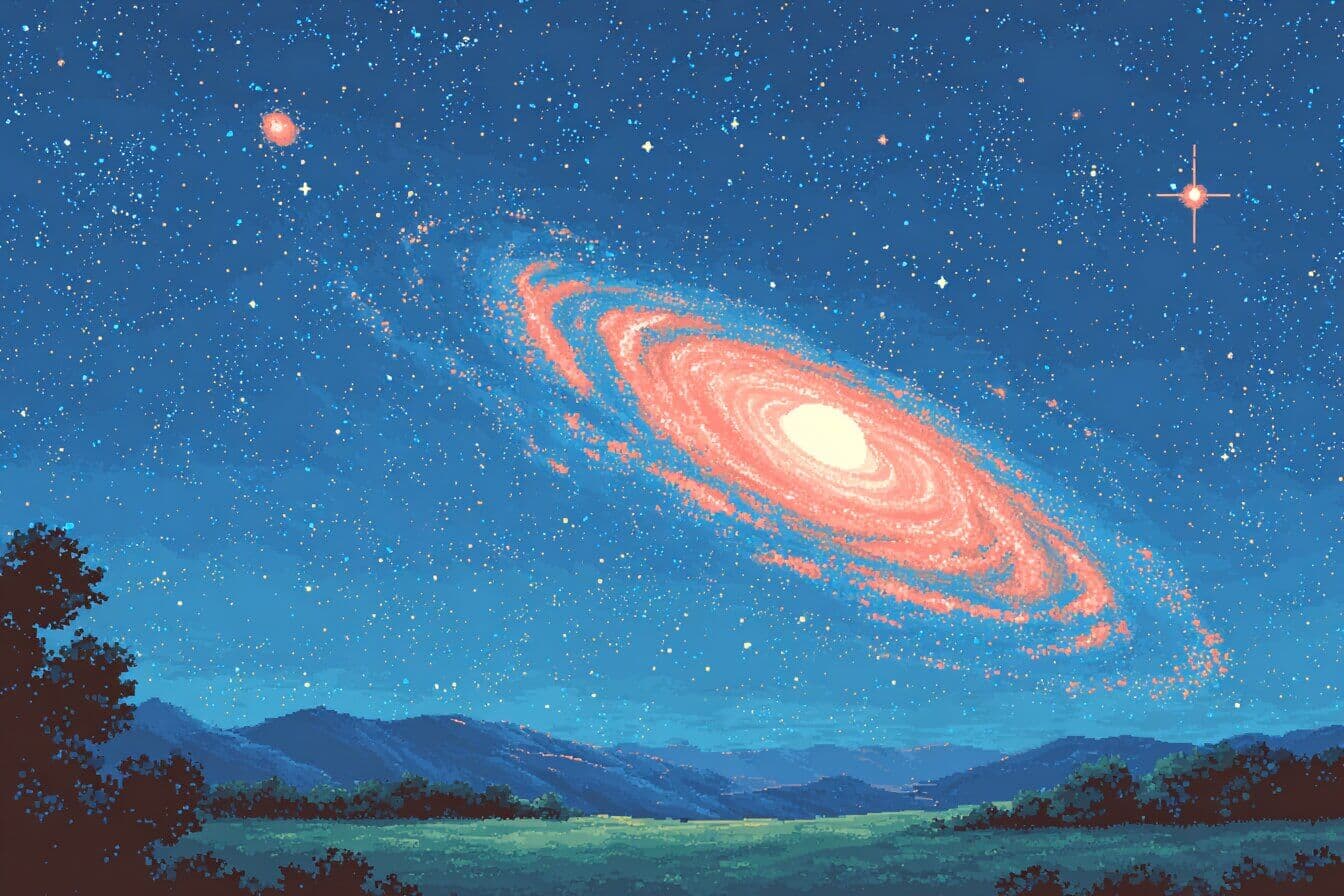
There is something about the night sky that makes even the most restless kid go still for a moment, mouth slightly open, just looking up. In this story, a firefly-sized star sprite named Stella notices that the galaxies are spinning too fast and sets off to learn why, collecting gentle answers from an octopus astronomer and a glowing teacher called Gravity along the way. It is the kind of galaxy bedtime stories adventure that trades loud excitement for slow wonder, which is exactly what a winding-down brain needs. If you would like to build a version with your child's name in the stars or swap the comet for a friendly satellite, you can create one with Sleepytale.
Why Galaxy Stories Work So Well at Bedtime
Space has a natural slowness to it. Light takes years to cross from one star to the next, and galaxies turn so gradually that nothing seems to happen at all. For kids, a bedtime story about galaxies trades the fast, bright energy of daytime play for something enormous and unhurried. That shift in scale helps a child's breathing settle, because the mind has to stretch and quiet down to imagine something so vast.
There is also a built-in comfort in the idea that everything up there follows a pattern. Stars orbit, spirals hold their shape, and even collisions between galaxies happen so slowly they look like a dance. When a child hears that the universe has a rhythm it keeps, night after night, it gives them a quiet certainty. The sky is still there, doing its thing, and that is a reassuring last thought before sleep.
Stella and the Glittering Galaxies 10 min 25 sec
10 min 25 sec
Stella was a star sprite no bigger than a firefly, and she lived somewhere inside the Milky Way.
Every night she fluttered from constellation to constellation, polishing each star with a cloth she had stitched from leftover aurora thread. She liked the work. It was quiet, and the stars made a faint hum when they were clean, like a glass rim rubbed with a wet finger.
One evening she paused mid-polish and tilted her head.
The galaxies were spinning faster than usual. Not dangerously fast, but noticeably, the way a ceiling fan looks when someone bumps it up a notch. A few stars wobbled on their axes, blinking like they had something in their eyes.
Stella zipped to the nearest spiral arm where her friend Orion the octopus astronomer floated among a tangle of brass telescopes.
He had eight of them, naturally, one for each arm, and he never used fewer than five at a time.
"Orion, the galaxies are spinning like glitter dropped in water," Stella said.
Her voice had a worried little flicker to it.
Orion adjusted his spectacles, which were always sliding down because octopuses do not have noses.
He peered through his biggest lens and was quiet for a long moment.
"Indeed," he said finally. "The universe is giving us a lesson about motion and gravity tonight."
Stella perked up. She loved lessons almost as much as she loved polishing.
"Each galaxy holds billions of stars," Orion went on, gesturing with three tentacles at once. "Think of grains of sand on a beach, except each grain is on fire and a million miles wide."
He paused. "That analogy got away from me a bit."
Stella laughed, then asked if she could go see the spinning for herself.
Orion waved her off with a tentacle that also happened to be adjusting a telescope, jotting a note, and holding a cup of nebula tea. "Be careful out there."
She soared toward Andromeda.
Along the way she passed nurseries of gas where baby stars were forming, and the clouds glowed pink and gold from all that new heat. One infant sun hiccupped a small solar flare as she drifted by. Stella waved and promised to come back when it was older.
Farther out, she ran into Cosmo the comet.
He was doing wide loops, trailing ice and dust that shimmered behind him like a scarf someone forgot to tuck in.
"Where are you headed, Stella?"
"I want to understand why galaxies spin," she said. "Really understand it, not just know the word gravity and nod."
Cosmo grinned, which on a comet looks like a bright flare along the leading edge. "Then follow me to the Center of Rotation. The great teacher Gravity lives there."
They traveled past spiral arms and star clusters, and Stella tucked every new fact she heard into a tiny pouch she had sewn from moonlight. The stitching was uneven, she had made it in a hurry one evening, but it held.
She learned that galaxies spin because of the way matter first scattered after the big bang, carrying momentum outward like a skater pulling in her arms.
She discovered that dark matter holds everything together the way glue holds glitter on paper, invisible but doing most of the work.
Cosmo showed her how stars orbit the galactic center just as planets orbit the sun, only the distances are so huge that one trip around might take 230 million years.
"Imagine waiting that long for your birthday," Cosmo said.
When they reached the Center of Rotation, Stella found a gentle giant made of glowing equations. Numbers and symbols drifted across its surface like schools of fish.
Gravity spoke in a voice so deep and calm it vibrated in Stella's ribs.
"Welcome, little star sprite. You have questions, and I have had a long time to think about the answers."
Stella bowed and asked, "Why do galaxies look like glittering pinwheels?"
Gravity stretched out a hand and conjured a miniature galaxy in the air between them. It was barely the size of a soap bubble, but inside it, billions of tiny lights traced their paths.
"Watch," Gravity said. "Stars, gas, and dust pull on each other. Every piece tugging every other piece. That shared pull shapes the spiral arms."
Stella watched the tiny galaxy spin. Stars closer to the center whipped around quickly. Stars farther out took their time, drifting as if they had nowhere particular to be.
Gravity explained that this difference in speed is what keeps the arms looking like spirals instead of collapsing into a blob.
Stella clapped her hands, and sparks of starlight flew off her palms, making a nearby nebula blush purple.
"May I take this back and share it with the young sky watchers?" she asked.
Gravity nodded and handed her a small glowing book. The title on the cover read "The Dance of the Galaxies," and the pages turned themselves if you breathed on them.
Stella tucked it beside her moonlight pouch and thanked the teacher.
Cosmo escorted her partway home, then veered off toward the outer planets. "I promised Neptune I would swing by," he called over his shoulder, his tail flickering.
Stella flew alone for a while, and the quiet was enormous.
On her way back she found a lost planetoid named Pebble drifting in no orbit at all, just tumbling end over end like a sock in a dryer.
She used what she had learned about gravity to nudge Pebble into a safe, elliptical path around a small steady star.
Pebble squeaked, actually squeaked, a sound that should be impossible in a vacuum but happened anyway. "I am going to name my best crater after you!" Pebble called.
Stella laughed, and the sound was like tiny bells, thin and bright and gone almost before you heard it.
Near home she spotted Orion still floating among his telescopes, charting something with four tentacles while the other four held reference books open.
She landed on his shoulder and opened the glowing book.
Together they read about how galaxies collide and merge, not in explosions but in slow embraces that take millions of years, eventually creating new stars and shapes no one has named yet.
Orion set down his pen. "You have become a teacher yourself," he said, and patted her head with one tentacle, gently enough not to muss her aurora dress.
Stella blushed a soft gold.
Word got around. Comets, asteroids, moons, and even a few shy dwarf planets gathered near Orion's telescope cluster.
Stella stood on the eyepiece of the largest scope and spoke in her clear, small voice.
She told them how galaxies swirl because of gravity's patient pull.
She told them the Milky Way and Andromeda would meet someday and form something new and bigger, but not for billions of years, so nobody needed to pack a bag.
The young moons gasped. "Will we be safe?"
"It will be the slowest, most beautiful dance you have ever seen," Stella said. "And you will have front-row seats."
She held the book open so they could see illustrations of galaxies in every shape: smooth ovals, sprawling spirals, and a few that looked like someone had crumpled paper after a collision and then smoothed it back out, not quite the same.
When she finished, Stella asked everyone to become galaxy guardians who would look after the night sky.
The comets promised to streak only when it mattered. The asteroids agreed to keep to their belts. The moons vowed to reflect sunlight gently enough that faraway watchers could still see the stars behind them.
Orion wiped a tear from one eye and pressed a small silver badge, shaped like a spiral galaxy, into Stella's hand.
"Official Ambassador of Cosmic Knowledge," he said, and his voice wobbled just a little.
Stella pinned it to her aurora dress.
That night she flew down to Earth, where children were looking up through bedroom windows, some with their foreheads pressed against cool glass.
She sprinkled stardust on their eyelids, just a pinch each, so they could dream of spiral arms and glowing nebulae and friendly comets who loop around you when they are happy.
In their dreams the children rode through the sky, asked their own questions, and felt the answers settle in softly, the way snow lands on a mitten.
They woke knowing that the universe is enormous and still growing, still figuring itself out, just like them.
Stella returned to her spot near the Pleiades.
She opened the book again and read about dark energy, which makes galaxies drift apart the way dandelion seeds scatter on a slow breath.
She read until the pages stopped turning on their own, which meant it was time to rest.
She closed the book, pressed it against her chest, and hummed something quiet with no real words.
The galaxies kept swirling. The stars kept shining. And somewhere below, a child looked up, smiled, and whispered, "Thank you, Stella."
The Quiet Lessons in This Galaxy Bedtime Story
Stella's journey is really about what happens when curiosity replaces worry. She starts the night anxious about the spinning sky, but instead of fretting, she goes looking for answers, and the simple act of seeking turns fear into fascination. When she stops to help Pebble find an orbit, children absorb the idea that knowledge is most useful when you share it with someone who needs it right now. And the moment she tells the young moons that a galactic collision will be a slow, beautiful dance, she is modeling how to reframe something scary into something wondrous. These are reassuring thoughts to carry into sleep: that questions have answers, that helping feels good, and that even enormous changes can happen gently.
Tips for Reading This Story
Give Orion a low, slightly rumbly voice and let him trail off when his analogy about sand gets away from him, so your child can laugh at the pause. When Gravity speaks, slow way down and drop your voice as deep as it will go, because the story says Stella feels the vibration in her ribs, and your child should feel that shift too. At the part where Pebble squeaks after finding its orbit, let your kid make the squeak sound, it is the perfect spot for a little participation before things settle back into the quiet flight home.
Frequently Asked Questions
What age is this story best for?
Children around ages 4 to 8 tend to enjoy it most. Younger listeners love Stella's sparkly stardust and the squeaking planetoid Pebble, while older kids get drawn into Gravity's explanation of why spiral arms keep their shape. The language is simple enough for a preschooler to follow but has enough real science woven in to hold a second grader's attention.
Is this story available as audio?
Yes. You can press play at the top of the story to listen. The audio version brings Gravity's deep, calm voice to life in a way that is hard to match on the page, and the rhythm of Stella's flight from the Milky Way to Andromeda and back has a natural rise and fall that works beautifully as a listen-along at bedtime.
Will my child actually learn real science from this story?
Quite a bit, actually. The story accurately describes how gravity and momentum create spiral arms, how dark matter acts as an invisible glue, and how the Milky Way and Andromeda are expected to merge billions of years from now. Stella's conversation with Gravity simplifies these ideas without inventing anything false, so your child picks up genuine concepts wrapped in a cozy adventure.
Create Your Own Version
Sleepytale lets you build a personalized story set among the stars, shaped around your child's favorite details. You could swap Stella for a little moon fox, replace Orion's telescopes with a library floating in zero gravity, or set the whole adventure in a galaxy your kid invents and names. In a few moments you will have a calm, one of a kind bedtime tale ready to read aloud or press play whenever the night sky calls.
Looking for more educational bedtime stories?
Folklore Examples
Discover short folklore examples through a library night where Anansi the spider, a loyal crane, and a clever hare teach timeless lessons.
Children's Fable
A fast fox loses to a steady turtle in this short children's fable about patience, ripe pears, and the quiet power of one step at a time.
Science Stories For Kids
Leo and his mom explore twinkling stars with a flashlight and a jar of water in one of our coziest short science stories for kids.
Small Stories With Moral
A girl gives her red umbrella to a classmate in the rain, one of the best short small stories with moral for bedtime.
Short Christian Stories With Moral Lessons
Discover short christian stories with moral lessons like Pastor Eli's unplanned outdoor sermon that teaches kids faith grows in unexpected places.
Quick Stories With Moral Lesson
Marcus copies a science test but discovers short quick stories with moral lesson show that honest effort feels better than a perfect stolen score.