
Robinson Crusoe Bedtime Story
By

Dennis Wang, Bedtime Story Expert
9 min 2 sec
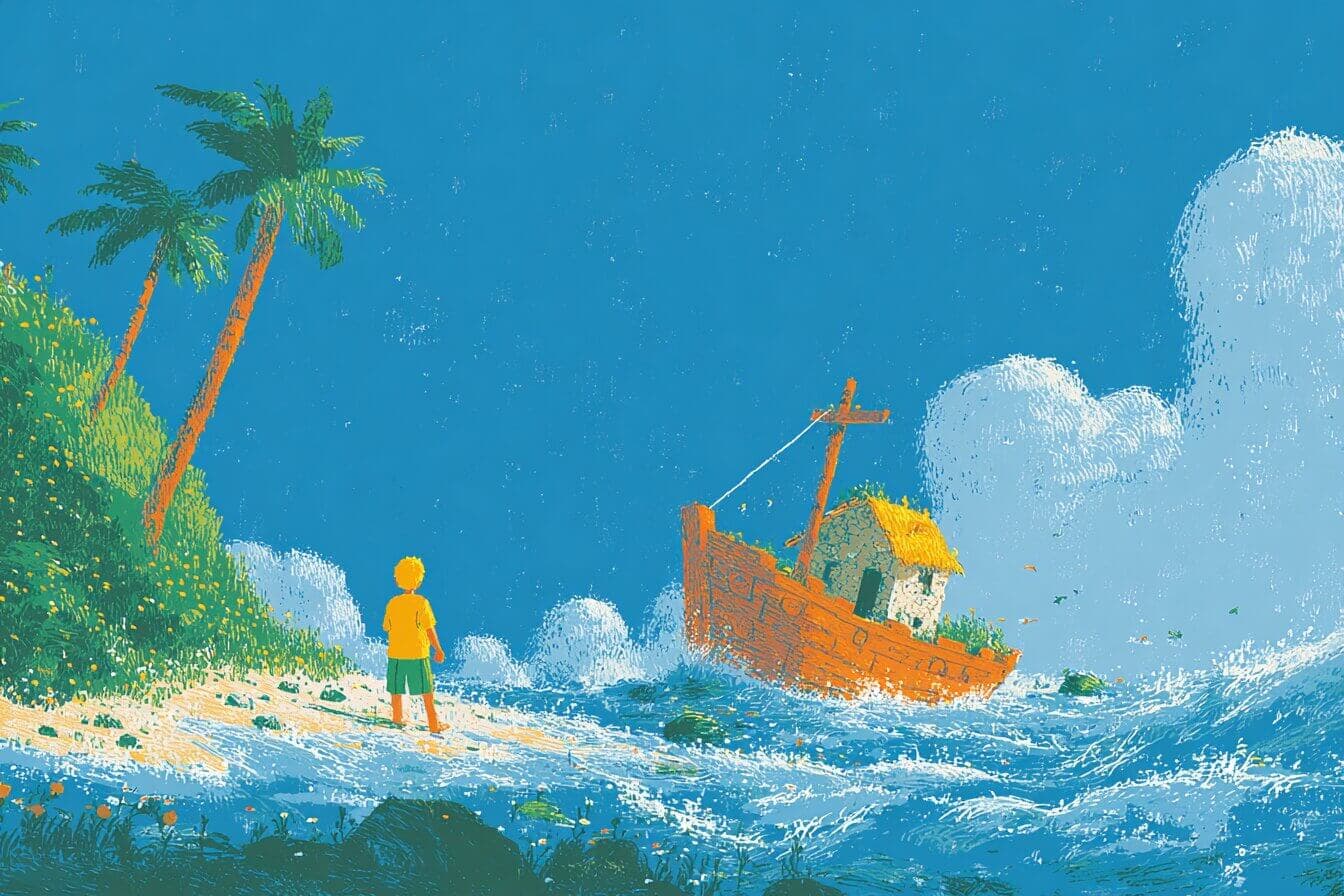
There is something about an island at night, the slow hush of waves folding onto sand, the rustle of palm fronds overhead, that makes even restless kids grow still. This retelling follows a young sailor named Milo Bright who washes ashore after a shipwreck and slowly turns a strange, empty beach into a home, helped along by a talkative parrot called Pickle and an unexpected friend. It is the kind of Robinson Crusoe bedtime story that trades the scarier parts for warm firesides, gentle problem solving, and a rescue that arrives right when eyes start to close. If your child loves castaways and hidden islands, you can craft your own version inside Sleepytale with any characters and details you like.
Why Robinson Crusoe Stories Work So Well at Bedtime
Castaway tales tap into something children already do every night: settle into a small, safe space and let the outside world fade away. When a character builds a shelter, gathers food, and names a friendly animal, the rhythm mirrors the cozy rituals of bedtime itself. Brushing teeth, tucking in, choosing a stuffed companion. A bedtime story about Robinson Crusoe gives kids permission to imagine being entirely self-sufficient, which is a deeply comforting thought right before sleep.
Islands also offer a natural boundary. There is ocean on every side, which means the world of the story stays contained and manageable. No crowded cities, no overwhelming choices, just one beach, one fire, one friend. That simplicity helps busy minds slow down. And the steady progression from shipwreck to safety mirrors the arc of a child's own evening: a little chaos, then calm, then rest.
The Castaway and the Curious Companion 9 min 2 sec
9 min 2 sec
The storm hit without warning.
One moment the trading vessel rocked in an ordinary swell, and the next the whole sky collapsed into noise, water slamming the deck like it had a personal grudge against wood.
Sailor Milo Bright wrapped both arms around the mast, pressed his forehead to the wet grain, and held on while his boots slid on the planks beneath him.
The final wave did not crash so much as lean, slow and enormous, until the ship simply rolled onto its side and slid Milo into the sea.
Salt water filled his mouth.
He kicked, coughed, kicked again, and then something heavy and dark folded over his thinking, and he was gone.
Sunrise found him facedown on sand so white it looked like sugar.
He sat up, spat grit, and stared at the wreckage strewn along a crescent beach: barrel staves, a torn sail draped over coral like a tablecloth, half a crate of biscuits already going soft in the humidity.
Palm trees lined the shore behind him, their fronds clicking together in a breeze that smelled of coconut and something faintly like cinnamon, though he never did figure out where that came from.
"I'm alive," he said to nobody.
A bright green parrot landed on a chunk of driftwood three feet away, tilted its head, and repeated, "Alive, alive!" in a voice that sounded startlingly cheerful for the occasion.
Milo named the parrot Pickle, mostly because of the way it squinted, as though every situation was some mild inconvenience it was choosing to tolerate.
For those first few days, everything was a problem to solve, and solving problems turned out to be a surprisingly good distraction from being scared. Milo cracked coconuts by dropping them from shoulder height onto a flat rock. He dragged driftwood into a lean-to, lashing the joints with strips of torn sailcloth. He sang sailor shanties while he worked, the ones with too many verses and nonsense choruses, and Pickle perched on the lean-to's ridge beam and sang along in a garbled squawk that never quite matched the tune.
When the coconuts ran low, Milo pushed past the tree line into shade so thick it felt like dusk.
He found berry bushes first, clusters of dark fruit that stained his fingertips purple.
Then a spring, no wider than his forearm, trickling over mossy stones into a pool that tasted so clean and sweet it made him close his eyes and just stand there for a moment, water dripping off his chin.
He fashioned a spear from a bamboo pole, sharpening the tip with a flat stone, and spent a whole afternoon crouched by a tidal pool learning how fish moved. They were silver and quick and completely uninterested in being caught. The trick, he discovered, was patience, real patience, the kind where you stop thinking about what you want and just watch. His first catch was small, barely the length of his hand, but he held it up like a trophy and Pickle bobbed his head in approval.
He roasted the fish over a fire he coaxed to life with two dry sticks and a blister on his thumb he would carry for a week.
The smell of it cooking, smoky and rich, floated through the trees.
Pickle ignored the fish entirely and gorged on berries until his feathers seemed to glow in the firelight, green as something newly grown.
Weeks became months. Milo lost track of the exact count, so he scratched tally marks into a coconut shell each time the moon went full. He built a tree house with walls of woven palm fronds and a roof thatched so tight that monsoon rain hammered outside while he stayed perfectly dry, listening. The rain on that roof sounded like hundreds of tiny drums, and sometimes he would lie on his back and just let the rhythm fill his head until he drifted off.
He carved toy boats from driftwood during long afternoons. Some of them were terrible, lopsided things that capsized the moment he set them in a tide pool. One, though, floated beautifully, and he watched it bob in the shallows until the tide took it out, spinning slowly past the reef, heading somewhere he couldn't follow.
He made up stories for Pickle about distant harbors where ships danced in the moonlight and sailors shared mangoes on the docks. Pickle listened with one eye closed, which Milo chose to interpret as deep concentration.
One morning the air smelled different, sharper, and Milo noticed black smoke curling above the western treetops.
He followed it carefully, parting branches with both hands, until he came to a small clearing where a boy knelt over a pile of damp twigs, blowing on them with the kind of desperation that meant he had been trying for a long time.
The boy looked up, and for a second neither of them moved.
He was skinny, sunburned, his shirt torn at both elbows. His eyes were wide and the whites showed all around.
Milo crouched down slowly. He pulled a ripe mango from the sling he carried and set it on the ground between them, the way you might offer something to a nervous cat.
"I'm Milo," he said. "That fire's never going to catch with those twigs. They're soaked through."
The boy stared at the mango, then at Milo, then at Pickle, who had landed on a nearby branch and was preening with total indifference.
His name was Friday. He had been a stowaway on a merchant ship that broke apart on the reef months earlier, and he had been eating roots and raw shellfish ever since, alone, not sure anyone else existed on the island or anywhere else.
Milo brought him back to the tree house.
He showed him the fire pit, the spring, the berry bushes. He gave him a dry shirt from the salvage pile and a carved cup to drink from. Friday held the cup with both hands and drank the spring water in small sips, as though he wanted to remember what it tasted like.
Together they made a plan.
They hauled driftwood to the highest cliff and stacked it into a beacon taller than both of them. They drew enormous letters in the sand below, S-O-S, packing the grooves with dark seaweed so the shapes would show from above. Every evening they checked the fire pit on the cliff, keeping dry kindling ready, and Pickle watched from the edge like a small green foreman overseeing the operation.
Nights were the best part. They sat by the low campfire in the clearing, and Friday, who turned out to be an excellent mimic, did impressions of seabirds that made Milo laugh until his ribs hurt. Milo taught him the shanties, and Friday added harmonies that Milo was pretty sure were invented on the spot but somehow worked.
One night the sky was so clear that the stars looked close enough to touch.
Friday was already half asleep against a palm trunk when Milo noticed a light on the water, not a star, not the moon's reflection. A spotlight, white and steady, sweeping across the waves.
"Friday." He shook the boy's shoulder. "Friday, look."
They ran to the cliff. Milo struck flint to the kindling and the beacon caught with a sound like a deep breath. Flames climbed the driftwood tower, orange and gold, sending sparks spiraling into the dark.
They waved branches wrapped in burning cloth, two small figures on the edge of a cliff, and far out on the water, the freighter's spotlight paused, swung back, and held.
A rescue boat dropped from the freighter's side and motored toward the island, its lamp bouncing across the swells.
Milo helped Friday down the rocks first. When the boat crunched onto the sand, he lifted Friday in, then climbed aboard himself, and Pickle landed on the gunwale with a decisive flap, as if this had been the plan all along.
The freighter was enormous up close, humming with engine noise and warm light spilling from every porthole.
Milo stood on the deck in bare feet, feeling the vibration of the hull beneath his toes, tasting salt spray, and for a long moment he said nothing at all.
He looked back. The island was already smaller, the beacon fire a fading orange dot against the dark ridge.
He did not think about what the island had taught him, because he did not need to. It was in his hands, calloused from building. In his voice, steady from all those nights singing to a parrot who never quite learned the words. In the way he had knelt down and offered a mango to a frightened boy, because it was the simplest, most obvious thing in the world to do.
The freighter turned toward the sunrise, and the horizon opened, wide and bright and unhurried.
Somewhere ahead there would be another harbor, another story.
But that was for tomorrow.
Pickle tucked his head under one wing.
Friday's eyes closed.
And the ship sailed on.
The Quiet Lessons in This Robinson Crusoe Bedtime Story
This story weaves together patience, resourcefulness, and generosity without ever stopping to announce them. When Milo crouches by the tidal pool and learns to wait instead of grab, children absorb the idea that slowing down is its own kind of strength. His decision to kneel and offer Friday a mango, no questions asked, shows that kindness does not need a reason or a speech, just an open hand. And Friday's willingness to trust a stranger after months alone gently models what it looks like to let someone help you, something many children wrestle with even in daylight. These small, specific moments land well at bedtime because they leave a child feeling that tomorrow's problems are manageable and that reaching out, whether to give help or accept it, is always a safe choice.
Tips for Reading This Story
Give Milo a calm, matter-of-fact voice, someone who talks to himself the way a kid might narrate a backyard expedition, and let Pickle's "Alive, alive!" come out in a bright, squawky burst that makes your child grin. When Friday appears, slow your pace way down; read the moment where he holds the cup with both hands in near silence, pausing just long enough for your child to picture it. During the final beacon scene, you can gradually raise your voice with the climbing flames, then drop to almost a whisper for the last three lines as Pickle tucks his head and Friday's eyes close.
Frequently Asked Questions
What age is this story best for?
Children around ages 4 to 8 tend to enjoy it most. Younger listeners connect with Pickle's parrot antics and the simple routines of cracking coconuts and building a shelter, while older kids appreciate the friendship between Milo and Friday and the suspense of waiting for a ship. The storm at the beginning passes quickly and resolves into safety, so it rarely feels too intense for preschoolers.
Is this story available as audio?
Yes! You can press play at the top of the story to hear it read aloud. The audio version is especially fun because scenes like Pickle echoing "Alive, alive!" and Friday's seabird impressions come to life with vocal performance. The story's steady rhythm, from quiet island mornings to the crackling beacon fire, also makes it a great one to listen to with the lights already dimmed.
Why does this version feel different from the original Robinson Crusoe?
This retelling is designed for bedtime, so it softens the scarier elements of Defoe's novel and focuses on the cozy, problem-solving side of island life. Milo is a child-friendly character who builds tree houses and names parrots rather than facing the darker conflicts of the original. Friday is reimagined as a fellow kid and equal companion, and the rescue arrives the same night the signal fire is lit, keeping the emotional arc short and reassuring.
Create Your Own Version
Sleepytale lets you reshape this castaway adventure into something perfectly fitted to your child's imagination. Swap Pickle for a sea turtle or a shy fox, move the island to a misty lake or a quiet forest clearing, or dial the tone from adventurous down to extra cozy so the whole story feels like a lullaby. In a few taps you will have a personalized island tale ready to play or read aloud whenever bedtime needs a little salt air and starlight.
Looking for more bedtime story classics?

Once Upon A Time Stories
What happens when June opens a golden book with no title? One of the sweetest short once upon a time stories about a forest, a hedgehog, and a blank page.

Fairy Tales Written By Hans Christian Andersen
Anders discovers short fairy tales written by Hans Christian Andersen as his grandmother reads from a soft brown book by lamplight.

Bluebeard Fairy Tale
In this short bluebeard fairy tale, the forbidden room holds not horror but a music box and memories of the people Lord Corvus loved most.

Red Shoes Fairy Tale
What happens when Karen's magical red shoes refuse to stop dancing? Discover this short red shoes fairy tale tonight.

Twinkle Twinkle Little Star Bedtime Story
Lily watches a kind star and floats up to help deliver dreams in this short twinkle twinkle little star bedtime story. A warm, quiet tale for sleepy nights.
Through The Looking Glass Bedtime Story
Step into a calm, magical short through the looking glass bedtime story and drift toward sleep with gentle wonder. Enjoy a soothing retelling that feels cozy from start to finish.