
Robin Hood Bedtime Story
By

Dennis Wang, Bedtime Story Expert
9 min 32 sec
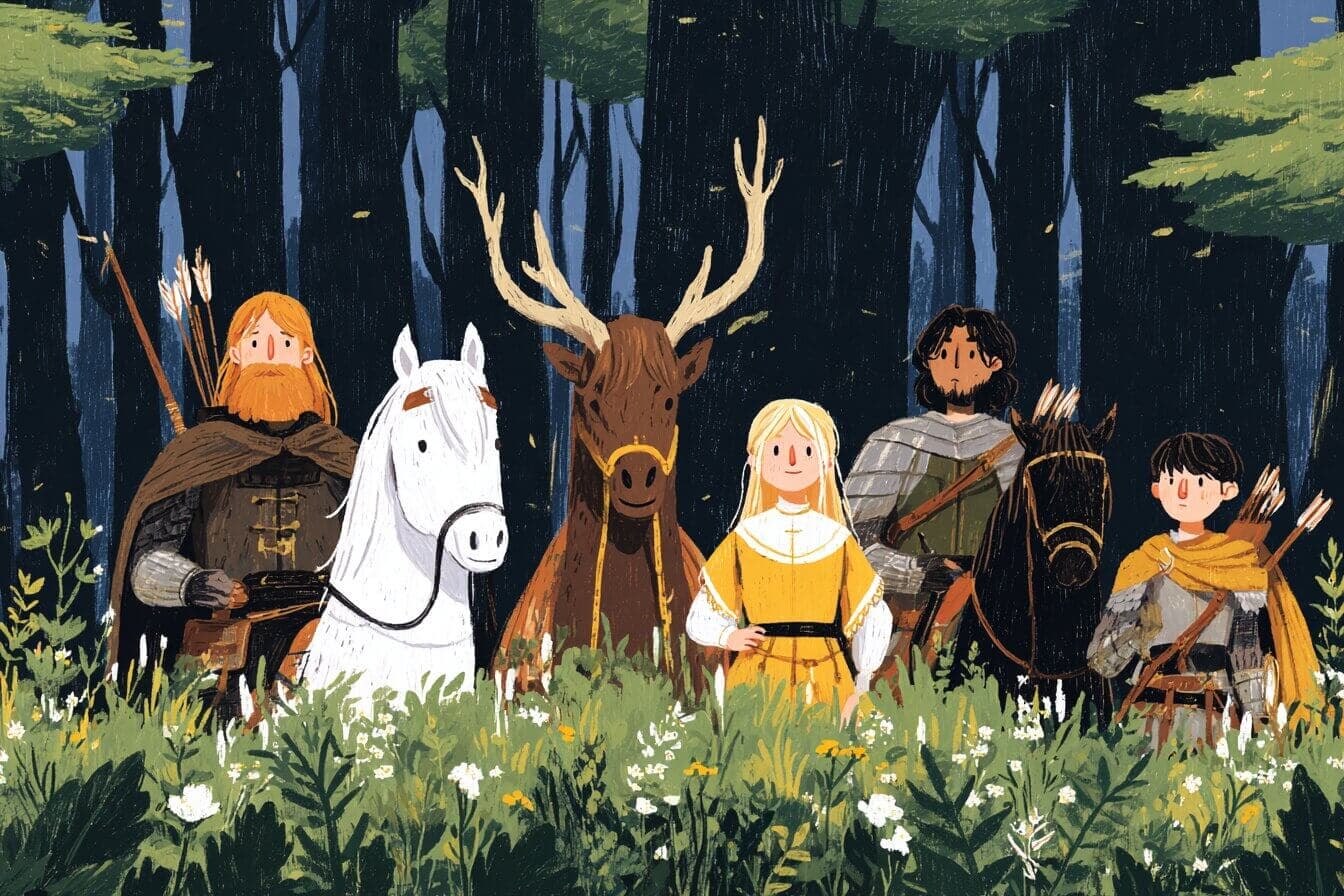
There's something about a forest at night that makes children lean in closer, as if the trees might whisper a secret just for them. In this Robin Hood bedtime story, a kind outlaw named Robin rallies his friends to outsmart a greedy sheriff and return what was stolen to the families who need it most, all without a single sword drawn in anger. It's the kind of tale where pinecone juggling counts as heroism, and sparrows carry gold through the sky. If you'd like to shape your own version with different characters or a softer pace, you can create one with Sleepytale.
Why Robin Hood Stories Work So Well at Bedtime
Robin Hood lives in a forest, and forests at night feel like the inside of a blanket. The rustling leaves, the campfire glow, the quiet paths between tall oaks; these details slow a child's breathing without them even noticing. A bedtime story about Robin Hood also puts the scariest figure, the sheriff, at a safe distance behind castle walls while the heroes stay tucked among the trees. That natural separation between danger and safety is exactly what a restless mind needs before sleep.
There's also something deeply reassuring about the idea that someone out there is looking out for people who can't look out for themselves. Children process fairness constantly, on playgrounds, at dinner tables, in sibling negotiations. Robin Hood stories let them sit with those big feelings in a world where things do get set right, gently and with a bit of humor, before the lanterns go out and the stars come up.
The Merry Band of Sherwood 9 min 32 sec
9 min 32 sec
Robin, the kindest outlaw in all of England, whistled a tune that bounced off the oaks of Sherwood Forest and came back to him a half second late, like the trees were trying to learn it.
His green tunic blended with the leaves. His feathered cap sat at a crooked angle because he'd bumped a low branch ten minutes ago and hadn't bothered to fix it.
Behind him, his merry band of friends followed with quiet footsteps.
Little John, the tallest of them all, carried a staff taller than most men. He had to duck under branches that nobody else even noticed.
Will Scarlet wore a bright red sash and loved to sing, though he only remembered about half the words to any given song.
Friar Tuck's round belly shook when he laughed, which was often. Maid Marian, Robin's best friend, moved through the underbrush as gracefully as a deer, barely disturbing a leaf.
They were heading back to their secret camp after a morning of practicing archery.
Robin could hit the center of a target from the farthest tree, but he only ever used that skill to help people, never to frighten them.
The Sheriff of Nottingham had been making life hard for the villagers. He demanded coins they didn't have and took food right off their tables, bread still warm from the oven.
Robin and his friends knew they had to do something about it.
When they reached the clearing where tall pines formed a natural roof overhead, Robin gathered everyone around the campfire. The logs popped and sent a spark spiraling upward.
"Friends," he said, "the Sheriff plans to collect double taxes tomorrow. We cannot let those families suffer."
Little John leaned on his staff so hard it sank an inch into the dirt. "We could disguise ourselves as traveling musicians and sneak into the village."
Will Scarlet's eyes went wide. "And while the Sheriff counts his coins, we swap his heavy bags of gold with bags of shiny pebbles!"
Friar Tuck chuckled into his collar. "And leave behind a note that says, 'Kindness weighs more than gold.'"
"We will give the real gold to the families who need it most," Maid Marian added, already folding her arms like the matter was settled.
Robin grinned. "Then let us prepare."
The rest of the afternoon buzzed. Will Scarlet practiced juggling pinecones so he could pass as a jester, dropping them roughly every fourth try and muttering to himself each time. Little John carved a flute from a fallen branch, blowing a note so low it startled a rabbit out of a bush.
Friar Tuck baked honey cakes, the kind that stuck to your fingers and smelled like summer even in autumn. Maid Marian wove wildflowers into garlands, humming something without a melody.
Robin painted tiny green arrows on smooth stones. "These are our calling cards," he explained. "When people see them, they'll know hope is near."
As twilight turned the sky lavender, they packed instruments and treats into woven baskets. Robin looked at each friend, one by one.
"Remember. We do this for the people, not for ourselves."
They nodded.
The next morning, the village square bustled with merchants and children darting between stalls. Bread, apples, bolts of colorful cloth, all piled high.
The Sheriff's guards stood like statues made of frowns, collecting coins in iron boxes.
Robin's band arrived playing cheerful tunes, slightly out of key in a way that made them sound more real.
Children clapped and danced. A dog barked along.
The Sheriff watched from a balcony, eyes narrow.
Robin bowed low. "Noble Sheriff, may we entertain you?"
The Sheriff sneered. "Peasants and their noise."
Yet he came downstairs anyway, curious despite himself.
Little John launched into a story about a bear who loved honey so much he tried to marry a beehive. Will Scarlet jumbled his rhymes on purpose, and the crowd laughed harder each time he pretended to look confused. Friar Tuck handed out honey cakes. Maid Marian twirled so her flower garlands flew in bright arcs through the air.
While everyone watched, Robin slipped behind the tax table.
He lifted each heavy bag, one by one, replacing it with a bag of pebbles painted gold. On each bag he pressed a tiny green arrow. His hands were steady, though his heart was going fast.
When the show ended, the Sheriff clapped once, like a door closing.
"Enough. Pay your taxes."
Robin bowed again. "Of course, kind sir."
The band placed a few coins in the box, just enough to avoid suspicion.
Then Robin whistled a special note, three short tones rising.
Sparrows swooped down from the rooftops, carrying the bags of real gold in their beaks. They soared toward the forest in a line, like a string of brown beads pulled through the sky.
The Sheriff shouted, "Seize them!"
But the crowd, laughing and cheering, pressed together and formed a wall of bodies and elbows. Nobody moved aside.
Robin and his friends strolled away, waving.
Deep in Sherwood, they found the sparrows waiting on a low branch, looking very pleased with themselves.
The gold was divided into small pouches. Robin wrote notes in his careful handwriting: "For warm soup." "For new shoes." "For books."
They hung the pouches on branches at the forest edge, low enough for anyone walking by to reach.
That evening, families discovered the gifts.
Eyes widened. A woman pressed her hand over her mouth. Children ran to tell neighbors, shouting so loud you could hear them from the clearing.
Soon the village square glowed with lanterns and music. People danced and tore bread into pieces to share.
The Sheriff, back in his castle, found only painted pebbles in his treasury. He swept them off the table and they clattered across the stone floor, rolling into corners.
Weeks passed. Crops grew taller. Bellies grew fuller. Hope crept back into conversations, the way sunlight creeps across a floor in the morning.
Robin and his friends practiced new tricks and mended old cloaks.
One afternoon, a shy boy named Rowan wandered into Sherwood carrying a tiny wooden sword that was really just a stick someone had whittled flat on one side.
"I want to learn to help people too," he whispered.
Robin knelt so they were eye to eye. "Courage lives in every heart. Would you like to plant acorns with us?"
Rowan beamed.
Together they dug small holes, tucking acorns into the cool earth. Rowan patted the dirt down with both palms, very seriously.
"These will become mighty oaks," Little John said, resting on his shovel.
Maid Marian taught Rowan to weave a crown of clover. He put it on sideways and left it that way. Will Scarlet showed him how to balance a stack of flat stones, and when the stack fell, they both jumped back and laughed.
Friar Tuck let him stir a pot of berry stew, the spoon almost too big for his hands.
By sunset, Rowan's grin hadn't faded once. "May I come back tomorrow?" he asked.
Robin ruffled his hair. "Sherwood is open to all who bring goodwill."
The next day, Rowan returned with friends. They carried drawings of forests and crumpled notes of thanks with wobbly handwriting.
Robin pinned each picture to a line strung between two trees. The clearing became a gallery of bright, lopsided art.
Even the Sheriff, hearing whispers of joy he couldn't quite explain, rode to the forest edge.
He saw children laughing. Families picking berries. Robin teaching a song about sharing, waving his arms like a conductor who'd never conducted anything before.
For a moment, the Sheriff's frown softened. Just slightly. Just around the edges.
He turned his horse away without a word.
Seasons turned. Snow blanketed Sherwood, and Robin's band built a snow fort shaped like a lopsided castle. They filled it with warm blankets and invited travelers to rest and drink something hot.
Spring returned with blossoms, and the merry band welcomed new friends: a girl who loved to paint butterflies on anything that held still long enough, a boy who could mimic bird calls so well that actual birds answered him, and twins who juggled pinecones in perfect rhythm, never dropping one.
Robin watched them all from the edge of the clearing.
"Our family grows like the forest," he said quietly, mostly to himself.
One evening, as fireflies blinked among the branches, Robin gathered everyone around the fire. The flames had burned low, just embers and a warm orange glow.
"True wealth is not gold," he told the children. "It is this. Right here."
They sang songs until stars filled the sky, voices getting softer with each verse, the way songs do when people are happy and tired at the same time.
Far away, the Sheriff sat alone in his chamber. He picked up a painted pebble and turned it over in his fingers. A memory of laughter flickered through his mind.
He set the pebble on the windowsill, where moonlight caught the gold paint and made it glow.
Years later, travelers still found pouches of coins hanging from low branches at the edge of Sherwood.
Children still danced in the village square on warm evenings.
And deep in the forest, Robin and his ever growing band of kind hearts kept watch over the trees and the people who walked among them. They never asked for praise. Only smiles.
If you walk quietly beneath the oaks at dawn, you might hear a whistle, the flip of a cloak, and the soft thud of an arrow landing in the trunk of an old tree. A green feather quivers at the end of it, catching the first light.
The Quiet Lessons in This Robin Hood Bedtime Story
This story is rich with themes of generosity, cleverness, and the courage to stand up for others peacefully. When Robin replaces the Sheriff's gold with painted pebbles instead of confronting him with force, children absorb the idea that problems can be solved with creativity and humor rather than anger. Rowan's arrival in Sherwood explores something subtler: that wanting to help is itself a brave act, even when you're small and carrying a stick that's barely a sword. And the Sheriff's quiet moment with the painted pebble on his windowsill lets children sit with the possibility that even difficult people carry seeds of change. These are reassuring ideas to carry into sleep, the feeling that kindness is stronger than it looks and that tomorrow is worth looking forward to.
Tips for Reading This Story
Give Robin a warm, slightly conspiratorial voice, like he's always about to let your child in on a secret. When Little John's flute startles the rabbit, make a quick surprised sound and let your child giggle before moving on. Slow your pace when Rowan pats the dirt down over the acorns; that quiet moment lands better with a pause. And when the Sheriff sets the painted pebble on the windowsill at the end, lower your voice almost to a whisper so the image settles like the moonlight it describes.
Frequently Asked Questions
What age is this story best for?
This story works well for children ages 3 to 8. Younger listeners love the sparrows carrying gold and Rowan planting acorns, while older kids pick up on the cleverness of the pebble swap and the Sheriff's small moment of reflection at the end. The humor, like Will Scarlet dropping pinecones and Little John's bear story, keeps it fun across that range.
Is this story available as audio?
Yes, you can press play at the top of the story to listen. The audio version really shines during the village square scene, where the music, laughter, and swooping sparrows create a lively moment that settles naturally into the quieter forest scenes afterward. Robin's whistle and the crackling campfire also come through beautifully in narration.
Why do children connect so strongly with Robin Hood?
Robin Hood is one of the few legendary heroes whose superpower is basically being generous, which children understand instinctively. In this story, Robin doesn't fight anyone or perform impossible feats. He juggles pinecones, writes kind notes, and plants acorns with a nervous boy. That accessibility is what makes him feel real to kids; he's a hero they can actually imagine being.
Create Your Own Version
Sleepytale lets you reshape this legend into a cozy tale that fits your family perfectly. You could move the adventure from Sherwood to a moonlit beach, turn the merry band into a group of siblings or woodland animals, or swap the gold pouches for baskets of warm bread and hand-knit scarves. In just a few taps, you'll have a personalized story about sharing and bravery that's ready to read again every night.
Looking for more bedtime story classics?

Once Upon A Time Stories
What happens when June opens a golden book with no title? One of the sweetest short once upon a time stories about a forest, a hedgehog, and a blank page.

Fairy Tales Written By Hans Christian Andersen
Anders discovers short fairy tales written by Hans Christian Andersen as his grandmother reads from a soft brown book by lamplight.

Bluebeard Fairy Tale
In this short bluebeard fairy tale, the forbidden room holds not horror but a music box and memories of the people Lord Corvus loved most.

Red Shoes Fairy Tale
What happens when Karen's magical red shoes refuse to stop dancing? Discover this short red shoes fairy tale tonight.

Twinkle Twinkle Little Star Bedtime Story
Lily watches a kind star and floats up to help deliver dreams in this short twinkle twinkle little star bedtime story. A warm, quiet tale for sleepy nights.
Through The Looking Glass Bedtime Story
Step into a calm, magical short through the looking glass bedtime story and drift toward sleep with gentle wonder. Enjoy a soothing retelling that feels cozy from start to finish.