
Rhino Bedtime Stories
By

Dennis Wang, Bedtime Story Expert
12 min 27 sec
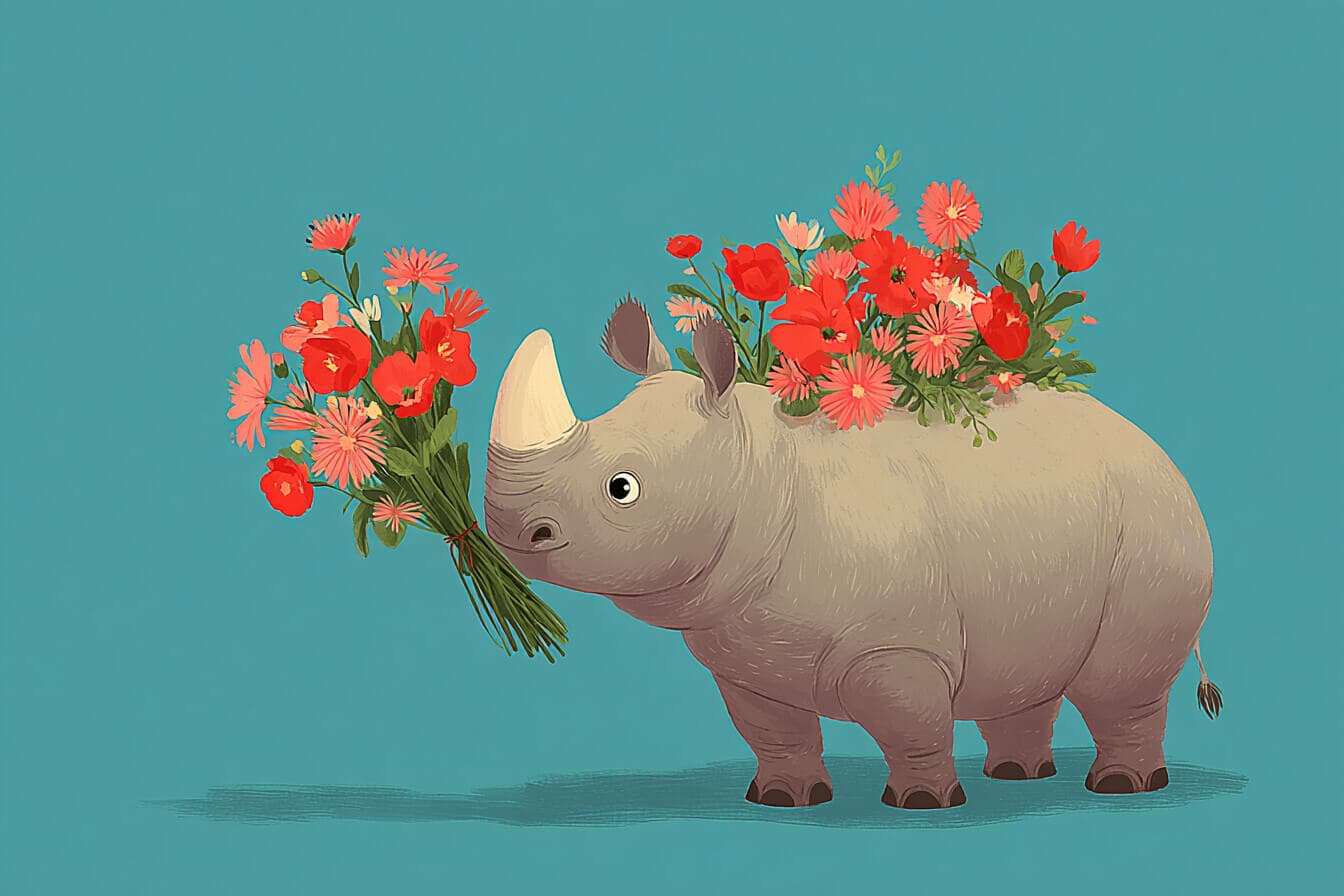
There's something about a big, gentle creature trying its absolute best not to knock things over that makes kids feel cozy right before sleep. In this story, a flower-loving rhino named Rosie sets out to help her town prepare for a parade, but her enormous feet and swishing tail keep turning good intentions into little accidents she has to patch up with kindness and blooms. It's one of those rhino bedtime stories that turns clumsiness into something warm and forgivable, which is exactly the mood a child needs before closing their eyes. If you'd like to customize the details to match your kid's world, you can build your own version with Sleepytale.
Why Rhino Stories Work So Well at Bedtime
Rhinos are huge and powerful, but when you put one in a story about flowers and apologies, something clicks for kids. The contrast between Rosie's size and her soft heart creates a feeling of safety. Children love characters who are physically strong yet emotionally careful, because it mirrors the kind of grown-up they trust most: someone big who moves gently on purpose. A bedtime story about a rhino stumbling through a parade rehearsal gives kids permission to laugh at small mistakes, which is a quiet kind of relief right before sleep.
There's also a sensory richness that rhino stories carry naturally. The heavy footsteps, the dust kicked up, the way Rosie's horn taps a doorbell by accident. These details ground a child in the scene and slow their breathing without them even noticing. By the time the parade is over and the town settles, listeners have already been easing toward sleep for several pages.
Rosie and the Garden of Sorry 12 min 27 sec
12 min 27 sec
On a sunny morning in Tumbleleaf Town, a clumsy rhino named Rosie woke up with a yawn so wide her jaw popped twice.
Her feet were huge and round, and sometimes they did exactly what they wanted regardless of what her brain had planned.
She bumped her nose on the bedroom doorframe, hard enough that the wood left a little chalky stripe on her horn.
She giggled and whispered to the door, I am sorry, friend.
Then she tucked a daisy bloom behind the hinge as an apology, the stem wedged in at a crooked angle that somehow looked intentional.
Rosie loved flowers more than anything.
Flowers were her favorite way to say sorry, to say hello, and to say hooray.
She stepped into the hallway and tried to tiptoe, as much as a rhino can tiptoe, past a wiggly mirror that hung by a single stubborn nail.
The mirror tilted anyway.
Rosie caught it with both hooves and it wobbled like jelly, reflecting her startled face back at her in a slightly warped way that made her nostrils look enormous.
Good mirror, she said. Thank you for not falling.
She slid another daisy into the frame and blinked with relief.
Today was a big day.
The Spring Fling Parade would fill the streets with music, and the Ice Cream Band would practice their scoops and swirls.
Rosie wanted to help, even though helping sometimes turned into oops.
She wore her sky blue scarf with little white petals on it, the one she had washed so many times the petals were more gray than white, though she would never admit it.
She packed more flowers, just in case, and went outside.
The sidewalk smelled like oranges because Mrs Puffer the baker had citrus bread cooling on the window ledge, the crusts still ticking as they shrank in the air.
Rosie waved, bumped the gate with her hip, and the gate squeaked open like a mouse singing.
Oops, said Rosie.
She left a marigold hooked on the latch.
Mrs Puffer blew her a smile from behind the counter and didn't even glance at the gate, which told Rosie this was not the first time.
At the corner, the Tumbleleaf Library stood tall with ivy climbing its brick walls.
Rosie loved the library almost as much as flowers.
She wanted to help Mrs Finch, the librarian, carry books for the reading circle, and she had been thinking about it all morning with a nervous sort of excitement that made her tail swish.
She tried to duck through the door, but her horn tapped the doorbell by accident and it rang so loudly a pigeon on the roof startled sideways.
Mrs Finch laughed softly and waved her in.
Rosie balanced a tower of storybooks on her back.
She walked carefully, counting one two three, and then her tail twitched at a tickle from a stray bookmark that had slipped between the pages and was brushing her spine.
The stack leaned.
The stack leaned more.
It slid off her broad back and landed in a fluffy pile, like a campfire of pages without any fire at all.
The children squealed, because the books made a friendly whump sound and one of them fell open to a picture of a whale wearing a hat, which was perfect timing.
Rosie put her front foot to her chest and took a deep breath.
I am sorry, she said.
She placed a tulip on top of the pile and tucked tiny violets between the covers.
The children clapped, because now the books looked like a garden that had learned to read.
Mrs Finch smiled and said, Thank you, Rosie, that is the prettiest accident I have ever shelved.
Rosie helped stack the books again, slower this time, pressing each spine flat with her chin.
A little boy asked if the tulip could stay in the dinosaur book.
The tulip nodded in its tulip way, which is to say it did not move at all, but everyone understood.
After the reading circle Rosie backed out slowly.
She almost made it.
Then her back foot tapped a broom, which twirled like a ballerina and kissed a dustpan, and they clattered like tiny cymbals.
I am sorry, Rosie said quickly, setting a daisy in the broom bristles.
The broom looked oddly happy to be decorated, standing there at a jaunty lean against the wall.
Across the street, the Parade Committee was busy building a giant paper float shaped like a strawberry wagon.
Mr Reed the mayor puffed out his cheeks and called, We could use your help, Rosie.
Rosie glowed.
She trotted over as lightly as a rhino can, which is not very lightly, and the ground felt each step.
She picked up a paintbrush with her lips and dipped it into strawberry red.
She swirled it in a careful circle, but the brush slid and painted a tiny red dot on the mayor's shoe.
The dot looked exactly like a cherry button.
Mr Reed stared at his shoe, then laughed and added another dot to the other shoe to make them twins.
Everyone chuckled.
The float began to look delicious.
While Rosie added green leaves to the strawberry stems, a flock of pigeons landed on the roof and cooed in a wiggly rhythm.
Rosie loved a good rhythm.
She tapped her foot. Then tapped again. Then couldn't stop.
The float shook, and a stack of paper cups tumbled off the edge.
Pigeons flapped and rose like a gray cloud that forgot to be quiet.
Cups went rolling along the curb like tiny white hats that had lost their heads.
Rosie gasped.
I am sorry, she said, and trotted after the cups, scooping them gently against the curb with her nose, one by one, the way you'd nudge a marble back into a circle.
She placed a bright zinnia in each cup, so they became little flower lanterns along the whole curb.
People clapped again.
A small girl asked if they could keep the flower cups for the parade.
Yes please, said Mr Reed.
Then the Ice Cream Band arrived, instruments gleaming, and started practicing.
Rosie shuffled closer to the drums because she could not help herself.
The drummer blew a whistle to count the beat, and Rosie blew along, which surprised everyone because rhinos do not usually whistle.
Hers made a sound like a kettle cheering for tea, high and wobbly and earnest.
The drummer grinned and let her keep time with a soft bell, and for a whole minute Rosie did not bump a single thing.
When the sun climbed higher, Rosie visited the park to make sure the picnic tables were straight.
She lined up napkins in neat squares, then sneezed, because napkins always tickle noses if you lean in too close.
The sneeze lifted a tablecloth so it sailed like a little cloud, drifted across the grass, and draped itself over a low branch in the oak tree, hanging there like a flag of lunchtime.
Rosie said I am sorry to the table, to the tree, and to the cloud of cloth.
She stretched up and could not reach.
So she asked her friend Tico the squirrel for help.
Tico was fast.
He bounced up the trunk, tugged the cloth free, and dropped it like a parachute into Rosie's waiting hooves.
She placed a bright sunflower in the middle of the table as thanks, and it shined its yellow face across the whole grassy field like a small lamp that ran on nothing but color.
Children raced by with ribbon sticks and kites that drew zigzags in the sky.
Rosie tried a ribbon stick too.
She swirled it in a circle, and it looked lovely until she stepped on the ribbon with her own foot.
She tried to unstep but stepped on the other end.
The ribbon turned into a red loop that gently hugged both her ankles, and she stood there, perfectly stuck, blinking at her own feet with genuine confusion.
She laughed so hard that she snorted bubbles of air, and the children laughed with her, because laughing is a very friendly kind of music.
A friendly goose waddled over and pecked at the ribbon until it came loose.
Rosie wrapped the ribbon around the goose like a scarf, and the goose honked proudly and strutted past the pond like a fashion star who had an audience of ducks to impress.
A gust of wind teased the pond and made ripples.
A toy boat bumped the shore, and Rosie hurried to catch it, but her hoof nudged a stack of paper boats that someone had folded for later.
The boats fell into the water and sailed away like a busy fleet that did not ask for directions.
Rosie stood very still.
Then very slowly she set pink clover blossoms on the drifting boats.
The pond looked like it had sprouted candy.
The boat maker, a shy kid with a freckled nose and ink stains on both thumbs, whispered, It is even better, and smiled so wide that the sun itself seemed to lean closer.
As afternoon leaned toward evening, the parade began.
Drums went boom.
Tubas went bwa bwa bwa.
People waved streamers that caught the light and spun it into sparkles that skittered along the street like something alive.
Rosie walked beside the strawberry float with careful steps, practicing thinking two steps ahead.
She counted one two, checked for things nearby, then counted again.
When a tiny dog zipped between her feet like a happy biscuit, Rosie froze mid-stride so the dog could zip out the other side.
Everyone cheered, because that was very careful.
But when she turned to bow, her tail flicked a stack of paper butterflies that had been sitting on a bench.
The butterflies flew into the air, a sudden cloud of color.
They whirled around the float and landed all over it, sticking to the wet paint, settling on the paper strawberry leaves, tucking into the green stems as if a magic breeze had been planning this all day.
Mr Reed gave Rosie a thumbs up.
A trumpet player gave her a silly toot of praise.
Rosie waved at nobody and everybody and felt her cheeks go warm under her gray skin.
Then she spotted trouble.
The end of the parade route dipped down a little hill toward the pond, and the strawberry float's brake rope had slipped loose.
The float began to roll faster than it should.
People gasped. The pigeons took off. The goose with the ribbon scarf honked a warning that was so loud a lamppost seemed to flinch.
Rosie took a deep breath.
I can help, she said.
She trotted to the front of the float, lowered her head, and pressed her horn against the paper strawberry.
She pushed with steady legs and a calm heart.
Her hooves dug friendly little moons in the dirt, each one filling with loose gravel that crunched and gave way.
The wheels slowed.
She pushed harder, thinking of flowers, thinking of apologies, thinking of all the times people had smiled anyway.
The float stopped right at the bottom of the hill, close enough to the pond that she could see her own reflection in the water, but it did not roll in.
The crowd was quiet for half a moment.
Then the cheer rose up like a thousand bubbles.
Mr Reed placed a ribbon around Rosie's neck.
It was green and sparkly with tiny painted petals that looked like they had been added by someone with a very small brush and a lot of patience.
He announced that Rosie was the Protector of Parades and also the Keeper of Accidental Decorations.
The second part made everyone laugh.
Rosie laughed too.
She looked around at the curb full of flower cups, the library books with blossoms tucked inside, the pond with clover boats, and the strawberry float dressed in paper butterflies.
She thought that oops and sorry could be good friends if you listened and tried again.
As the sun set, Tumbleleaf Town glowed with soft lights.
The Ice Cream Band played a lullaby with clinks of spoons and gentle hums.
Mrs Puffer shared tiny cones with orange citrus swirls, and Rosie took one lick and blinked at the taste like a giggle for her tongue.
She walked home slowly, trying not to bump the lampposts that stood like tall giraffes.
She still bumped one, because habits do not change in a minute.
She patted it, said I am sorry, and gave it a sprig of lavender that smelled like bedtime.
She tucked herself into her cozy blanket with petal patterns.
She lined her windowsill with three daisies.
One for the day that had been. One for the tomorrow that would come. One for right now, the best time to smile.
Then she closed her eyes and listened to crickets tuning their tiny violins somewhere in the hedge.
Tico snored from the oak tree.
The goose tucked its ribboned head under its wing.
The fridge in the kitchen hummed a single low note, and the house creaked once, softly, in a way that meant You are welcome.
The Quiet Lessons in This Rhino Bedtime Story
Rosie's story is built around the idea that mistakes don't have to be the end of the conversation. When she knocks a stack of books off her back and pauses to breathe before saying sorry, children absorb the idea that taking a moment before reacting is something even the strongest creatures do. Her habit of leaving a flower at every accident scene teaches generosity as repair, the notion that you can turn a mess into a small gift if you care enough to try. And when the parade float rolls loose and Rosie digs her hooves into the dirt to stop it, kids see that the same bigness that causes clumsiness can also be the thing that saves the day. These are reassuring ideas to carry into sleep: that tomorrow's inevitable oops moments are not scary, because you already know what to do about them.
Tips for Reading This Story
Give Rosie a warm, slightly bumbling voice, a little slow, like she's always choosing her words carefully, and let the I am sorry lines land with genuine softness rather than rushing past them. When the books slide off her back in the library, pause after "The stack leaned more" and let your child guess what happens next. At the parade climax, where Rosie digs her hooves into the dirt, slow your pace way down and lower your voice so the quiet moment before the crowd cheers really lands.
Frequently Asked Questions
What age is this story best for?
It works best for children around ages 3 to 7. Younger listeners love the repeating pattern of Rosie bumping something, saying sorry, and leaving a flower, because the predictability feels safe. Older kids in that range enjoy the parade climax where Rosie stops the float, and they pick up on the humor of the goose strutting with a ribbon scarf.
Is this story available as audio?
Yes, just press play at the top of the story. The audio version is especially fun because Rosie's repeated "I am sorry" lines develop an almost musical rhythm as the story goes on, and the parade scene with the drums, tubas, and Rosie's kettle-whistle comes alive when you hear it rather than read it. It makes a great wind-down listen after the lights go off.
Why does Rosie use flowers to apologize instead of just words?
It gives kids a concrete, visual way to understand what making amends looks like. Each flower is a small action that follows the words, which reinforces the idea that sorry works best when it comes with effort. It also means the town ends up accidentally beautiful, which shows children that repair can create something better than what was there before.
Create Your Own Version
Sleepytale lets you reshape this story into something that fits your child perfectly. Swap Tumbleleaf Town for a seaside village, trade Rosie's daisies for seashells or stickers, add a hedgehog sidekick, or turn the parade into a sandcastle contest. In a few taps you'll have a cozy, personalized tale ready for tonight.
Looking for more animal bedtime stories?
Polar Bear Bedtime Stories
A shimmering palace appears the sea ice, and a small wish turns into shared laughter. Drift into short polar bear bedtime stories with a bright, gentle twist.
Bear Bedtime Stories
Drift off with short bear bedtime stories that feel warm and soothing, plus a simple way to create your own cozy version in Sleepytale.
Tropical Fish Bedtime Stories
Sunlight paints golden paths across a coral reef as a brave little fish leads a pattern parade. Drift into short tropical fish bedtime stories with gentle pride and calm sea sounds.
Pufferfish Bedtime Stories
Drift under turquoise waves with short pufferfish bedtime stories where a jumpy little fish turns surprise bounces into a brave stage dance. A conch charm makes the twist feel tender.
Piranha Bedtime Stories
Drift into the Amazon with short piranha bedtime stories where a toothy fish hosts a leafy picnic and wins hearts one crunch at a time.
Pigeon Bedtime Stories
Ease into comfort as Pablo delivers tiny folded notes tied with a sky blue ribbon to lift lonely hearts. Settle in with short pigeon bedtime stories that bring warmth, hope, and easy sleep.