
Hippo Bedtime Stories
By

Dennis Wang, Bedtime Story Expert
8 min 47 sec
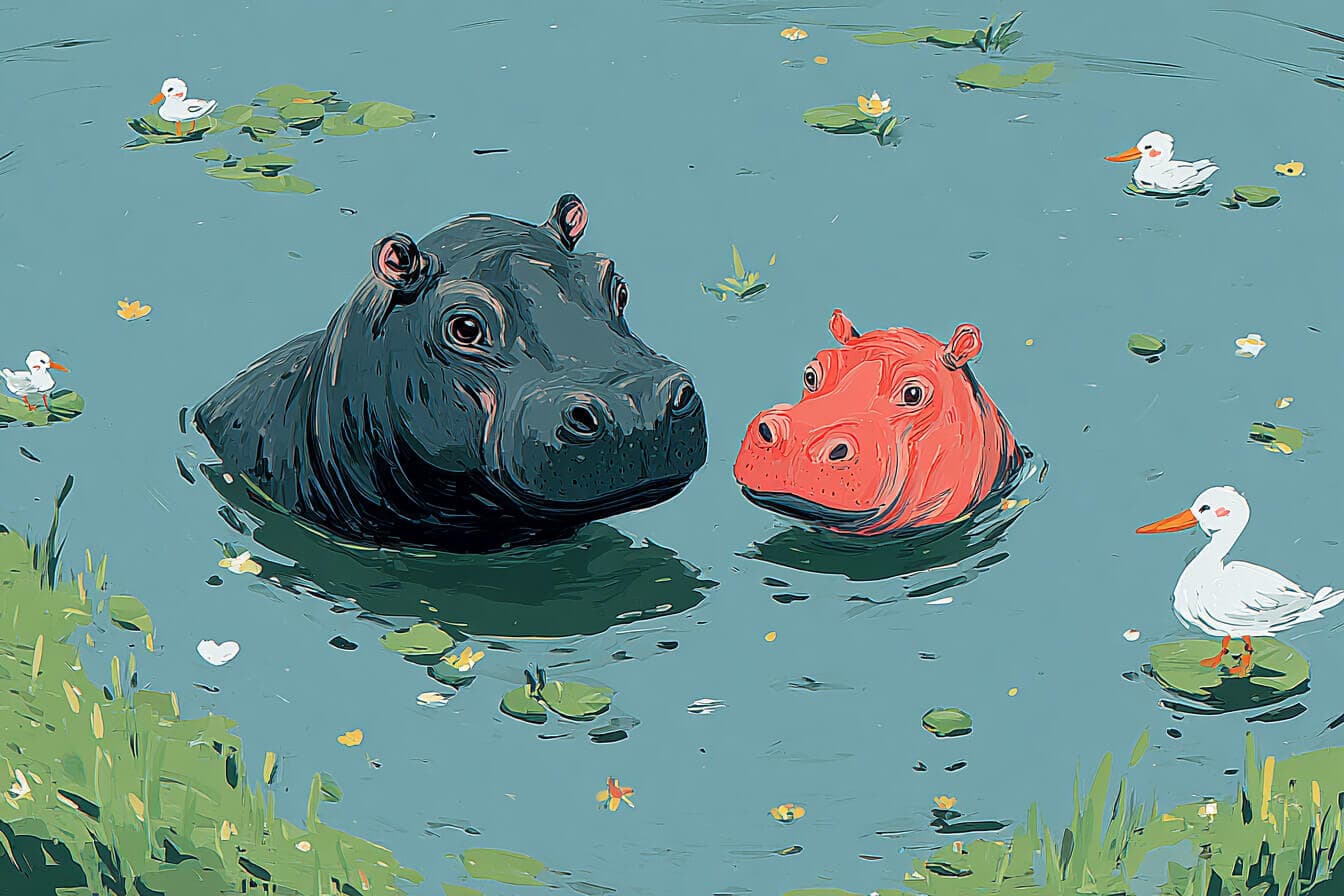
There's something about the slow, warm weight of a hippo that makes children feel anchored right before sleep. In this story, a gentle hippo named Henry discovers that pressing love poems into cool riverbank mud is the one gift he can give his best friend, Hattie, and the whole river starts listening. It's the kind of hippo bedtime stories scene that settles a busy mind: soft earth, blinking fireflies, and words that feel like a hug. If your child would love a version with their own details tucked in, you can shape one with Sleepytale.
Why Hippo Stories Work So Well at Bedtime
Hippos move through the world at their own pace. They sink into water, rest on warm banks, and carry a kind of heaviness that children find deeply reassuring at night. A bedtime story about a hippo doesn't rush anywhere. The rhythm of the animal itself, slow and deliberate, mirrors the rhythm a child needs as they wind down toward sleep.
There's also something special about how hippos live between two worlds, land and river, wakefulness and rest. That in-between quality maps perfectly onto the bedtime moment when a child is still awake but drifting. Hippo stories at night let kids imagine sinking gently into warm mud or floating in cool water, and those images do the quiet work of relaxation without anyone having to say "time to sleep."
Henry's Heart Shaped Mud Verses 8 min 47 sec
8 min 47 sec
In the soft green bend of the Lululu River, Henry the hippo woke up with a warm glow sitting right behind his ribs.
He rolled out of his sleeping hollow, which was really just a dip in the bank where his body had worn the earth smooth over years, and stretched until his back legs trembled.
Then he waddled toward the mud.
Today he would make something for Hattie, his best friend, who loved songs and stories and anything that carried even a small crumb of kindness inside it.
Henry could not sing. The weaverbirds had that covered. He could not paint like the children in the village who sometimes wandered down to the shore with brushes made from sticks.
But he could shape words. He'd always been able to do that, the way other animals shaped clay or nests or tunnels.
He dipped his wide hoof into the cool brown mud and pressed.
The first poem said: Hattie, you are the morning sun on the river.
He drew a wavy line beneath it to show the ripples her laughter made in his chest. The line came out crooked, but he left it.
A dragonfly hovered close, read the words out loud in a voice like tissue paper tearing, and clapped its wings together.
Henry blushed.
He kept writing.
The second poem said: Your kindness is a nest where shy feelings rest.
A family of ducks waddled over, studied the letters for a long time, and quacked so loudly that a mongoose popped up from the grass to see what was happening.
Then another mongoose. Then their two cousins, who immediately giggled and rolled onto their backs.
Grandmother elephant arrived without anyone noticing, the way she always did, and squirted a trunk-full of water straight up in approval.
Even the bushbuck stepped near, which was unusual because the bushbuck was afraid of almost everything, including his own reflection.
Henry wrote: When you smile, the papyrus blooms open like candles on a cake.
Hattie, who had been downstream gathering water lilies, heard the chatter and came trotting around the bend. Her hooves left deep round prints in the wet earth.
She saw the poems. She read them slowly, moving her lips.
Her cheeks turned the color of ripe mangoes.
She touched her snout to Henry's ear. "These are the finest gifts I have ever received," she whispered, and her breath smelled like river grass and the lilies she'd been carrying.
Henry's heart drummed so loud he was sure the crocodiles downstream could hear it.
He wrote another line: If friendship were a river, I would swim beside you forever.
The animals cheered. Guinea fowl flew up in swirling spirals. A little boy from the village heard the commotion and came running to the shore, his sister right behind him, both of them barefoot and out of breath.
They copied the poems onto paper with a pencil that had no eraser left.
Henry thanked them and pressed one final line into the bank: Love is a hippo song that rhymes with every creature.
The children laughed, folded the papers into boats, and set them on the current. The boats spun slowly in the eddies before straightening out and drifting downstream where other animals could find them.
That night, Henry and Hattie lay side by side beneath the acacia tree. The bark was rough and peeling in places, and a beetle was making its slow way up the trunk, but neither of them noticed.
Fireflies blinked overhead.
"Did the poems truly make you happy?" Henry asked. His voice was quiet enough that the crickets almost drowned it out.
Hattie didn't answer right away. She hummed a tune, something that sounded the way moonlight looks on water, if moonlight had a sound.
Then she said, "You made the whole river smile today."
Henry felt so light he thought he might float.
He closed his eyes and dreamed of verses shaped like clouds.
The next morning the entire herd wanted lessons.
Mothers wanted poems for their babies. Teenagers wanted poems for crushes they refused to name out loud. Old Uncle Gus, who spent most of his time submerged with just his ears and nostrils showing, wanted a poem for his favorite swimming hole.
Henry agreed, but he made one rule. "Every poem must be kind," he said. "And true."
The hippos formed a rough circle while Henry demonstrated how to press letters into the mud. He explained that poems could be short like minnows or long like pythons, but the words had to come from somewhere real.
A young hippo named Tilly wrote: Mud hugs are better than bug hugs.
Everyone applauded. Tilly's ears went pink.
Uncle Gus wrote: Swimming holes are doorways to cool dreams. Then he sank back into the water as though embarrassed by his own tenderness.
By midmorning the riverbank looked like a library that had tipped over and spilled into the earth.
Parrots copied poems onto leaves and carried them across the savanna. Giraffes stretched their necks to read from high above. Even the pangolin, who usually stayed curled in a ball until everyone left, rolled out to listen.
Henry moved from poem to poem, offering small suggestions. "Try a shorter line here," he told one hippo. "Let the silence do some of the work."
When an author finished, the listeners would tap their hooves against the ground, a sound like soft rain.
By sunset more than forty poems decorated the bank.
Henry and Hattie walked the whole line together, reading each one aloud. Their voices layered over each other, sometimes in unison, sometimes staggered like river and rain arriving at different speeds.
They found poems about favorite fruits. Poems about secret hiding spots. Poems about dreams of flying, which is a strange thing for a hippo to dream about, but there it was.
They found poems for friends who had moved away and for babies not yet born.
Every creature there felt, for a moment, like someone had actually seen them.
As the sky turned lavender, Henry looked at the crowd. He opened his mouth, then closed it. He had been about to say something grand, but instead he just squeezed Hattie's hoof and sat down.
The animals formed a circle around the two of them. Someone started singing. Crickets kept rhythm. Frogs found the harmony. Fireflies drifted into a slow pattern overhead that almost, if you squinted, spelled something.
Weeks passed, and the tradition held.
Each dawn hippos hurried to the river before the sun got too hot and the mud turned cracked and stubborn. Visiting animals added their own verses. Zebras wrote in striped patterns. Flamingos balanced on one leg and wrote with the other, which took forever but looked magnificent. Chameleons wrote in ink that kept changing color, so you had to read fast.
The riverbank became a living book, thicker with every tide.
Henry kept Hattie's favorite poem fresh, tracing the letters each morning. His hoof fit perfectly into the grooves now.
One afternoon a storm swept in without warning. The sky went from blue to iron in minutes, and rain poured in silver sheets.
It washed every poem away. The bank was smooth and blank.
The animals stood in the downpour and stared.
Henry lifted his head. Water ran off his ears.
"Don't worry," he said. "The river has memorized every word."
He closed his eyes, took a long breath, and began to recite.
One by one, others joined. Tilly remembered hers. Uncle Gus surfaced and mumbled his. Even the bushbuck whispered a line.
Together they pressed the poems back into the wet earth, and somehow they came out sharper than before.
Hattie looked at Henry. "Our poems aren't just in the mud," she said.
"They live in us."
Henry smiled, a real one, the kind where his whole face changed shape.
From that day on the animals kept two records: the muddy poems by the river and paper copies hidden inside a hollow baobab tree. They appointed young meerkats as guardians of the paper, teaching them to read and recite in case the rain came back.
Henry and Hattie kept writing side by side. Their verses grew deeper, the way the river itself did after each season's rains.
Travelers arrived from distant places to read the poems and left carrying something they hadn't brought with them.
Some started poem banks along their own rivers and lakes.
Henry welcomed every visitor. He never turned anyone away.
Years later, when his muzzle had gone gray and Hattie's laugh had softened to something barely louder than a breath, young hippos picked up where they left off. Fresh lines appeared beside faded ones.
The tradition stayed. A quiet promise that kindness, once written, circles back like water finding its source.
And if you visit the Lululu River at dawn, you might still see poems pressed gently into the mud, waiting.
The Quiet Lessons in This Hippo Bedtime Story
This story carries a few ideas that settle well right before sleep. When Henry realizes he can't sing or paint and chooses mud-writing instead, children absorb the notion that their own particular way of doing things is enough. The moment the storm washes everything away and the animals rebuild together shows kids that losing something doesn't mean it's gone, especially when people remember it together. And Tilly's pink ears after her first poem, Uncle Gus sinking back into the water after revealing his softer side, these small beats normalize the nervous thrill of being honest about what you feel. At bedtime, that kind of reassurance makes tomorrow's vulnerabilities seem a little less frightening.
Tips for Reading This Story
Give Henry a low, unhurried voice, almost sleepy, and let Hattie's whispered line about "the finest gifts" land right against your child's ear like a secret. When the storm arrives and the bank goes blank, pause for a real beat of silence before Henry says "Don't worry," so your child feels the weight of the loss before the relief. For Uncle Gus, try a grumbly half-submerged mumble, and when Tilly's ears go pink, glance at your child and let them giggle before you move on.
Frequently Asked Questions
What age is this story best for?
It works best for children ages 3 to 7. Younger listeners will love the animal sounds and the image of Henry pressing letters into mud with his big hoof, while older kids will connect with Tilly's nervousness and the idea of rebuilding something after a storm washes it away. The vocabulary is gentle enough for preschoolers but the emotions have enough texture for early readers.
Is this story available as audio?
Yes. You can press play at the top of the story to hear it read aloud. The audio version brings out moments that really benefit from voice, like the contrast between Henry's quiet question under the acacia tree and the noisy celebration when the guinea fowl spiral upward. Uncle Gus's mumbled poem and the sound of hooves tapping like soft rain also come alive in narration.
Why does Henry write poems in mud instead of on paper?
Henry uses what's right in front of him, the cool riverbank mud he lives beside every day. It fits his character as a hippo who is happiest near the water. The mud also makes the poems feel temporary and precious, which is why the storm scene matters so much. When the animals eventually add paper copies in the baobab tree, it shows children that important things are worth protecting in more than one way.
Create Your Own Version
Sleepytale lets you turn a small idea, like a poem pressed into riverbank mud, into a bedtime story shaped around your child's world. You can swap the Lululu River for a backyard pond, change Henry and Hattie into new characters your child names, or shift the tone from cozy to silly depending on the night. In just a few moments you'll have a story ready to replay whenever bedtime needs a little quiet magic.
Looking for more animal bedtime stories?
Polar Bear Bedtime Stories
A shimmering palace appears the sea ice, and a small wish turns into shared laughter. Drift into short polar bear bedtime stories with a bright, gentle twist.
Bear Bedtime Stories
Drift off with short bear bedtime stories that feel warm and soothing, plus a simple way to create your own cozy version in Sleepytale.
Tropical Fish Bedtime Stories
Sunlight paints golden paths across a coral reef as a brave little fish leads a pattern parade. Drift into short tropical fish bedtime stories with gentle pride and calm sea sounds.
Pufferfish Bedtime Stories
Drift under turquoise waves with short pufferfish bedtime stories where a jumpy little fish turns surprise bounces into a brave stage dance. A conch charm makes the twist feel tender.
Piranha Bedtime Stories
Drift into the Amazon with short piranha bedtime stories where a toothy fish hosts a leafy picnic and wins hearts one crunch at a time.
Pigeon Bedtime Stories
Ease into comfort as Pablo delivers tiny folded notes tied with a sky blue ribbon to lift lonely hearts. Settle in with short pigeon bedtime stories that bring warmth, hope, and easy sleep.