
Parrot Bedtime Stories
By

Dennis Wang, Bedtime Story Expert
6 min 4 sec
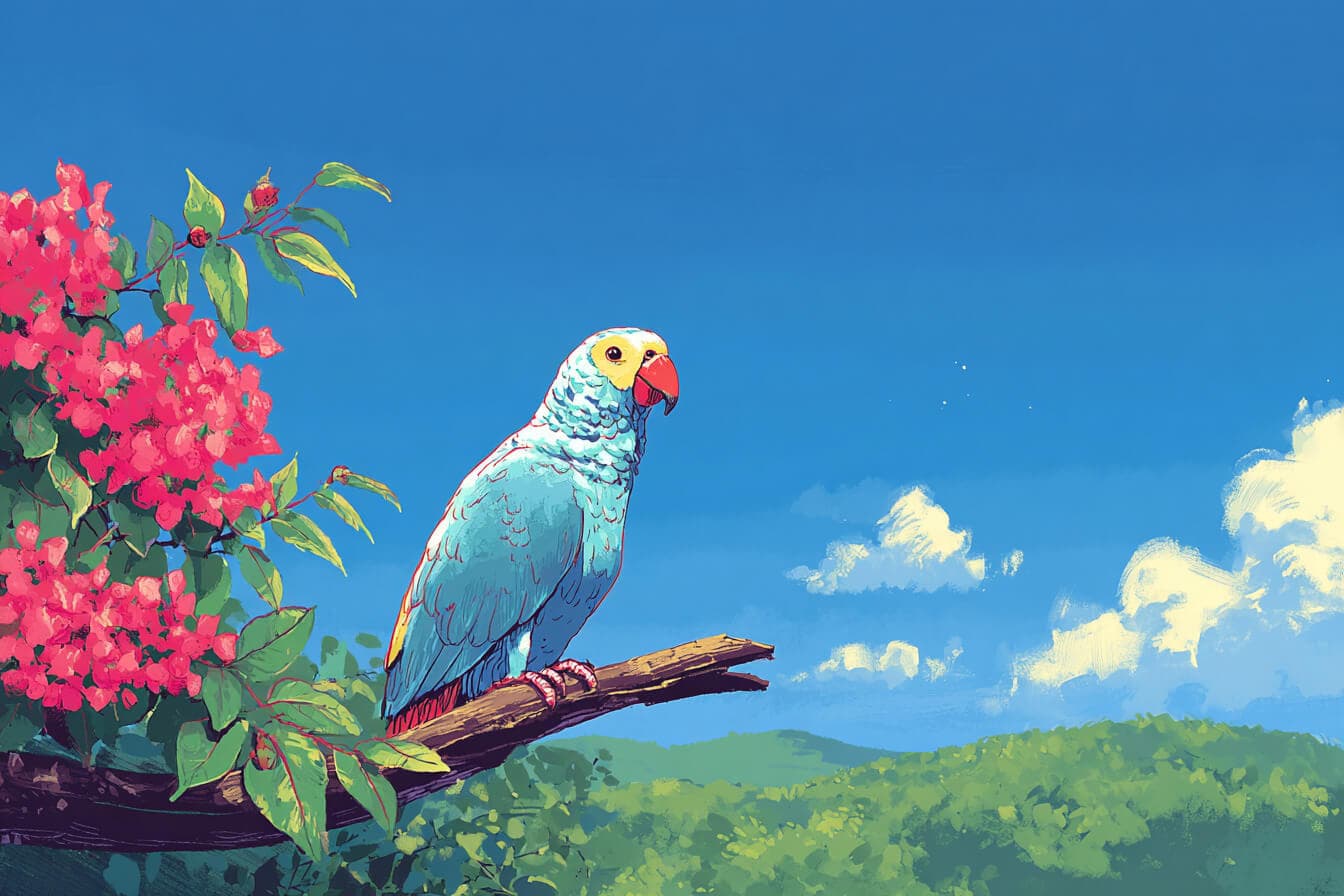
There is something about a bird's voice drifting through a quiet room that makes the whole world feel smaller and safer. In this story, a parrot named Polly discovers a silver feather etched with sky language, and she uses it to learn a lullaby powerful enough to calm the stormiest clouds on earth. It is one of those parrot bedtime stories that moves slowly, with wind and song and just enough wonder to let a child's eyes grow heavy. If you would like to shape one around your own child's favorite details, you can create a custom version with Sleepytale.
Why Parrot Stories Work So Well at Bedtime
Parrots are natural talkers, repeaters, listeners. For kids, that makes them feel like companions who are paying attention. A story about a parrot learning words, especially gentle ones, mirrors the way children themselves are absorbing language all day long. Hearing a parrot character whisper and sing gives that process a cozy, almost magical shape right before sleep.
There is also something calming about the idea of a bird perched high in a tree, watching the sky change color. It places the child in a world that is elevated but safe, surrounded by leaves and wind rather than walls. A bedtime story about a parrot who speaks to clouds takes all the noise of the day and turns it into something musical, something that fades naturally into quiet.
Polly and the Whispering Sky 6 min 4 sec
6 min 4 sec
Polly the parrot lived high in a banyan tree, the kind with roots that dangled from branches like half-finished thoughts. The tree was so tall its upper limbs disappeared into low cloud on damp mornings. Every dawn she practiced the bright words people had taught her: hello, good morning, pretty bird, where are my keys. She could say them all perfectly, but none of them felt like they belonged to her.
One evening a silver feather drifted down and landed on her perch.
Along its edge, tiny symbols shimmered the way moonlight moves on water, never quite holding still. Polly turned the feather with her foot. She squawked the first symbol aloud, just to see what would happen, and the wind stopped. Not slowed. Stopped. The clouds bent closer, the way someone leans in when they think you might be speaking their language.
Then the sky answered.
It came as a low, rolling syllable, half thunder, half purr. Polly's feathers stood on end. She tried the next symbol, and the next, and each time something shifted in the air around her, something enormous and patient paying attention. From that night on, she studied. She learned that certain trills could call a cool breeze on a sweltering afternoon. Low, throaty coos could part fog so the fishermen in the harbor below could finally see where they were going. One particular whistle, if she held it just right, made the banyan leaves rearrange themselves into new words she had never read before.
The children in the village noticed first. Whenever Polly flew overhead, the weather seemed to behave itself. They started leaving seeds on their windowsills, bright red ones and striped sunflower seeds, hoping she would land and maybe teach the clouds to do a trick.
Polly loved the seeds. She loved the sharing. But she also felt something else pulling at her, a kind of pressure in the air, like distant lightning that has not decided where to land.
One midnight, with the stars packed so close they looked sticky, the oldest cloud drifted down to the banyan. Her name was Grandmother Nimbus, and she moved the way very old things move, slowly, but with the weight of everything behind her. She told Polly about the storm heart: a knot of wind and worry at the far edge of the world that had been tightening for years. It had forgotten how to let go. Polly's task, if she chose it, was to weave a lullaby strong enough to unknot it.
Polly ruffled her emerald wings once. "Show me where," she said.
She followed the silver feather upward the next morning, past the banyan, past the brown hills she knew, past the blue she recognized, into a place where the sky was stitched together from every sunrise and sunset that had ever happened. Colors breathed there. Silence had a sound, a kind of hum you felt in your chest more than heard with your ears.
A breeze carried stories of faraway places where storms had forgotten how to end. Rain that fell for weeks. Lightning that circled the same field over and over like a dog that could not find its bed. Polly tucked each story beneath her wing.
Grandmother Nimbus murmured, "Beyond the edge of tomorrow, child."
Polly spiraled down again, rehearsing under her breath, letting each note settle the way dew settles on spider silk, which is to say perfectly, without being asked.
Village fields passed beneath her in squares of green and gold, stitched together by dirt paths. She saw farmers look up. Children waved, their laughter rising like kites that had slipped their strings. Polly dipped a wing.
The silver feather glowed brighter as she reached the coast. Purple clouds brooded on the horizon, stacked in columns that looked almost architectural, like a city built out of bad weather.
A young wind spirit named Zephyr met her there, spinning in a tight circle that smelled like salt and open ocean. "I can carry you across," he said. "But you'll have to hold on with your feet and your stubbornness."
They traveled together above coral reefs, above sleeping whales whose backs broke the surface like slow grey islands, above ships that blinked their running lights in confusion at a parrot riding a column of air. Polly sang to the sails as they passed, filling them with steady breath. One sailor looked up and laughed, which made Polly laugh too, a sound like a squeaky gate, and for a moment the whole ocean seemed lighter.
Then the storm heart.
It hung at the edge of the world like a bruise. A swirling core of grey and violet, booming like drums with broken heads, flashing with lightning that looked more lonely than angry. The wind here tasted of iron and old rain.
Polly hovered. Her chest hammered.
She began.
The lullaby started with the banyan, the creak of its branches, the way its leaves sounded like whispered gossip in a light wind. Then she sang the children's laughter, and the fishermen pulling nets heavy with silver, and the smell of bread in a grandmother's kitchen where the window was always cracked open. She sang the seeds on windowsills. She sang the sound of Zephyr spinning. She sang every gentle thing that lives beneath a sky and does not ask for much.
The storm heart listened. Its flashes dimmed, one by one, like lamps being turned down in a house where someone is finally ready to sleep. Cloud tendrils reached toward her voice and began weaving themselves into calm.
Slowly, slowly, the core unknotted. It unraveled into soft rain that drifted sideways toward deserts that had been waiting for it without knowing they were waiting.
Polly felt the sky exhale.
Grandmother Nimbus appeared, beaming the way the horizon beams at first light, and said simply, "Guardian." That was all. Polly did not need more.
Zephyr carried her home. The banyan leaves shivered in welcome. Villagers noticed the nights growing gentler, the mornings arriving with fewer sharp edges. Children began to whistle cloud syllables of their own, joining their voices with Polly's in the hour before dusk when the air turned gold.
She taught them that every breath is a word in the sky's story, if you are quiet enough to hear it.
And each evening, as stars blinked awake one at a time like shy guests arriving at a party, Polly perched on her favorite branch with the silver feather resting above her heart. She whispered a thank you to the wind, and the wind whispered back something that sounded a lot like goodnight.
Far above, clouds drifted like sheep across the moonlit meadow of the sky, carrying dreams from one sleeping child to the next. Polly closed her eyes. The vast breathing of the world rose and fell around her, steady as a pulse, and her lullaby echoed on somewhere in the warm space between stars and outstretched wings.
The Quiet Lessons in This Parrot Bedtime Story
Polly's journey is built around the idea that the most powerful things you can do are often the quietest: listening, practicing, and offering comfort when someone is hurting. When the storm heart booms and flashes, Polly does not fight it or run from it. She sings. Kids absorb the idea that big, scary feelings, their own or someone else's, can be met with patience instead of force. There is also the thread of growing into responsibility. Polly starts by repeating words that are not hers, and by the end she has found a voice that genuinely belongs to her. That arc, moving from imitation to something real, mirrors what children do every day as they learn to express themselves. At bedtime, these lessons settle in gently because the story never announces them. They arrive the way Polly's lullaby does, softly, and they stay.
Tips for Reading This Story
Give Grandmother Nimbus a deep, slow voice that sounds like it comes from the bottom of a very old well, and let Zephyr sound quick and slightly out of breath, like he cannot quite stand still. When the storm heart first appears, lower your voice and slow way down, then let the lullaby passage build warmth gradually, almost like you are singing rather than reading. At the line "Polly hovered. Her chest hammered," pause for a full beat and let the silence do the work before you continue.
Frequently Asked Questions
What age is this story best for? It works well for children ages 3 to 8. Younger listeners will love Polly's talking, the silver feather, and the friendly wind spirit Zephyr, while older kids can follow the longer journey across the ocean and understand the idea of calming the storm heart with song rather than strength.
Is this story available as audio? Yes. Press play at the top of the story to hear it read aloud. The audio version brings out the musical rhythm of Polly's lullaby passage especially well, and the shift from the booming storm heart to soft rain is the kind of moment that sounds even better than it reads. It is a good one to let play as the lights go down.
Why does Polly speak to the sky instead of to other parrots? The story draws on the real habit parrots have of mimicking the sounds around them. Polly takes that instinct further by learning the language of the wind and clouds, which turns a familiar bird behavior into something magical. It is a way of showing children that listening carefully to the world around you can become its own kind of superpower.
Create Your Own Version
Sleepytale lets you reshape this story into something that fits your child perfectly. Swap the banyan tree for a backyard oak, change Polly into a cockatoo or a mynah bird, or move the whole adventure from the sky to the sea. You can adjust the tone, the length, and even the kind of lullaby Polly sings, so bedtime sounds exactly the way your family needs it to.
Looking for more animal bedtime stories?
Polar Bear Bedtime Stories
A shimmering palace appears the sea ice, and a small wish turns into shared laughter. Drift into short polar bear bedtime stories with a bright, gentle twist.
Bear Bedtime Stories
Drift off with short bear bedtime stories that feel warm and soothing, plus a simple way to create your own cozy version in Sleepytale.
Tropical Fish Bedtime Stories
Sunlight paints golden paths across a coral reef as a brave little fish leads a pattern parade. Drift into short tropical fish bedtime stories with gentle pride and calm sea sounds.
Pufferfish Bedtime Stories
Drift under turquoise waves with short pufferfish bedtime stories where a jumpy little fish turns surprise bounces into a brave stage dance. A conch charm makes the twist feel tender.
Piranha Bedtime Stories
Drift into the Amazon with short piranha bedtime stories where a toothy fish hosts a leafy picnic and wins hearts one crunch at a time.
Pigeon Bedtime Stories
Ease into comfort as Pablo delivers tiny folded notes tied with a sky blue ribbon to lift lonely hearts. Settle in with short pigeon bedtime stories that bring warmth, hope, and easy sleep.