
Owl Bedtime Stories
By

Dennis Wang, Bedtime Story Expert
8 min 39 sec
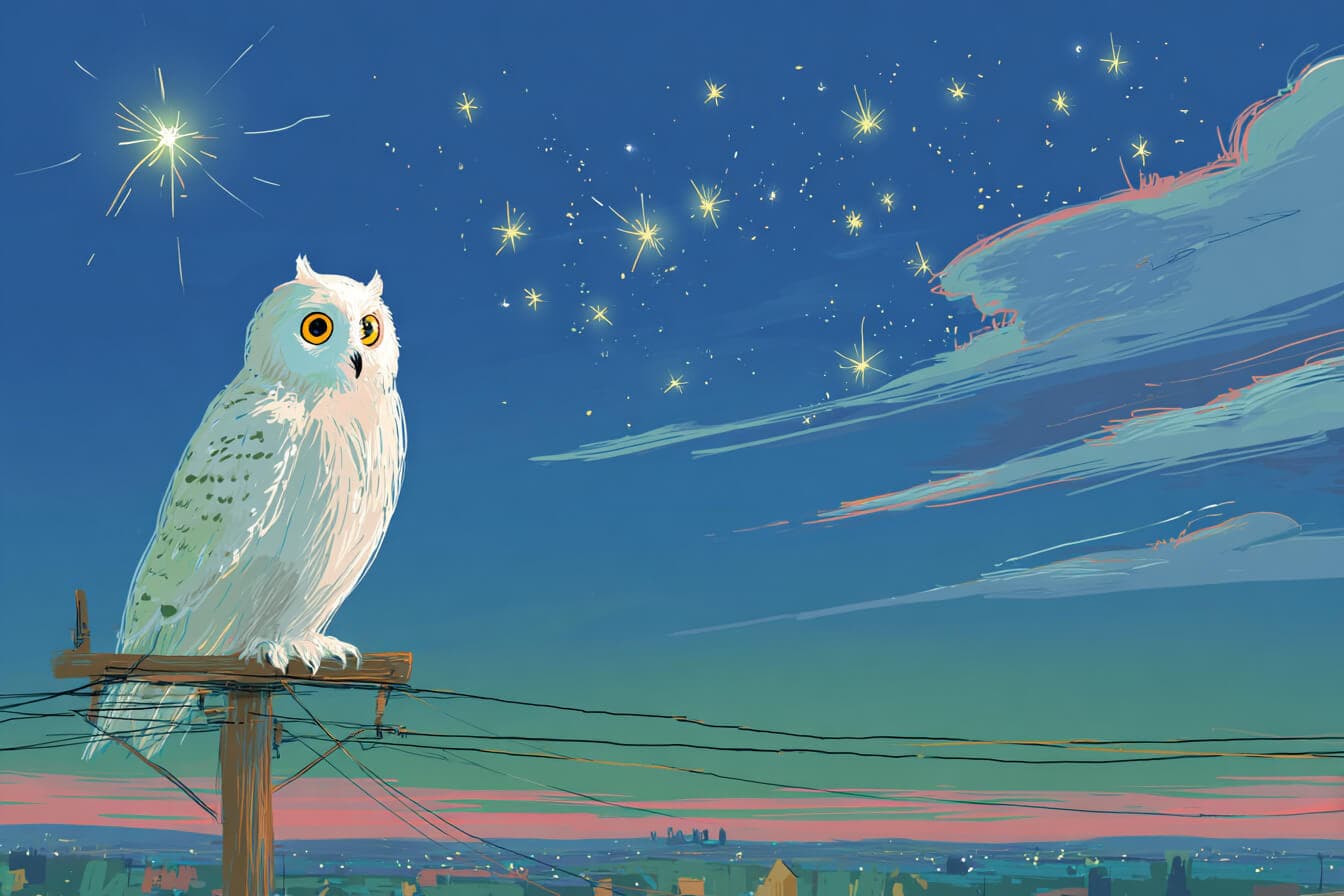
There is something about owls that makes nighttime feel less big. Maybe it is the way they sit so still, watching over everything, or the low sound of a hoot carrying through cold air. In this story, a small owl named Oliver discovers his voice can make the stars rearrange themselves, and he has to figure out what to do when that magic starts to fade. If your child loves owl bedtime stories with a gentle, starlit feeling, you can create your own version with Sleepytale.
Why Owl Stories Work So Well at Bedtime
Owls are creatures of the night, and that simple fact gives them a built-in connection to the bedtime hour. When a child hears about an owl gliding through darkness, the night stops being something empty or scary and becomes a place where someone is awake, keeping watch, and maybe even making something beautiful. That quiet guardianship mirrors what kids need most before sleep: the feeling that someone is paying attention while they drift off.
There is also something calming about the rhythm of owl life. Owls perch, they listen, they move slowly and deliberately. A bedtime story about owls naturally settles into that unhurried pace, matching the slower breathing and heavier eyelids of a child who is ready to rest. The hush of feathers and the stillness of branches create a world that feels safe enough to let go in.
Oliver and the Starlight Symphony 8 min 39 sec
8 min 39 sec
High in the tallest cedar of Maplewood Forest lived Oliver, a small owl with brown feathers and eyes like polished amber.
Most nights he glided over the quiet town below, hooting notes that slipped between chimney tops and settled into open attic windows like they belonged there.
One clear evening, as he tilted his wings to swoop past the old stone bridge, he let out a hoot that surprised even him. It hung in the air longer than usual, and something about it seemed to shimmer.
The stars above flashed twice as bright, then rearranged themselves into the shape of a bird in flight before scattering back into their ordinary positions.
Oliver blinked.
He waited. Then he hooted again, softer this time, almost a question.
The sky answered with a twinkling oak leaf that held its shape for three full seconds before dissolving.
He sat on the bridge rail for a long time after that, turning his head the way owls do, as though looking at the idea from every angle. His voice could paint the sky. That was either wonderful or terrifying, and he had not decided which.
Night after night he practiced. Long, smooth hoots made sweeping curves of light. Quick chirpy notes popped constellations into being like sparks from a campfire. He found that if he held a note and let it wobble slightly at the end, the stars would pulse, almost breathing.
Word got around. Woodland animals started gathering beneath his cedar after dark.
Fireflies hovered beside him, adding their own glow. Field mice squeaked requests, mostly cheese shapes, though one bold mouse kept asking for a star portrait of herself.
Oliver loved it. He also could not shake the worry that the whole thing might just stop one night, without warning, the way a faucet sometimes gives up.
One crisp autumn evening he decided to attempt his most ambitious picture: a life-size deer leaping across the sky.
He inhaled the cool air, feeling it fill his small chest until it almost ached. Then he released a careful sequence of hoots, watching the stars swirl into antlers, a long neck, legs mid-stride.
The forest went silent.
A gust of wind came from nowhere and scattered the whole thing sideways, antlers dissolving into a messy streak of light.
Oliver's stomach dropped. But the animals below erupted into cheering, louder than any night before. A raccoon stood on his hind legs clapping. "That was the best one!" someone shouted, and Oliver realized they meant it. The deer falling apart had been more alive than any perfect picture.
He sat with that thought for a while.
Then he decided to share the music with the children of Maplewood, the ones who pressed their faces against cold windowpanes looking for something worth dreaming about.
He flew from house to house, hooting lullabies that painted starlight sailboats, castles, and creatures above the rooftops. Each picture wobbled a little, imperfect, and that made them better.
The children fell asleep smiling. Their parents stood on porches, coffee mugs in hand, tilting their heads back in quiet amazement.
One small girl named Mia left a purple scarf at the base of his cedar the next morning. It was lumpy and uneven, clearly her first knitting project, and Oliver loved it immediately.
He hooted a thank-you that formed a glowing heart above her bedroom window. It flickered once, then held steady.
As winter crept in, the air grew colder, and the sky started responding more slowly to his calls. Some nights the stars barely stirred.
He visited Grandmother Tortoise, who was soaking up moonlight in the meadow, her shell pale as a dinner plate.
"Every magic has a season," she told him, not unkindly. "Perhaps the stars need rest, same as the ground does."
Oliver said nothing for a while. A leaf blew across the meadow and stuck to Grandmother Tortoise's shell, and neither of them bothered to remove it.
"What do I do, then?" he finally asked.
"Share the magic that lives in your chest," she said. "Not just the part that comes out of your mouth."
He did not fully understand, but he flew home and started inviting the forest creatures to try making their own starlight.
The raccoons tapped rhythms on hollow logs. Faint constellations pulsed overhead, wobbly and strange. The crickets rubbed their wings in careful harmony, and silver dust drifted across the lower sky like someone had tipped over a jar of glitter.
Even the wind joined, shaping clouds into animals that wandered among the stars. None of it was as precise as what Oliver could do alone. All of it was warmer.
On the longest night of the year, the entire forest gathered beneath the cedar for what someone had started calling the Grand Festival, though nobody could remember who named it that.
Oliver led a chorus of owls in a melody that painted the sky with shimmering snowflakes. Each flake seemed to hold a tiny scene inside it, though if you looked too hard it disappeared.
The stars glimmered in slow motion, as if they wanted to memorize the sound.
When the final note faded, the sky went dark for one full heartbeat. Then light broke open across the whole canopy, silent and enormous, wrapping the forest the way a quilt wraps a sleeping child.
Oliver felt something settle inside him. The magic had never been his alone. It lived in every creature willing to add their voice.
Spring returned. The stars woke up refreshed and eager.
Now when Oliver hooted, the pictures came brighter and bolder than before. But he no longer felt the pressure to perform. Some nights he just perched in the cedar, quiet, watching the constellations do their own slow dance without any help from him.
The animals still gathered. They told stories. They argued about which star picture had been best last week. They laughed at things that were not even that funny, because laughing together in the dark feels good.
Years passed. Young owlets begged Oliver to teach them sky singing.
He led them through gentle exercises, patient with the ones whose notes came out squeaky or too loud. Some produced comets that streaked across the horizon. Others stirred soft halos around the moon. One owlet, by accident, made a star hiccup, and everyone agreed it was the funniest thing they had ever seen.
Together they formed the Great Owl Choir, whose harmonies painted the night with something that looked a lot like hope.
Oliver grew old. His feathers silvered like moonlit frost. He moved to a lower branch because the high ones made his wings ache.
Mia, grown now, brought her own children to the forest. Oliver blessed them with quiet hoots that formed tiny guardian constellations above their heads, small enough to fit in a palm if constellations could be held.
When the time came for his final flight, the forest gathered in silence.
Oliver lifted off slowly, wings beating with the rhythm of a resting heartbeat.
He circled once above the cedar. Once above the meadow where Grandmother Tortoise's empty spot still held a faint warmth. Then he rose toward the sky.
With a hoot that echoed through every memory the forest held, he released his last picture: a great oak tree whose branches stretched further than anyone could see, each leaf a twinkling point of light.
The animals watched as Oliver merged with the glowing branches and settled at the very top, the brightest star on the tree.
There he stays. His soft silver hoot still rides the wind on quiet nights.
Children who listen closely can hear it woven through the crickets and rustling leaves. It does not say anything grand. It just says: you carry a spark, and the dark is not as big as it looks.
The forest sleeps beneath that living tapestry, stitched together by an owl who learned the simplest song, offered in love, can turn the night into something worth staying awake for, at least for a little while.
The Quiet Lessons in This Owl Bedtime Story
Oliver's journey weaves together several ideas that settle well into a child's mind right before sleep. When the wind scatters his star-deer and the crowd cheers anyway, kids absorb the notion that imperfection can be more alive than perfection, and that mistakes do not have to mean failure. His visit to Grandmother Tortoise models something valuable too: asking for help when you are scared, and sitting with an answer you do not fully understand yet, rather than panicking. The shift from solo performance to shared music teaches that letting others in does not diminish what you have; it multiplies it. These are reassuring ideas to carry into sleep, the kind that make tomorrow feel a little less pressured and a little more generous.
Tips for Reading This Story
Give Oliver a soft, round voice, almost a murmur, and let Grandmother Tortoise speak slowly with long pauses between her sentences, as though each word has to travel a great distance. When the wind scatters the star-deer, make a quick whooshing sound and then go completely silent for a beat before reading the crowd's reaction. At the moment Mia's lumpy purple scarf appears, pause and ask your child what color scarf they would knit for an owl. During the final flight, slow your reading to match the "resting heartbeat" rhythm described in the text, letting each sentence land gently before moving to the next.
Frequently Asked Questions
What age is this story best for?
Children ages 3 to 8 tend to connect with it most. Younger listeners enjoy the starlight pictures and animal characters like the bold mouse requesting her own portrait, while older kids pick up on Oliver's worry about losing his gift and the way Grandmother Tortoise's advice takes time to make sense. The pacing is slow enough for drowsy toddlers but the emotional layers hold attention for early readers too.
Is this story available as audio?
Yes. Press play at the top of the story to listen. The audio version brings out details that are easy to miss on the page, like the contrast between Oliver's long, smooth hoots and the quick chirpy notes, and the hush that falls over the forest right before the final burst of light. It works especially well for nights when you want to lie beside your child and let someone else do the reading.
Why does Oliver's magic fade in winter?
The story connects Oliver's starlight singing to the rhythms of nature, the same way real animals and plants slow down in cold months. Grandmother Tortoise explains that the stars need rest just as the earth does. This gives children a gentle way to understand that quiet seasons are normal, not something to fear, and that energy and creativity come back when they are ready.
Create Your Own Version
Sleepytale lets you reshape this story to fit your child's world. Swap Maplewood Forest for your own backyard, replace the starlight pictures with moon shadows or cloud shapes, or give Oliver a different name and a companion owl who sings harmony. In a few taps you get a cozy, personalized story you can return to whenever bedtime needs a little extra calm.
Looking for more animal bedtime stories?
Polar Bear Bedtime Stories
A shimmering palace appears the sea ice, and a small wish turns into shared laughter. Drift into short polar bear bedtime stories with a bright, gentle twist.
Bear Bedtime Stories
Drift off with short bear bedtime stories that feel warm and soothing, plus a simple way to create your own cozy version in Sleepytale.
Tropical Fish Bedtime Stories
Sunlight paints golden paths across a coral reef as a brave little fish leads a pattern parade. Drift into short tropical fish bedtime stories with gentle pride and calm sea sounds.
Pufferfish Bedtime Stories
Drift under turquoise waves with short pufferfish bedtime stories where a jumpy little fish turns surprise bounces into a brave stage dance. A conch charm makes the twist feel tender.
Piranha Bedtime Stories
Drift into the Amazon with short piranha bedtime stories where a toothy fish hosts a leafy picnic and wins hearts one crunch at a time.
Pigeon Bedtime Stories
Ease into comfort as Pablo delivers tiny folded notes tied with a sky blue ribbon to lift lonely hearts. Settle in with short pigeon bedtime stories that bring warmth, hope, and easy sleep.