
Jack and the Beanstalk Bedtime Story
By

Dennis Wang, Bedtime Story Expert
12 min 16 sec
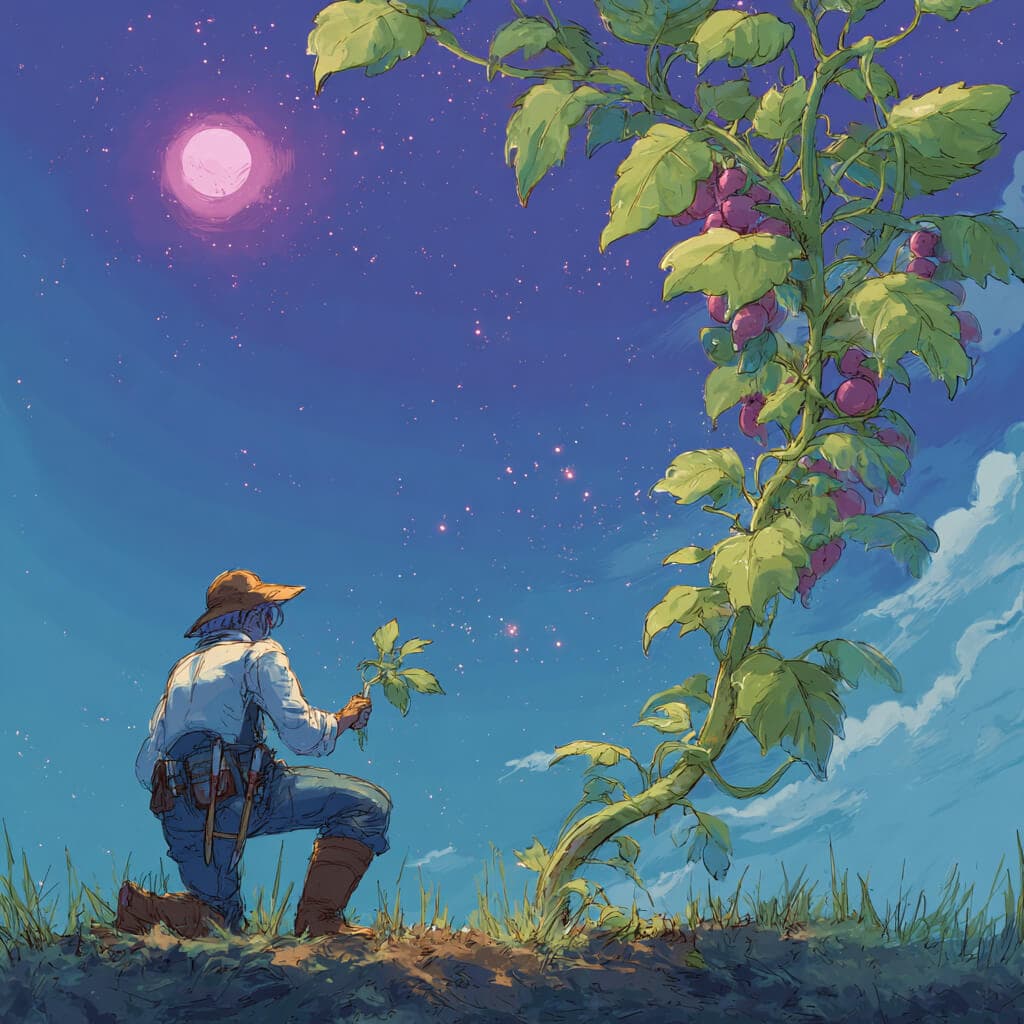
There is something about a beanstalk stretching into the clouds that makes a child pull the covers a little higher and lean in close. This gentle retelling follows Jack on a climb that leads not to danger but to a lonely giant boy named Rowan, a golden harp, and the quiet work of mending an old misunderstanding. It is the kind of Jack and the Beanstalk bedtime story that trades stomping and shouting for music, honesty, and the slow warmth of a shared meal. If your child wants to star in the adventure themselves, Sleepytale lets you build a personalized version with their name, their setting, and even narrated audio.
Why Beanstalk Stories Work So Well at Bedtime
A beanstalk is really just a staircase that grows while you sleep, and that image taps into something kids already feel at night: the sense that the world is quietly transforming around them while their eyes are closed. Climbing up, seeing the village shrink below, touching mist, all of it mirrors the slow letting-go that happens as a child drifts off. The vertical journey from ground to sky feels like a natural arc from wakefulness to dreaming.
That is why a bedtime story about a beanstalk lands differently than a daytime adventure. The pace invites slowness. The clouds at the top suggest softness, not danger. And the return home at the end reassures kids that no matter how high you climb, you always come back to your own bed, your own window, the familiar hum of your own house settling in for the night.
Jack and the Gentle Giant 12 min 16 sec
12 min 16 sec
Jack lived with his mother in a little cottage where the roof sagged like a sleepy hat and the wind sang through the chimney at night.
They had once owned a whole herd of cows, but years of dry summers had left them with only one: a soft-eyed animal named Milky who walked slowly and sighed a lot. Milky's tail was always swishing at nothing in particular, which made Jack laugh even when nothing else did.
One morning, the milk pail came back almost empty.
Jack's mother brushed flour off her hands and said, quietly, that they might need to sell Milky so they could buy food. She did not look at Jack when she said it. She looked at the wall, and her voice wobbled at the edges, and Jack felt his chest tug in two directions at once: one toward his mother's worry, the other toward the cow who had listened to every secret he had ever told out loud.
He hugged Milky's neck and promised to find her a kind new home.
Then he led her down the lane toward the village market. The sky was soft and gray. The fields smelled of clover and rain, and somewhere a gate was banging open and shut in the breeze like it could not make up its mind.
On the way, Jack met an old traveler sitting on a stone, warming his hands around a cup of tea.
The stranger's coat was patched with tiny stars, and his pockets rustled when he moved, as though they were full of dry leaves or folded maps or both.
"That cow looks well loved," the man said, nodding toward Milky.
"If you must trade her, perhaps you would like something that grows instead of something that disappears."
From his pocket he poured a small pile of beans that gleamed green and silver, as if each one held a bit of morning inside it.
"They are patient beans," he said. "They do not promise riches. Only a path to somewhere you have not seen yet."
Jack thought of salt, sugar, and flour at the market, all gone by the end of winter.
Then he thought of Milky and how she liked having her ears scratched in exactly one spot, just behind the left one, nowhere else.
"If I take the beans," Jack asked, "will you take good care of her?"
The old man smiled, the kind of smile that made the air feel warmer.
"I will," he said. "And I will tell her your stories on the road."
So Jack traded the cow for a handful of quiet shimmer and walked home with his fist closed tight around the strange, cool beans.
His mother, seeing empty hands where a lead rope should have been, felt fear before she saw the possibility. When Jack poured the beans into her palm, she sank into a chair, more from worry than anger, and said she had been hoping for bread, not mysteries.
Still, she tipped the beans into a clay bowl and set it on the windowsill.
That night, Jack lay awake listening to the wind, wishing he could somehow keep both Milky and the comfort of a full cupboard. He turned his pillow to the cool side three times before he stopped counting.
Before dawn, a soft cracking woke him.
He padded to the window and found the bowl full of leaves. A slender green stem had pushed the shutters wide and reached toward the clouds, climbing and thickening as it went. Bark and vine twisted together into a living staircase that smelled faintly of rain and fresh mint. One of the bean hulls was still stuck to a lower leaf, split open and papery, and for some reason that tiny detail made the whole impossible thing feel real.
Fear flickered. Then curiosity stepped in front of it.
He scribbled a note for his mother, "Gone climbing, back by supper," and began to climb.
The air grew cooler as he went, his village shrinking into a patchwork quilt of fields and rooftops. Birds tilted their heads as he passed, then flew beside him for a while, as if escorting him to wherever the beanstalk wished to end. One finch landed on his shoulder for exactly four heartbeats before darting off again.
At last his fingers touched mist.
He pushed through and found himself standing on soft, springy ground made of cloud. Above him stretched a sky so blue it looked freshly washed. Not far away rose a castle, its walls the color of rose quartz, its windows shining.
Jack expected thunderous footsteps and booming voices, but the courtyard was quiet. Flower beds edged the path, full of daisies and clover large enough to lean against.
As he stepped forward, the door opened with a sigh.
A giant boy, perhaps twice as tall as Jack but no more, stood there in a tunic stitched with cloud shapes. His hair fell in sleepy curls, and his eyes looked more surprised than fierce.
"Oh," said the giant boy. "You must be Jack?"
Jack blinked. "How did you know?"
The giant held up a book the size of a door. On its cover, painted in soft colors, was a picture of a boy climbing a beanstalk.
"My name is Rowan," the giant said. "My father reads me stories about you. He says once there was a Jack who came here and ran away with our harp. Ever since, he has been upset with the world below."
Rowan stepped aside to let Jack in.
Inside, the castle felt less like a fortress and more like a very big house that had been quiet for a long time. A kettle hummed on the hearth, a low steady note, almost a song. Blankets lay folded on a chair big enough to be a hill.
On a low table sat a golden harp, its strings still as moonlight.
Beside it, an enormous cup held a puddle of untouched cocoa, gone cold, a thin skin forming on top the way it does when no one remembers to drink.
"My father went looking for another musician," Rowan explained, "but most travelers run away when they hear how large his footsteps are."
Jack remembered the old tales of a roaring giant and sacks of gold. The whispered warnings about climbing too high. But the boy in front of him looked lonely, not dangerous. He was picking at a loose thread on his tunic the way Jack sometimes picked at the hem of his shirt when he did not know what to say.
"I did not come for treasure," Jack said. "I came because the beans grew, and I wanted to see where they led."
Rowan's shoulders dropped. Not in defeat. In relief.
"Would you like to hear the harp?" he asked. "It still sings, but only if someone listens on purpose."
He plucked a string with a careful fingertip. The harp answered with a gentle sound, like a lullaby played from the other end of a long hallway. Notes drifted through the room, wrapping around chairs and banisters, softening corners that had grown sharp from silence.
Rowan showed Jack how to touch the strings so they hummed instead of shouted. Jack, in turn, taught Rowan how to clap quietly so the echo did not make the windows rattle. They spent the morning playing slow patterns of sound: three notes for waking, two for resting, one held long for wishing.
When Rowan's father returned, the ground outside shivered with each step, but the castle inside stayed calm.
The giant filled the doorway. Shoulders broad. Eyes heavy with old hurt.
Then he heard the music.
He stopped, as if someone had pressed pause on his anger. His gaze found the harp, then the two boys sitting side by side on the rug, one small and one tall, their hands still resting on the strings.
"I thought my music was gone forever," the giant said. His voice was deep but quieter than Jack expected. It had the rough softness of someone who has not spoken gently in a long time and is remembering how.
Jack rose, heart fluttering.
"I think a Jack long ago made a mistake," he said. "But I am not here to steal. I am here to listen."
The giant knelt, bringing his face level with Jack's. Up close, his eyes were the same shade of brown as Rowan's, with the same tired kindness at the edges.
"In that case," the giant said, "we might still mend things between up here and down there."
He reached into a pocket and brought out a pouch of soft leather.
Inside lay three seeds, round and pearly, each one with a faint glow.
"Plant these near your home," he said. "They will not grow into beanstalks. They will grow into trees that shelter and feed more than they take."
Jack accepted the gift with both hands.
"In return," he said, "will you let the stories change?"
Rowan's father tilted his head.
"Maybe next time someone tells a story about Jack and a beanstalk at bedtime," Jack went on, "they can say the giant was kind. And that the boy came back to visit instead of to take."
The giant's mouth curved into a slow smile.
"I would like that," he said. "It is hard to sleep when you are always cast as the villain."
They shared a simple feast of bread, honey, and warm milk from a pitcher big enough to bathe in. Rowan accidentally knocked over the salt, and nobody mentioned it, which Jack thought was the politest thing that had happened all day. The harp played by itself for a while, weaving notes that sounded like forgiveness.
When it was time for Jack to go, Rowan walked him to the edge of the cloud.
They looked down at the beanstalk spiraling toward the world below.
"Will you visit again?" Rowan asked.
"If my mother agrees," Jack said, "and if you will have me."
Rowan nodded. "Bring your stories. I will bring mine."
Jack climbed down carefully, the pouch of seeds tucked safe against his heart. The air grew warmer as he descended. Birds flew past with curious glances, as though they already knew the tale was changing.
Back at the cottage, Jack's mother ran to meet him, relief washing over her face like sunlight.
He told her everything: the cloud castle, the lonely boy, the harp, the giant who was tired of being feared. She listened without interrupting, which was how Jack knew she believed him.
Together they planted the three seeds around their home.
Jack watered them at dusk and dawn, speaking softly about all he had seen. Soon tiny sprouts appeared, then saplings whose leaves made a sound like pages turning whenever the wind passed through.
At night, when the breeze was just right, faint music drifted down the beanstalk and into their open window.
The villagers who walked by paused, feeling something inside them unclench.
Jack sometimes looked up and saw a small figure waving from the clouds. He waved back, knowing that somewhere above the breeze a harp was playing a tune that made it easier for everyone to close their eyes.
The Quiet Lessons in This Beanstalk Bedtime Story
This story is really about what happens when someone chooses honesty over taking. When Jack tells Rowan's father, "I am not here to steal, I am here to listen," kids absorb the idea that showing up with openness can dissolve years of suspicion. The friendship between Jack and Rowan explores loneliness too, and how simply sitting beside someone and learning their favorite sounds can be enough to change a relationship. There is also the thread of responsibility: Jack asks the traveler to care for Milky, accepts seeds instead of gold, and plants them patiently, showing that real gifts require tending. These themes settle well at bedtime because they reassure a child that mistakes can be mended, that kindness is stronger than fear, and that the world will still be there, a little better, in the morning.
Tips for Reading This Story
Give Rowan a voice that is gentle but slightly deeper than Jack's, as if he is trying hard to sound brave but keeps forgetting to. When Jack and Rowan play the harp together, slow your pace down to match the "three notes for waking, two for resting, one held long for wishing" rhythm, and let each pattern hang in the air for a beat before moving on. At the moment Rowan's father stops in the doorway and hears the music, pause for a full breath of silence so your child can feel the shift before you read his first quiet line.
Frequently Asked Questions
What age is this story best for?
This version works well for children ages 3 to 8. Younger listeners enjoy the sensory details like the beanstalk's mint smell and the harp music, while older kids connect with the friendship between Jack and Rowan and the idea that an old story can be rewritten to be kinder. There is nothing frightening here, so even sensitive listeners tend to settle in comfortably.
Is this story available as audio?
Yes. You can press play at the top of the story to hear it read aloud. The audio version brings out moments that really benefit from a voice, especially the contrast between the giant's deep, careful speech and the light notes of the harp scene. The pacing of Jack's climb also translates beautifully into narration, with natural pauses as he rises through the mist.
Why is the giant friendly in this version?
This retelling reimagines Rowan's father as someone carrying old hurt rather than old rage. The idea is that the original story only told one side, and Jack's willingness to listen opens the door to a different relationship. It lets children see that people, or giants, who seem scary might just be lonely or misunderstood, which is a comforting thought to carry into sleep.
Create Your Own Version
Sleepytale lets you reshape this classic climb into something that fits your family perfectly. Swap Jack for your child's name, turn Rowan into a shy dragon or a cloud-dwelling fox, set the beanstalk in your own backyard, and choose whether the adventure feels cozy, silly, or somewhere in between. In a few taps you can generate a personalized story with soft pacing, kind characters, and narrated audio, so bedtime feels familiar and easy to come back to every night.
Looking for more bedtime story classics?
Once Upon A Time Stories
What happens when June opens a golden book with no title? One of the sweetest short once upon a time stories about a forest, a hedgehog, and a blank page.

Fairy Tales Written By Hans Christian Andersen
Anders discovers short fairy tales written by Hans Christian Andersen as his grandmother reads from a soft brown book by lamplight.

Bluebeard Fairy Tale
In this short bluebeard fairy tale, the forbidden room holds not horror but a music box and memories of the people Lord Corvus loved most.

Red Shoes Fairy Tale
What happens when Karen's magical red shoes refuse to stop dancing? Discover this short red shoes fairy tale tonight.
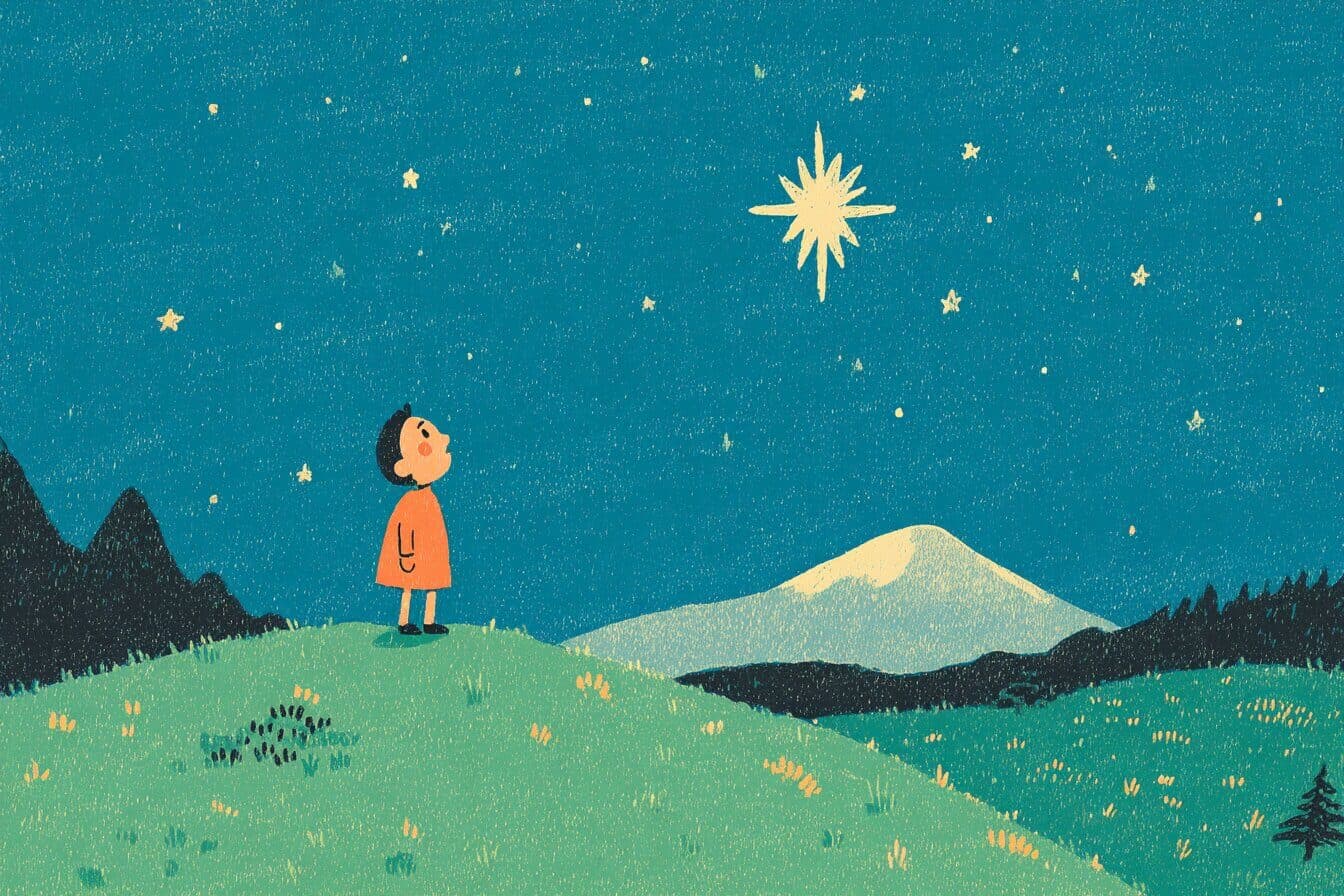
Twinkle Twinkle Little Star Bedtime Story
Lily watches a kind star and floats up to help deliver dreams in this short twinkle twinkle little star bedtime story. A warm, quiet tale for sleepy nights.
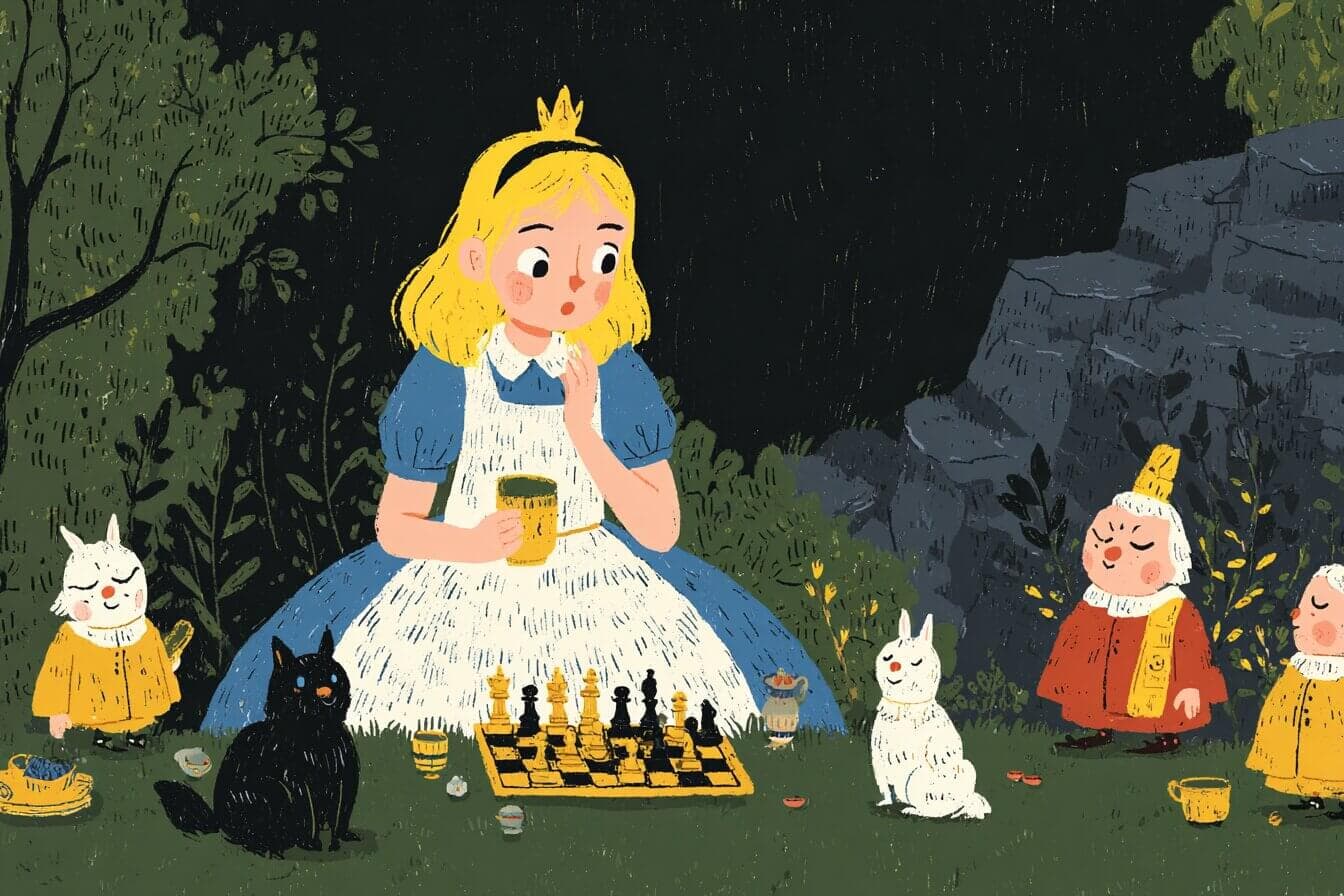
Through The Looking Glass Bedtime Story
Step into a calm, magical short through the looking glass bedtime story and drift toward sleep with gentle wonder. Enjoy a soothing retelling that feels cozy from start to finish.