
Heidi Bedtime Story
By

Dennis Wang, Bedtime Story Expert
11 min 47 sec
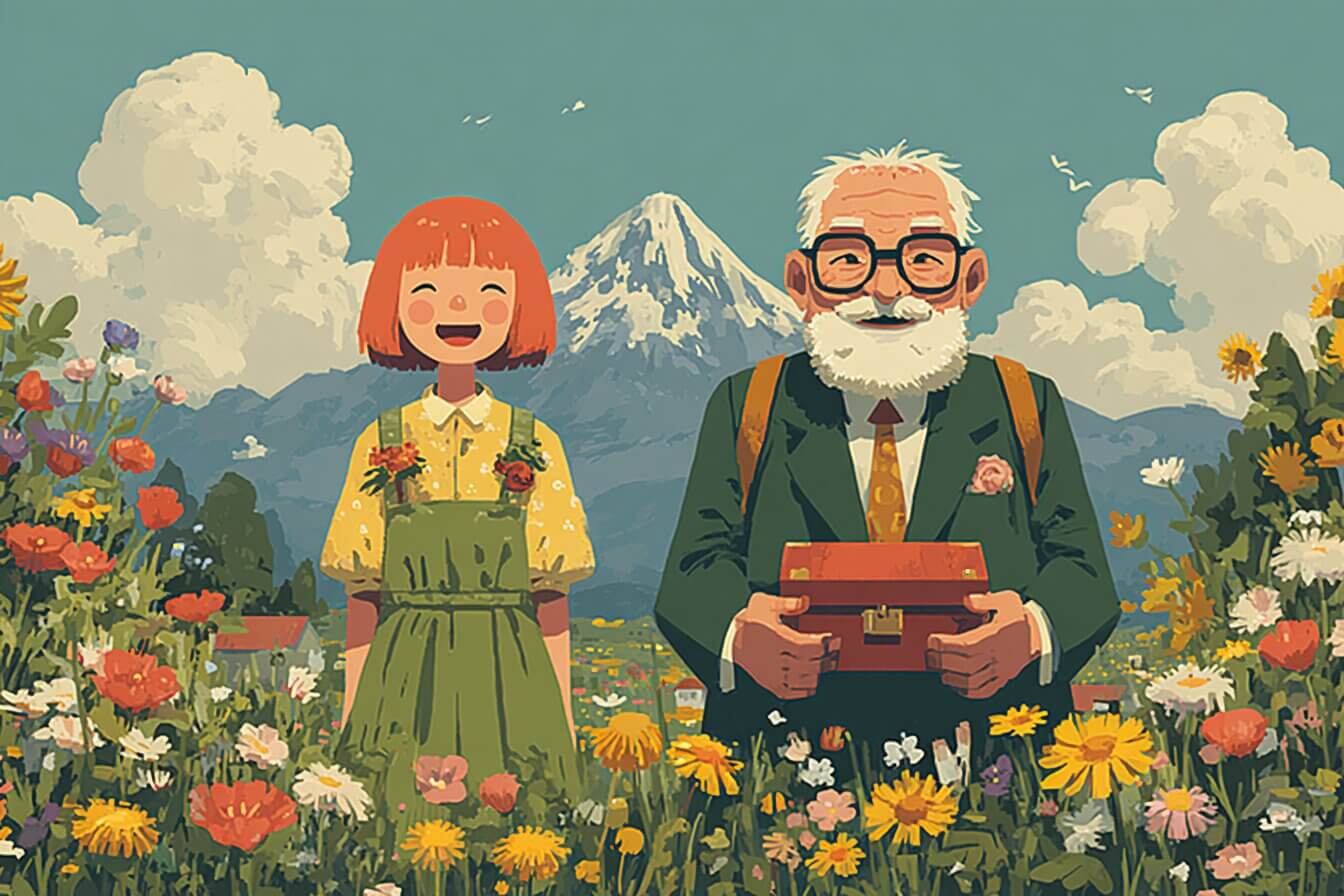
There's something about cool mountain air and pine smoke drifting from a cabin chimney that makes a child's eyelids heavy in the best possible way. In this Heidi bedtime story, a brave orphan girl climbs to her grandfather's cottage above the clouds and slowly turns loneliness into warmth, one song and one shared piece of bread at a time. The meadows, goat bells, and soft snowfall give the whole tale a rhythm that feels like breathing itself slowing down. If you'd like to shape the details to match your child's mood tonight, you can make your own version with Sleepytale.
Why Heidi Stories Work So Well at Bedtime
Mountains have a natural quieting effect on the imagination. When kids picture wide meadows, slow-moving goats, and a tiny cabin tucked into a slope, the world shrinks to something manageable and safe. A bedtime story about Heidi sets the scene in a place where the biggest sounds are bells and wind, and that simplicity helps a busy mind settle. The alpine setting also carries a sense of being held, with peaks standing like gentle walls around a small, cozy life.
Heidi herself is a character who transforms cold or uncertain spaces into warm ones, and that's exactly what children need to feel as they close their eyes. She doesn't fight monsters or race against time. She shares food, sings to echoes, and sits with people until they feel better. For a child lying in bed, that kind of quiet courage is deeply reassuring. It says the world rewards patience and kindness, and that tomorrow will be good.
Heidi and the Alpine Heart 11 min 47 sec
11 min 47 sec
High above the world, where clouds tickled mountain peaks and goats wore bells like necklaces, lived a girl named Heidi who had no parents but carried more songs in her heart than a whole choir.
The village below whispered that Grandfather Alp was as cold as the snow on his roof. Yet the morning the cart left Heidi at his door, she only smiled, tucked her patched red shawl tighter, and walked inside as though she had been expected for years.
The cottage smelled of pine resin and old smoke, the kind that sticks to wool. Grandfather's first words came out more grumble than greeting.
Heidi answered by placing a small wooden robin she had carved on the windowsill. "The sun will love to visit," she said, and that was that.
By lunchtime she had coaxed a fire to dance. By supper she had coaxed Grandfather to hum. By bedtime the three goats had poked their curious heads through the doorway, and Heidi had convinced the old man to let them stay, arguing that they were cold and she could see their breath, which was only half true.
The next dawn, when the first pink light caught the snow, Heidi ran outside with her apron flying and sang her mother's lullaby to the mountains. Every echo sang it back, softer each time, until the last one faded like a whisper telling her to be still.
Peter the goatherd arrived soon after, knees purple with cold, and Heidi shared her hunk of bread and her dream of finding an edelweiss flower glowing like a star on some cliff she hadn't found yet.
Peter, who had never dreamed aloud in his life, surprised himself by promising to show her the secret meadow where the rarest flowers grew. His only condition: she had to keep telling stories while they climbed, because silence made him think too much.
So up they went, past goats whose bells clinked in no particular order, past eagles pulling slow circles in the sky, past snowfields that looked like someone had spilled a bag of flour and decided to leave it.
When they reached the narrow ledge, Heidi spotted it. The fuzzy white star she had imagined, except smaller and more stubborn looking than she expected, clinging to the rock as though it had opinions about being picked.
Peter warned that one slip meant rolling all the way to Italy. Heidi considered this.
Then a laugh bubbled up because the wind carried Grandfather's humming from below, faint but unmistakable, as though the old man had become part of the mountain itself, urging her forward.
She lay flat on her stomach, stretched both arms, and whispered to the flower that the whole Alps were proud of its courage. The edelweiss came free as softly as a sigh. Her fingertips tingled from the cold rock.
At that same moment Grandfather appeared on the path below, having followed the sound of her laughter the way a shepherd follows bells.
His eyes widened at the flower, but they shone even more at the smile she gave him. Back home, Heidi set the edelweiss in a tin cup beside the wooden robin, and that night Grandfather told a story for the first time in years, a tale of an orphan boy who became a friend to eagles. Heidi knew the boy was really her grandfather, only younger, only lonelier.
Word of the singing girl on the alp drifted down to the village like thistledown. Soon crippled Klara arrived, wrapped in blankets and a kind of sadness that sat behind her eyes, with her governess in tow, to breathe the famous mountain air.
Heidi saw past the wheelchair. She saw a girl whose eyes held the same hunger she herself had felt in the orphanage, and she took Klara's pale hands and said the mountains would teach her to dance even if her legs had other plans.
Day by day, Heidi carried Klara outside to sit among the goats, who nuzzled her knees with their warm, slightly damp noses until Klara giggled. The wind told stories better than any book, and Klara started listening.
Peter taught them to milk goats. The warm foam tasted of sunshine and wild thyme, or at least that is what Heidi claimed. Peter said it tasted like goat milk, which was also true.
Grandfather carved a pair of light crutches, and Heidi decorated them with edelweiss petals pressed flat like tiny stars. Every afternoon she walked beside Klara, one step, then another, while the Alps stood around them like enormous, patient friends.
One morning, when the grass glittered with dew so thick it soaked their shoes, Klara stood up from her chair. She wobbled. She took one step, then two, then three, straight into Heidi's arms. The mountains threw the sound of their laughter back and forth until even the eagles circled twice to see what the fuss was about.
The governess wept. Peter whistled. Grandfather smiled so wide the creases in his cheeks deepened into new geography.
Heidi spun Klara around until both girls collapsed, dizzy and breathless, among the wildflowers.
Summer passed in a blur of gold. When autumn arrived wearing its cloak of fiery leaves, Klara returned to the village on her own two feet, waving until Heidi's arm went limp from waving back.
Life on the alp settled into goat bells and cheese making. Yet something had changed inside the cottage walls. Grandfather now sang while he carved. Peter talked about writing a book someday. And Heidi understood, in the wordless way a person understands weather, that love, once invited inside, does not leave.
Winter came with soft white paws, wrapping everything in silence. One evening, as snowflakes drifted past the window, Grandfather pulled out an old box and set it on the table without a word. Inside was a letter Heidi's mother had written before she died, full of wishes for her daughter to grow bright and brave and kind.
Heidi read it aloud, her voice steady. When she finished, Grandfather wiped his eyes and said that sometimes orphans are simply children whose parents have become stars, and stars are never far away.
That night Heidi stepped outside, lifted her face to the sky, and told the brightest star she was doing her best to shine. The star winked back through the swirling snow. Or maybe it was just the snow. She decided it was the star.
Spring came early the next year, crocuses poking through the last patches of snow like purple promises. Heidi decided to plant a garden of edelweiss along the path so that every weary traveler who climbed the steep way would find courage blooming before they reached the top.
She enlisted Peter and Grandfather, and together they carried stones to build terraces, filling cracks with soil hauled in their pockets, and planted seedlings while singing lullabies Heidi's mother once sang.
Birds joined the chorus. Goats offered fertilizer with royal dignity. Even the shy marmots peeked out to watch a family grow flowers as tough as stars.
By midsummer the ledges blazed white. Travelers did come, weary and worried, but left with straighter backs after sipping Heidi's goat milk and hearing Grandfather's stories.
Among them came a boy who carried a wooden flute and played tunes so sad that even the rocks seemed to flinch. After one afternoon among the flowers and Heidi's laughter, his music changed. It danced. He promised to return every year to play for the mountains that taught him joy again.
Seasons turned. Heidi grew taller, though her heart stayed as wide as the sky, always ready to welcome anyone who needed warmth.
One crisp autumn day, a letter arrived sealed with a wax sun, inviting Heidi to study in the valley school. Grandfather's face folded into worried lines, and he busied himself with carving so he wouldn't have to look at her.
Heidi kissed his weathered cheek and told him songs could travel up and down mountains as easily as birds, and she would return each weekend with new stories to trade for his.
So she went, skipping down the path bordered by her own blooming edelweiss, and the mountains leaned close to listen, because they knew that a girl who carries joy in her pocket leaves a trail even the snow cannot cover.
In the classroom she sat beside children who had never seen an eagle or tasted warm goat milk straight from the pail. She told them of skies so clear you could hear stars twinkle, of goats who answered to names like Cloud and Thunder, of flowers that grew only where courage lived.
The children listened with wide eyes. Soon their drawings filled with snowy peaks and flying bells, and their games echoed with laughter borrowed from Heidi, proving that happiness, once shared, multiplies like goats in spring.
Weekends became small festivals. Heidi raced up the path while Grandfather waited with hot chocolate and Peter tuned his new guitar, and together they sang until the stars appeared, each one a proud watcher keeping guard over the girl who lit the mountain from the inside out.
Years passed gently, like clouds drifting across the sun. Heidi grew into a young woman whose eyes held both the quiet of mountains and the spark of the orphan girl who once arrived with nothing but a red shawl and a song.
Travelers still climbed to see the edelweiss garden. Klara returned each summer to dance barefoot in the meadows. The flute boy became a composer who dedicated his first concerto to the girl of the Alps. And Grandfather Alp, no longer grumpy, taught every child who visited to carve wooden robins and set them on windowsills so the sun would always know where to find friends.
The tin cup on the shelf still held its edelweiss, dry now and papery, but glowing whenever the firelight caught it just right.
The Quiet Lessons in This Heidi Bedtime Story
This story weaves together patience, belonging, and the kind of quiet bravery that doesn't require a sword. When Heidi places a carved robin on Grandfather's windowsill and simply says the sun will love to visit, children absorb the idea that warmth can be offered without waiting for permission. Klara's three wobbly steps into Heidi's arms show that progress is slow and unsteady and worth celebrating anyway, a message that sits well with kids who are still learning new things every day. And when Heidi reads her mother's letter aloud with a steady voice, then steps outside to talk to a star, it gently opens a door for children to feel that loss doesn't erase love. These are reassurances that settle into a child's mind right before sleep, reminding them that kindness works, people grow, and the people who love us stay close even when we can't see them.
Tips for Reading This Story
Give Grandfather a low, rumbly voice that softens as the story goes on, so your child can actually hear him warming up. When Peter warns Heidi that one slip means rolling all the way to Italy, let your voice go deadpan and pause for the laugh. At the moment Klara takes her three steps, slow your reading way down, one step per breath, and let your child feel the weight of each one before Heidi catches her.
Frequently Asked Questions
What age is this story best for?
It works beautifully for children ages 4 through 9. Younger listeners love the goats, the flower on the cliff, and Klara's big moment of walking, while older children connect with Heidi reading her mother's letter and choosing to leave home for school. The plot moves in clear, gentle stages that keep both age groups anchored.
Is this story available as audio?
Yes. Press play at the top of the story to hear it read aloud. The audio version brings out the rhythm of the goat bells and the echoing lullaby in the early scenes especially well. Grandfather's slow shift from grumbling to singing is something a narrator's voice captures in a way that makes it feel like the room itself is getting warmer.
Why does Heidi connect so well with children who feel anxious at bedtime?
Heidi arrives at a strange, cold place and turns it into a home through small, repeatable actions, sharing bread, singing, sitting with someone. Children who feel unsettled at night often need exactly that kind of proof that small comforts add up. Watching Heidi transform Grandfather's silent cabin into a place full of songs gives anxious kids a picture of safety they can carry into sleep.
Create Your Own Version
Sleepytale lets you reshape this alpine adventure to match your child's mood tonight. Swap the mountain cabin for a lakeside cottage, trade the edelweiss for a different brave little bloom, or add a friendly fox who follows Heidi up the trail. In just a few taps you can build a cozy, personalized story with illustrations that's ready to read whenever bedtime needs a little extra warmth.
Looking for more bedtime story classics?

Once Upon A Time Stories
What happens when June opens a golden book with no title? One of the sweetest short once upon a time stories about a forest, a hedgehog, and a blank page.

Fairy Tales Written By Hans Christian Andersen
Anders discovers short fairy tales written by Hans Christian Andersen as his grandmother reads from a soft brown book by lamplight.

Bluebeard Fairy Tale
In this short bluebeard fairy tale, the forbidden room holds not horror but a music box and memories of the people Lord Corvus loved most.

Red Shoes Fairy Tale
What happens when Karen's magical red shoes refuse to stop dancing? Discover this short red shoes fairy tale tonight.
Twinkle Twinkle Little Star Bedtime Story
Lily watches a kind star and floats up to help deliver dreams in this short twinkle twinkle little star bedtime story. A warm, quiet tale for sleepy nights.
Through The Looking Glass Bedtime Story
Step into a calm, magical short through the looking glass bedtime story and drift toward sleep with gentle wonder. Enjoy a soothing retelling that feels cozy from start to finish.