
Gullivers Travels Bedtime Story
By

Dennis Wang, Bedtime Story Expert
10 min 59 sec
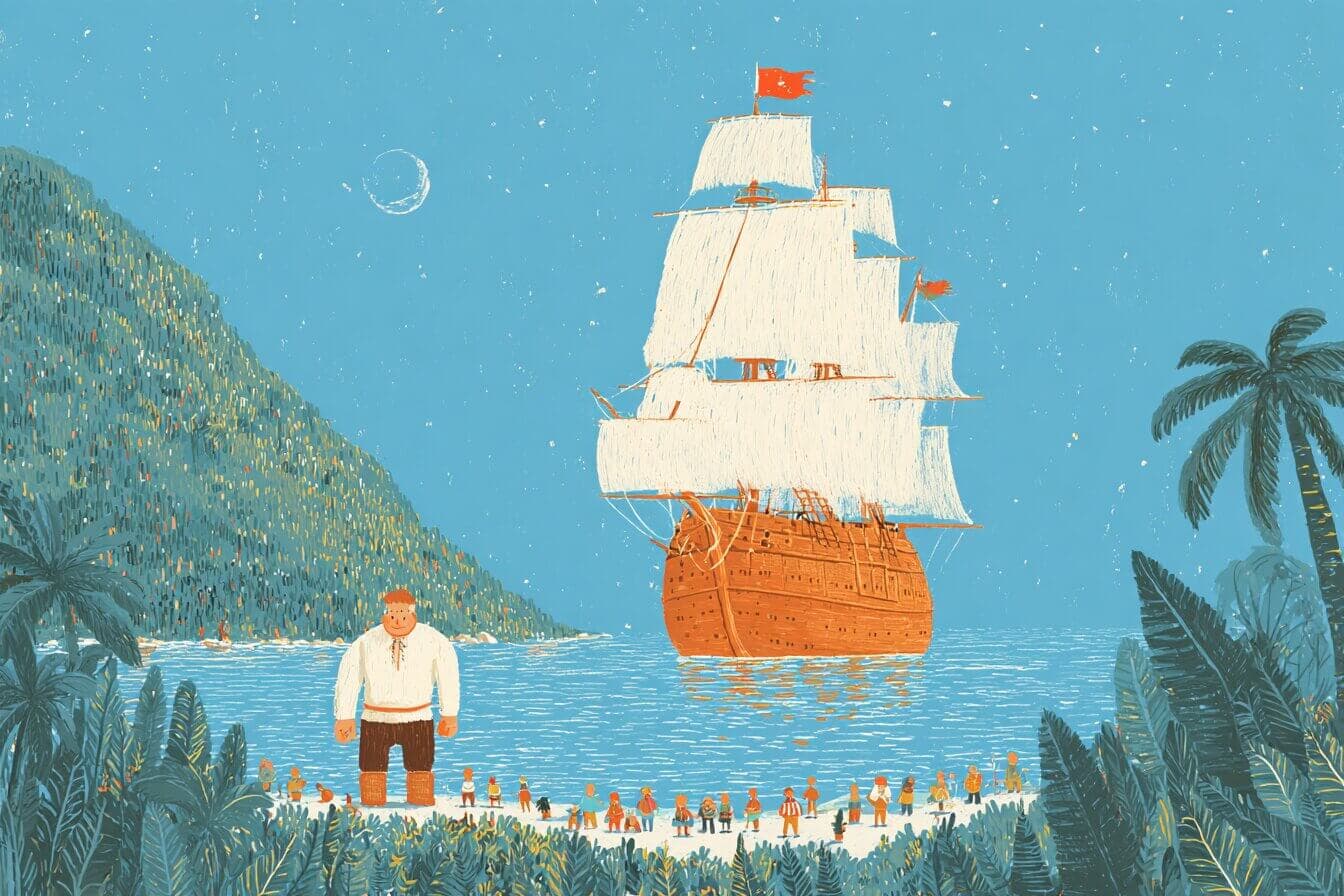
There is something about a lantern beam sweeping across dark water that makes a child's whole body settle into the pillow. Tonight's Gulliver's Travels bedtime story follows Dr. Oliver Bell, a ship's doctor who washes ashore on an island of thimble-sized people and must earn their trust one careful step at a time. It is gentle, it is unhurried, and it ends with a lighthouse glow that feels like a goodnight hug. If your little one loves the idea, you can craft your own version with different characters and settings inside Sleepytale.
Why Gulliver's Travels Stories Work So Well at Bedtime
The idea of a giant tiptoeing among tiny people is naturally calming. Everything slows down. Footsteps become deliberate, voices drop to whispers, and even honey is served in a thimble. For children, that shift in scale mirrors the way bedtime asks them to move from the loud, fast daytime into something smaller and softer. A bedtime story about Gulliver's world invites kids to imagine being gentle on purpose, and that kind of focused imagining is remarkably good at quieting a busy mind.
There is also a deep comfort in the idea that someone very big can choose to be very kind. Children spend their days surrounded by grown-ups who are, from a kid's perspective, giants. When Oliver kneels to meet Lira's eyes or walks slowly to avoid blueberry huts, it tells a child that size and power do not have to be frightening. That reassurance is exactly the feeling you want lingering as the lights go out.
Dr. Oliver and the Lilliput Lighthouse 10 min 59 sec
10 min 59 sec
Dr. Oliver Bell had served as the ship's doctor aboard the merchant vessel Starling for three calm years. He kept a tin of peppermint tea in his coat pocket and a habit of humming sea shanties while he bandaged scraped knuckles. So when a midnight storm cracked the mast in two and threw him into silver water, the only thought he managed before going under was, "I never finished my tea."
He did not drown.
Salt stung his eyes, but through the spray he caught the pale curve of a beach, barely longer than a dining table. He dragged himself onto it, coughing up seawater that tasted like it had opinions, and collapsed under a daisy as tall as a ship's wheel. The petals blocked the wind. He slept.
Dawn came gold and warm. Oliver opened one eye and found a circle of people the size of thimbles aiming sewing needles at his nose.
Their leader, a bright-eyed captain named Lira, planted her boots on his collar button and declared him a "mountain man sent by the tide." Oliver tried to sit up slowly, very slowly, and explain that he was simply a doctor who loved peppermint tea. The Lilliputians cheered anyway and declared him their protector, which Oliver suspected he had not actually agreed to.
They led him along paths woven from spider silk. The city appeared around a bend: rose-petal flags snapping in the breeze, walnut shells drifting like boats along a brook, and a bakery the size of a matchbox pumping out a smell so warm Oliver's stomach growled loud enough to rattle windows. Everywhere he stepped, citizens shouted directions so he would not squash their blueberry huts. One hut had a crooked chimney that puffed lavender smoke. He liked that one.
He promised to be careful. They rewarded him with a thimble of honey and a hammock stitched from dandelion fluff. That night he lay beneath the stars while tiny musicians climbed onto his shoulder and played reed flutes. The melody was thin and strange and perfect. He fell asleep before the second song ended.
Not every heart welcomed the giant.
Chancellor Grip, a stout Lilliputian whose beard was twirled into a tight spiral that bounced when he talked, warned the court that giants brought trouble. He challenged Oliver to prove his kindness by rescuing the royal bees, which had flown into the neighboring valley of Grodden, home of the Brobdingnag mice. Oliver looked at Lira. Lira shrugged. Oliver accepted.
At sunrise he carried Lira and six soldiers across meadows where dewdrops sat on grass blades like wobbly glass beads. They crossed a matchstick bridge that creaked under his thumb. The soldiers sang a marching song with more enthusiasm than melody, and Lira corrected their rhythm with a tiny drumstick on his knuckle.
When they reached Grodden, Oliver found the bees huddled inside a cracked teacup half buried in moss. They were buzzing, panicked, bumping against porcelain. He knelt, cupped his hands around the cup, and sang a lullaby his mother used to hum when the kettle whistled. It had no real words, just a wandering tune that went nowhere in particular. The bees settled. One landed on his fingertip, cleaned its face, and flew calmly into the air. The rest followed.
On the return journey he used a daisy stalk as a walking stick and placed each foot with the concentration of someone crossing a room full of sleeping cats. He did not crush a single mouse home, though he came close once and muttered "sorry" to a startled mouse who was hanging laundry on a twig.
The bees trailed behind him like a golden cloud. The air smelled of honey all the way home.
Back in Lilliput, festivals bloomed. Children painted his boots with berry juice in patterns he could not quite decode. Bakers crafted tiny bread loaves shaped like stethoscopes, which Oliver found both flattering and slightly strange. He taught them first aid using grass blades as splints and buttercup petals as bandages. They taught him to weave baskets from pine needles, and he was terrible at it, but nobody said so.
Together they built a lighthouse from sunflower stems, thick and golden, anchored with pebbles. Oliver climbed inside the tower and lit a firefly lantern. The glow was emerald green. It swept across the waves like a slow, steady breath.
Grip still scowled.
He claimed Oliver's footprints had changed the river's course, which was, to be fair, partially true. A puddle now sat where a bend used to be. To settle the matter, Oliver offered to map the entire island from above. He climbed a maple tree, balanced on branches that swayed under him, and drew for three days on parchment no larger than a leaf. He hummed sea shanties the whole time and got sap on his elbows.
When the map was finished, even Grip went quiet. He held it up, turned it, squinted, and said, "The hill by my house looks taller in person." But he did not scowl.
The Lilliputians printed copies on mushroom paper and traded them with distant towns.
Oliver's homesickness faded like morning mist, though sometimes he caught himself staring at the horizon, searching for sails that were not there. Lira noticed. She always noticed.
She climbed onto his knee and asked if he wished to leave.
Oliver knelt so their eyes could meet. "I miss my crew," he said. "But I have found a new crew in you." He paused. "Both things are true at the same time."
Lira proposed building a boat large enough for Oliver to sail home yet small enough for Lilliputians to crew alongside him. They named the vessel Unity before they had even drawn the plans.
For weeks the island buzzed with work. Carpenters carved oars from toothpicks, tailors stitched sails from butterfly wings, and cooks packed barrels of honey cakes into the hold. Oliver carved a figurehead shaped like a bee, sanding it smooth with a scrap of moss until it gleamed.
Launch day came with dolphins leaping around the hull and gulls wheeling overhead.
Lira stood at the bow, spyglass pressed to her eye, her coat flapping. "Ready?" she called.
"No," said Oliver honestly. "Let's go anyway."
They sailed at sunset, following constellations Oliver had taught them to read. The ocean stretched and stretched. The Unity was small, but it cut the water like a dragonfly skimming a pond. When full dark came, glowing jellyfish drifted around the hull, painting the water turquoise. Lilliputians hung over the railing to watch. Oliver played his tin whistle, and the music drifted out across the moonlit tide until it became part of the quiet.
Weeks passed. They reached a port where towering humans gathered at the dock and stared in amazement at the tiny crew waving from the rigging. Oliver stepped ashore and introduced his friends to merchants who traded spices for stories. The Lilliputians sold maps, jars of honey, and songs performed on the spot, earning enough gold to buy a fleet of miniature ships. Lira haggled harder than anyone Oliver had ever met.
Oliver found his former captain in a tavern near the harbor. The old man wept, hugged Oliver so hard his ribs ached, and promised to protect the Lilliputians with everything he had. Together they signed treaties of friendship between empires large and small, the ink still wet when the celebration started.
Before sailing back, Oliver planted a sunflower seed in the harbor cobblestones. "For a new lighthouse," he said. Lira nodded, satisfied.
Back on Lilliput, the islanders crowned Oliver not as a king but as a friend. Grip attended the ceremony. He did not clap, but he did not leave, and for Grip that was something.
Seasons turned. The Unity sailed on, carrying Oliver, Lira, and any child brave enough to dream of distant shores. They rescued stranded crabs, delivered mail to mermaids, and once helped a lost star find its constellation, though Oliver was never entirely sure how that worked.
Every evening Oliver told bedtime stories about peppermint tea and gentle giants. Lilliputians danced around coral fires, their shadows flickering tall against the sand. And whenever waves grew wild, the lighthouse beam, bright as a promise, swept across the dark and guided every ship safely home.
One quiet night Oliver sat on a pebble, writing in his journal with a seagull feather. The ink kept smudging. He wrote that the world is vast, yet hearts can be vaster still.
Lira read over his thumb and nodded.
"Even the smallest voice," she said, "can calm the largest storm."
They watched dawn paint the sky peach. Neither spoke for a while. The lighthouse still glowed behind them, faint now against the growing light, and the sea was so calm it barely whispered.
The Quiet Lessons in This Gulliver's Travels Bedtime Story
This story is rich with lessons that settle gently into a child's mind right before sleep. When Oliver places each foot with painstaking care to avoid crushing blueberry huts, children absorb the idea that real strength looks like slowness and attention, not force. His willingness to accept Grip's challenge, even when the welcome feels uncertain, shows that trust is earned through patient action rather than argument. And the moment Oliver admits to Lira that he misses his old crew while loving his new one teaches kids that two feelings can be true at once, a reassurance that is especially comforting when a child is processing a complicated day. These are not lessons announced with a fanfare; they arrive quietly, wrapped in honey and starlight, exactly the way bedtime should feel.
Tips for Reading This Story
Give Lira a confident, clipped voice, someone who is always two steps ahead, and let Grip sound grumbly and slightly nasal so his grudging silence at the ceremony lands as a real moment of change. When Oliver sings the lullaby to calm the bees in Grodden, try actually humming a wandering, wordless tune instead of reading the description; it shifts the room's energy instantly. At the very end, when Oliver and Lira watch the sky turn peach without speaking, let the silence sit for a few seconds before you close the book.
Frequently Asked Questions
What age is this story best for? Children ages 3 to 8 tend to love it most. Younger listeners are drawn to the scale play, like honey served in thimbles and boots painted with berry juice, while older kids appreciate Oliver's quiet negotiations with Grip and the idea of signing friendship treaties between big and small worlds.
Is this story available as audio? Yes. Press play at the top of the story to hear it read aloud. The audio version brings out details that reward listening, like the thin reed-flute music on Oliver's shoulder, the creaking matchstick bridge, and the moment the jellyfish light up the water around the Unity. Oliver's tin whistle scene is especially lovely when you can just close your eyes and hear it.
Why does this version use a doctor instead of the original Gulliver? Dr. Oliver Bell keeps the spirit of Jonathan Swift's voyage to Lilliput, the giant among tiny people, the political tensions, the careful footsteps, but softens the satire into something cozy for young listeners. Making him a doctor gives him a natural reason to be gentle and helpful, which lets the story focus on kindness and trust rather than the sharper humor of the original.
Create Your Own Version
Sleepytale lets you reshape this island adventure into something perfectly suited to your child's imagination. Swap the sunflower lighthouse for a coral tower, replace Dr. Oliver with a friendly librarian or a curious kid, or move the whole voyage to a cloud kingdom instead of Lilliput. In a few moments you will have a calm, replayable tale that feels like a safe voyage your family can return to every night.
Looking for more bedtime story classics?

Once Upon A Time Stories
What happens when June opens a golden book with no title? One of the sweetest short once upon a time stories about a forest, a hedgehog, and a blank page.

Fairy Tales Written By Hans Christian Andersen
Anders discovers short fairy tales written by Hans Christian Andersen as his grandmother reads from a soft brown book by lamplight.

Bluebeard Fairy Tale
In this short bluebeard fairy tale, the forbidden room holds not horror but a music box and memories of the people Lord Corvus loved most.

Red Shoes Fairy Tale
What happens when Karen's magical red shoes refuse to stop dancing? Discover this short red shoes fairy tale tonight.

Twinkle Twinkle Little Star Bedtime Story
Lily watches a kind star and floats up to help deliver dreams in this short twinkle twinkle little star bedtime story. A warm, quiet tale for sleepy nights.
Through The Looking Glass Bedtime Story
Step into a calm, magical short through the looking glass bedtime story and drift toward sleep with gentle wonder. Enjoy a soothing retelling that feels cozy from start to finish.