

Quick answer
Most babies begin to truly play with toys around 3 to 6 months, once they can reliably reach, grasp, and bring objects to their mouth, though they engage with faces, light, and sound from the very first weeks. Real toy play builds slowly, from batting at a mobile, to gripping a rattle, to stacking and sorting near the first birthday. Sleepytale fits the quiet end of that same arc, with screen free audio stories and lullabies that help your baby wind down once playtime is over.
If you have a basket of toys ready and waiting, you may be wondering when your baby will finally start using them. The honest answer is that play begins much earlier than most people expect, it just does not look like play at first. Below we walk through what to expect at each stage, when babies start grabbing toys, how they interact with them as they grow, and what to do if your little one seems uninterested for now.
When Do Babies Start to Play With Toys?
Play does not start with a toy at all. It starts with you. In the first weeks of life, your baby is busy studying your face, turning toward your voice, and tracking light as it moves across the room. That focus and curiosity is the foundation of play, and it is already hard at work long before your baby can hold anything.
Toy play in the way most parents picture it, where a baby actually reaches for an object and does something with it, tends to arrive around 3 to 6 months. That is when reaching and grasping come together with enough head and trunk control to make a toy useful. From there it grows quickly, month by month, into the busy, hands on play of the first birthday and beyond.
What Age Do Babies Play With Toys? A Month by Month Guide
Every baby moves at their own pace, so treat these as gentle signposts rather than a strict schedule.
Birth to 3 months. This is the watching and listening stage. Your baby is drawn to high contrast patterns, faces, and slow movement, so simple black and white cards and a soft mobile are far more useful than anything they could hold. A few minutes of tummy time near a low mirror gives them something to focus on while they build neck strength.
3 to 6 months. Reaching and grasping begin in earnest. Your baby starts batting at hanging toys, then grabbing and holding lightweight objects like a wooden rattle or a fabric ball. Almost everything goes straight to the mouth, which is a completely normal way for babies to explore texture and shape.
6 to 9 months. Now play gets more deliberate. Your baby passes toys from one hand to the other, bangs them together, and discovers cause and effect by dropping things over and over to see what happens. Sitting up frees both hands, which opens up a whole new world of objects to investigate.
9 to 12 months. This is when classic toy play clicks into place. Babies love putting things into containers and taking them out, knocking down stacks, and exploring simple stacking rings. The pincer grasp, using the thumb and one finger, lets them pick up smaller pieces with surprising focus.
When Do Babies Start Grabbing Toys?
Grabbing arrives in stages. Around 3 to 4 months, most babies begin swiping or batting at toys within reach, often missing more than they hit. By 4 to 5 months, that turns into a real, intentional grab, although the grip is whole hand and a little clumsy. Over the next few months it becomes steadier, and somewhere around 9 to 12 months the pincer grasp appears, letting your baby pick up tiny objects with care. If your baby is reaching and gripping a bit later than a friend's baby, that is usually nothing to worry about, since this range is wide and very individual.
How Do Babies Interact With Toys at Each Stage?
Early on, interacting with a toy mostly means mouthing it, since the mouth is one of a baby's most sensitive tools for learning. After that comes banging, shaking, and the famous dropping game, where your baby releases a toy again and again and watches you pick it up. It can feel repetitive to us, but to your baby it is a fascinating experiment in cause and effect. By the end of the first year, interaction becomes purposeful, with babies fitting, stacking, and beginning to use objects for what they are actually meant to do.
The key thing to remember is that there is no wrong way for a baby to play with a toy. Chewing a block, dropping it, and banging it on the floor are all real learning.
What If Your Baby Is Not Interested in Toys Yet?
If your baby would rather stare at the ceiling fan or your face than touch the lovely toy you bought, you are in good company. Some babies are slower to warm up to objects and prefer people, movement, and sound for longer. A few simple things tend to help: offer one toy at a time instead of a crowded pile, get down on the floor at their level, and give them an unhurried moment to reach before you intervene. Following your baby's lead almost always works better than steering them.
That said, you know your baby best. If you have ongoing worries about how your baby is reaching, gripping, or responding, your pediatrician is the right person to talk to, and there is never any harm in asking.
From Playtime to Bedtime
Here is something many new parents discover the hard way. A long stretch of stimulating play can leave a baby wired rather than tired, especially toward the end of the day. Little nervous systems take in a lot, and they need a gentle off ramp before sleep just as much as they need stimulation while awake.
That is the moment a calm, screen free wind down really earns its place. Dimming the lights, slowing your voice, and shifting from busy toys to something soft and steady tells your baby's body that the day is closing. A quiet audio companion fits this perfectly, since there is nothing to look at and nothing to grab, only a warm voice and a soothing tune.
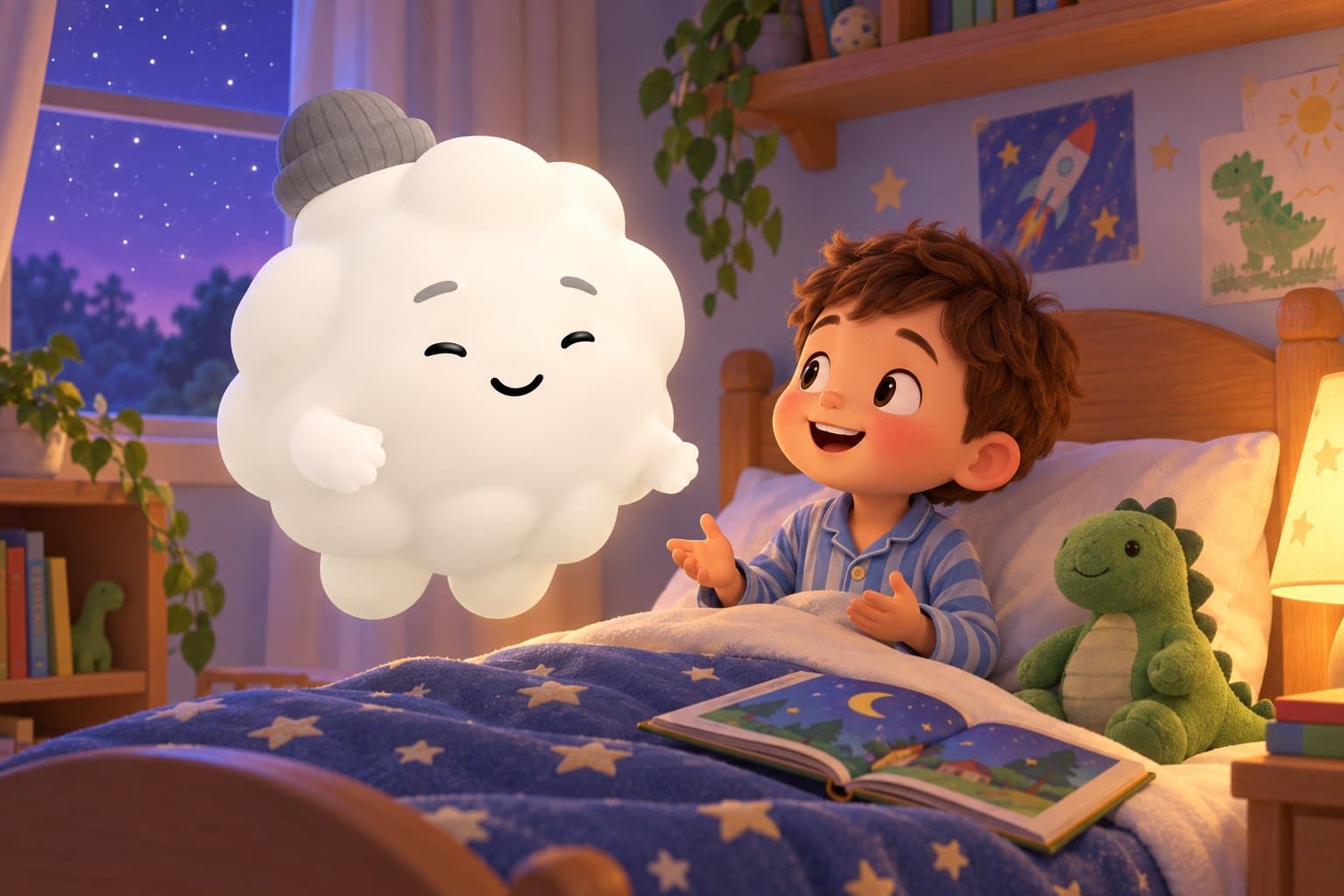
That is the part we care about most at Sleepytale. Cleo, our gentle cloud companion, turns the end of the day into a calm personalized bedtime story or a soft lullaby for children, all without a screen. It will never replace a basket of good first toys, and it is not meant to. Think of it as the quiet bookend to a day full of reaching, grabbing, and discovering.
Frequently Asked Questions
When do babies start playing with toys?
Most babies begin to truly play with toys around 3 to 6 months, once they can reach, grasp, and bring objects toward their mouth. Before that, from birth, they are still engaging with the world by watching faces, tracking light and movement, and listening, which is the earliest form of play.
What age do babies start grabbing toys?
Babies usually start batting at toys around 3 to 4 months and begin grabbing and holding them on purpose around 4 to 5 months. The grip is clumsy at first and gets more precise over the following months, ending with the pincer grasp using the thumb and finger around 9 to 12 months.
How do newborns interact with toys?
Newborns interact mostly with their eyes and ears rather than their hands. They focus on high contrast patterns, watch faces, and turn toward sounds. Simple black and white cards and a gentle mobile suit this stage far better than anything they need to hold.
What are the best toys for a baby learning to play?
Lightweight, easy to hold objects work best, such as a wooden rattle, soft fabric balls, a simple mirror for tummy time, and stacking rings near the first birthday. The goal is to support reaching, grasping, and early hand and eye coordination with safe, simple things.
Why is my baby not interested in toys yet?
Interest in toys comes in waves and varies a lot from baby to baby. Some babies prefer faces, voices, and being carried for longer than others, and that is normal. If you have ongoing concerns about your baby's development, it is always worth raising them with your pediatrician.
How can I encourage my baby to play with toys?
Get down on the floor with your baby, offer one toy at a time, and follow their lead rather than rushing them. Narrate what you are doing, give them a moment to reach, and keep the play area calm and uncluttered so a single toy can hold their attention.
Make Bedtime the Calm Part of the Day
Sleepytale creates personalized bedtime stories around the things your child loves, narrated in a warm voice and ready in seconds. After a busy day of reaching, grabbing, and discovering, let Sleepytale carry your little one off to sleep. Try it free tonight.
Looking for more parenting guides?
AI Safety for Kids
A practical AI safety for kids checklist for parents of ages 2 to 10: privacy, content filters, honesty, parental controls and no ads. From Sleepytale.
Is ChatGPT Safe for Kids? A Parent Guide
Is ChatGPT safe for kids? An honest look at ages, risks, and what to check, plus how Sleepytale offers a kid-built AI friend for bedtime.
Is Character AI Safe for Kids? A Parent Guide
Is Character AI safe for kids? A plain-spoken guide to the risks parents raise, what to check, and what a safe AI companion for children looks like. Sleepytale.

Can AI Be a Friend to Your Child
Can AI be a friend to your child? A calm parent's guide to what AI companions are, the real risks, healthy limits, and how Sleepytale fits in.
Benefits of AI for Kids
Explore the real benefits of AI for kids, from learning support to creativity, plus the limits that matter. A calm parent guide from Sleepytale.
AI Imaginary Friends for Kids
Is an AI imaginary friend healthy for your child? Sleepytale explains why kids bond with AI, the real risks, the right age, and how to set limits that keep real friends first.