
Violin Bedtime Stories
By

Dennis Wang, Bedtime Story Expert
7 min 27 sec
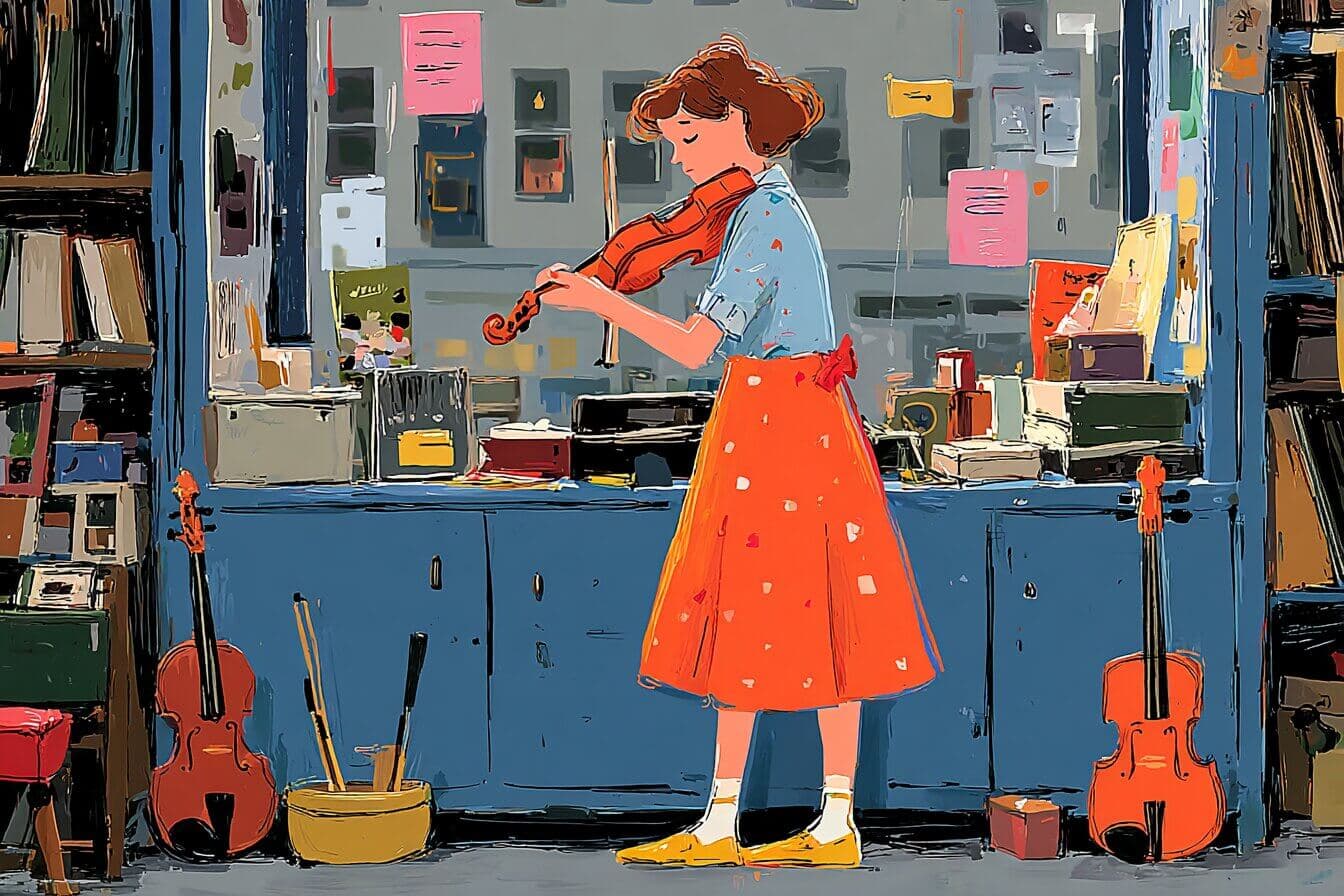
There is something about the sound of a violin that feels like being wrapped in a warm blanket, each note soft enough to carry you toward sleep. In The Violin That Waited, a boy named Rowan discovers a mysterious girl who plays a glowing violin each evening in a dusty music shop, unlocking memories hidden inside its honey colored wood. It is one of those short violin bedtime stories that stays with you, full of starlight and gentle wonder. You can even create your own magical version with Sleepytale.
Why Violin Stories Work So Well at Bedtime
There is a reason violin music appears so often in lullabies and calm evening playlists. The instrument's voice sits close to the human voice, and children respond to that warmth instinctively. A bedtime story about a violin taps into that same feeling, wrapping the narrative in something familiar and soothing. When kids imagine the sound of strings, their breathing naturally slows, making the transition to sleep feel effortless. Violin stories also carry a sense of mystery that appeals to young listeners. The instrument itself looks elegant and old, as if it holds secrets inside its curved wood. That quality invites imagination without overstimulation, which is exactly what bedtime calls for. Children can picture the music without needing loud action or bright spectacle, and that gentle focus helps them drift off peacefully.
The Violin That Waited 7 min 27 sec
7 min 27 sec
The violin at the back of the music shop has no price tag.
Its wood glows like honey held to fire, and the strings hum when anyone walks past, even when no bow touches them.
Mr.
Alder, the shop owner, dusts it every morning with a cloth the color of river stones.
When children ask to hold it, he smiles but shakes his head.
“Not mine to give,” he says, and that is all he says.
Every evening, ten minutes before closing, the bell above the door gives a single silver jingle.
A girl steps inside.
She wears a coat the deep green of pine needles after rain.
Her boots never squeak on the old floorboards.
She nods once to Mr.
Alder, lifts the violin, and plays one song with her eyes closed.
The notes rise like birds startled from a field, swirling around the lamps until the glass shades ring.
When the last echo fades, she rests the violin on its velvet pad, turns, and leaves.
No bow, no case, no goodbye.
Mr.
Alder never learns her name.
He tries once, clearing his throat as she reaches the door.
“Child, what should I call you?” She pauses, fingers on the handle.
“Call me the echo,” she answers, and then she is gone into the night fog.
One autumn evening, a boy named Rowan hides behind the drum sets.
He is supposed to be practicing scales for his lesson, but he has waited to see the echo girl.
When she plays, he feels the music tug at his chest like a kite string.
After she leaves, Rowan creeps out.
Mr.
Alder is locking the cash box.
The violin still vibrates on its stand, a faint shiver in the wood.
“Why does she come?” Rowan whispers.
“To remember,” Mr.
Alder says.
He does not explain what memory needs music, and Rowan’s tongue feels too heavy to ask again.
The next night Rowan returns, earlier this time.
He sits on a stack of lesson books near the violin.
Mr.
Alder lets him stay.
“She might not appear if she senses a watcher,” the old man warns.
Rowan pulls his knees to his chin and tries to breathe like wallpaper.
At eight minutes to closing, the bell rings.
The girl steps inside, coat dripping rain.
She sees Rowan.
Her eyes widen, pale as moonlit ice, but she does not flee.
Instead she lifts the violin, tucks it under her chin, and plays.
This time the song is different.
It begins soft, like snow falling on cedar, then quickens into hoofbeats across frozen ground.
Rowan’s heartbeat keeps pace.
The music paints pictures behind his eyelids: a bridge of woven starlight, a mountain that hums instead of wind, a mother wrapping her child in wings instead of blankets.
When the final note lands, the shop is silent except for the rain against the windows.
Rowan discovers tears on his cheeks.
The girl lowers the violin.
She studies him the way someone studies a reflection, curious and a little sad.
“You heard the journey,” she says.
Her voice sounds older than her face.
“I heard… my mom,” Rowan answers, though his mother is alive and cooking dinner three blocks away.
Still, the song smelled like her cinnamon, felt like her hands rubbing his back after nightmares.
The girl nods.
“The violin remembers for us.” She touches the scroll, gentle as stroking a sleeping cat.
“Once it belonged to a sky sailor who tied clouds to ship masts.
He traded it for safe passage through a storm.
Then it passed to a queen who wanted to learn grief.
Each owner left a story inside the wood.
When I play, the stories wake.” Rowan swallows.
“Why only you?” She smiles, small and crooked.
“Because I am the last story.” Rowan wants to ask what that means, but the clock clicks to closing time.
Mr.
Alder lifts the lantern from the counter, signaling the end.
The girl turns to leave.
Without thinking, Rowan reaches out.
His fingers brush her sleeve.
A spark jumps between them, bright blue.
The lights flicker.
For an instant, the shop fills with the scent of pine and salt.
Then the girl is gone, door swinging shut behind her.
Mr.
Alder locks up, face unreadable.
“Best head home, lad.
Stories need rest too.” That night Rowan dreams of feathers made of sheet music.
He wakes before dawn, pulls on his sneakers, and runs through empty streets back to the shop.
The windows are dark, but he sees a shape inside: the girl, standing motionless beside the violin.
She is translucent, like breath on winter air.
Rowan presses his palm to the glass.
She looks up.
Her lips move.
Two words: Help me.
He tries the door.
Locked.
He circles the building, heart hammering.
Behind the shop, a narrow window stands ajar.
Rowan wedges it wider, scrapes through, and drops into the storage room.
Dust and the sour smell of old metronomes greet him.
He tiptoes past stacks of trumpet cases into the main shop.
The girl stands where she was, but fainter.
The violin glows brighter, pulsing like a lighthouse.
Rowan steps closer.
The air feels thick, as if the room is underwater.
“I’m stuck between notes,” she whispers.
“The violin kept my story, and now it wants to finish it.
But I can’t remember the ending.” Rowan remembers his mother saying every song needs a listener.
“Play for me,” he says.
“Maybe I can hold the ending.” She lifts the instrument.
Her bow trembles.
The first note cracks, then steadies.
Music spills, raw and new.
Rowan closes his eyes.
He sees the girl standing on a cliff above a sea of clouds.
She holds a silver thread tied to the moon.
She must choose: let go and drift into sky, or tie the thread to earth and become human.
The thread snaps.
She falls, not down but sideways, into a place without wind or time.
There the violin waits, offered by hands made of starlight.
Rowan opens his eyes.
Tears streak the girl’s face.
He reaches into his pocket and pulls out a small seashell his mom gave him years ago.
“Put this inside,” he says.
“A new story to finish the old one.” She opens the violin’s F hole.
The shell slides in, clicking against the wood.
Light bursts, soft and warm.
The girl solidifies, coat bright again.
The violin’s glow dims to a candle flicker.
“I can leave now,” she says, wonder in her voice.
“But the violin must stay.
It needs a new echo.” Rowan understands.
He places his hand on the strings.
They feel alive, humming like bees.
“I’ll come every evening,” he promises.
“I’ll play what I remember of your song until someone else needs to remember.” She smiles, the first full smile he has seen.
“Close your eyes.” He does.
She kisses his forehead, light as pages turning.
When he opens them, he stands alone beside the violin.
The shop is ordinary again: dusty shelves, scuffed floor, morning light leaking through the blinds.
On the counter lies a single pine needle and a seashell-shaped pick.
Rowan tucks both into his pocket.
He lifts the violin, tucks it under his chin, and begins to play.
The notes stumble at first, then rise, carrying the echo of a girl who walked through rain and left behind a sky sailor’s lullaby.
Outside, the city bus sighs and rolls forward.
Inside, the music keeps going, soft and steady, until the bell above the door rings once more.
The Quiet Lessons in This Violin Bedtime Story
This story explores patience, generosity, and the courage to help someone you barely know. Rowan shows patience by returning to the shop night after night, sitting quietly among lesson books just to understand the mysterious girl and her music. His generosity shines when he offers his mother's treasured seashell to complete a stranger's unfinished story, expecting nothing in return. At bedtime, these gentle lessons remind children that kindness often means showing up, listening closely, and giving something of yourself when it matters most.
Tips for Reading This Story
When reading the echo girl's dialogue, try a soft, slightly distant voice that sounds older than you would expect from a child, especially when she says 'Call me the echo.' Slow your pace during the second performance scene where the music paints pictures of starlight bridges and humming mountains, letting each image linger before moving to the next. When Rowan whispers 'I heard my mom,' pause for a full breath so the emotion can settle before Mr. Alder lifts his lantern and signals closing time.
Frequently Asked Questions
What age is this story best for?
This story works beautifully for children ages 5 to 10. Younger listeners will love the magical details like the glowing violin and the translucent girl who appears at closing time, while older children will connect more deeply with Rowan's emotions when the music unexpectedly reminds him of his mother. The themes of memory and promise keeping are simple enough for little ones yet layered enough to spark conversation with older kids.
Is this story available as audio?
Yes, just press play at the top of the page to hear the full story read aloud. The audio version brings special life to the moment when the echo girl's music paints swirling images of a starlight bridge and a mountain that hums, and you can hear the shift in tone when Rowan quietly realizes the song reminded him of his mother's cinnamon scent. It is a lovely way to wind down before sleep.
Why does the violin glow and hum on its own in this story?
In the story, the violin holds the memories of every person who ever owned it, from a sky sailor who traded it during a storm to a queen who wanted to learn grief. Those collected stories live inside the wood, causing it to glow and hum whenever someone walks past. The echo girl explains that when she plays, the stored stories wake up and fill the room with vivid images and emotions.
Create Your Own Version
Sleepytale turns your child's ideas into personalized bedtime stories filled with warmth and wonder. You can swap the violin for a piano or a music box, move the setting from a cozy shop to a moonlit forest, or replace the seashell with a favorite toy from your child's own room. In just a few moments, you will have a calm, cozy tale ready to carry your little one off to sleep.
Looking for more music bedtime stories?

Rock Bedtime Stories
A dad's secret past as a crowd surfing guitarist sparks a family jam session in one of our favorite short rock bedtime stories.
Rap Bedtime Stories
Ever wondered why short rap bedtime stories help kids sleep? Suki's sticky note rhymes and Milo's shoebox surprise say it all.
Pop Bedtime Stories
What happens when Mina performs for glowing jellyfish in one of our short pop bedtime stories featuring a silver pearl?
Orchestra Bedtime Stories
Mia's single triangle note unites a quarreling orchestra in one of our favorite short orchestra bedtime stories for little listeners.
Lullaby Bedtime Stories
Enjoy short lullaby bedtime stories like Mira's magical night Lark Lane, where a glowing feather chooses its keeper.

Kpop Bedtime Stories
A copper gold seed leads Jennie through Central Park in one of our favorite short kpop bedtime stories.