
The Three Little Pigs Bedtime Story
By

Dennis Wang, Bedtime Story Expert
10 min 41 sec
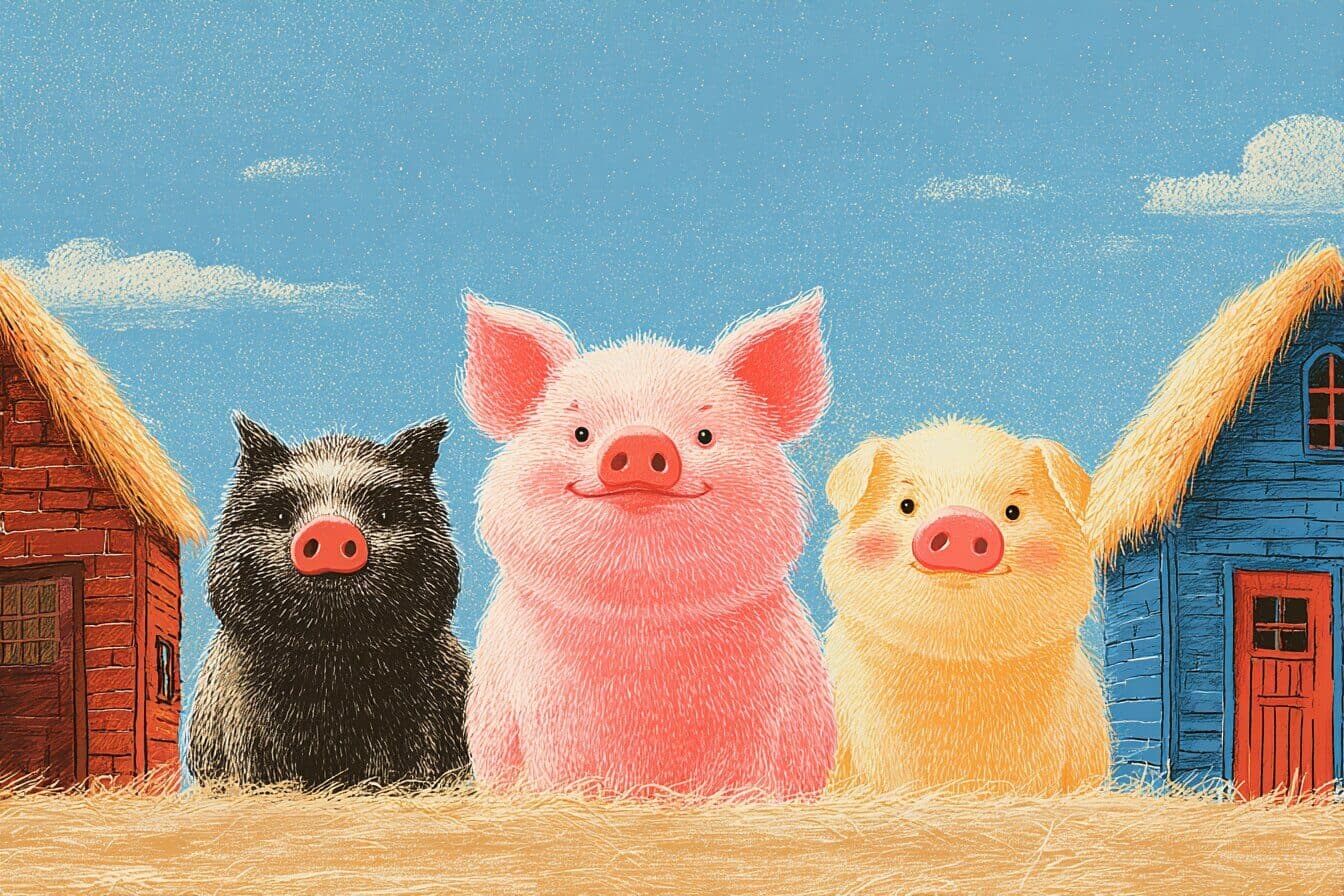
There is something about straw, sticks, and bricks that makes a child's mind go quiet and curious at the same time, especially when the lights are low and the blankets are pulled up. This gentle retelling follows Percy and his two brothers as they build three very different homes in a forest clearing, then invite a science-loving wolf to see what the wind can do. It is exactly the kind of the three little pigs bedtime story that turns building and testing into something cozy instead of scary. If you want to reshape the characters, setting, or ending into something perfectly suited to your little one, you can create your own version with Sleepytale.
Why Three Little Pigs Stories Work So Well at Bedtime
The three little pigs is one of those tales children ask for again and again, and there is a good reason it fits the bedtime window so naturally. The plot follows a clear, repeating pattern: build, test, learn, build better. That rhythm mirrors the way a child's breathing slows when they settle into something predictable. The houses grow sturdier as the story moves forward, and that quiet arc from wobbly to solid feels like being tucked in tighter with each paragraph.
A bedtime story about three little pigs also gives kids a safe way to sit with a little bit of worry, the huff, the puff, and then watch it resolve into something warm. The wolf knocks, the walls hold or don't, and every outcome leads to learning rather than danger. By the time the last house stands firm, children have practiced feeling brave from the safety of their pillow. That is a powerful thing to carry into sleep.
Percy and the Three Wise Houses 10 min 41 sec
10 min 41 sec
Percy the pig woke with a plan that tickled his snout and pushed his thoughts into neat little rows, the way beans line up in a garden.
He and his brothers, Felix and Bruno, were building homes of their own today.
Percy kept a notebook tied with a ribbon and a short pencil that smelled like cedar. He had sharpened it so many times that it was barely longer than his thumb, but he refused to throw it away because it still had ideas left in it. Every choice, he figured, was a learning choice.
Felix wanted straw. Fast, soft, and he liked the whispery sound it made when a breeze tiptoed through. Bruno wanted brick because he liked to stack things until they made squares and tidy towers. Percy chose sticks, because he enjoyed walking through the forest counting rings on fallen branches and wondering how trees grew so high with only water, air, and light.
Before anyone lifted a tool, Percy called his brothers close.
If we build three different houses, he said, we can compare them and discover which one keeps us safe, dry, and comfortable.
Felix grinned. Bruno nodded. A game that also taught you something felt like two warm muffins in one basket.
They sketched a little map of the clearing and placed three colored stones where each house would stand. Percy had read that good builders start by checking the ground, so they looked for level spots and dangled a string with a pebble tied to the end to see what was straight. When the string hung still, they smiled and clapped, but softly, because the birds were singing a morning song that sounded like tiny bells and nobody wanted to interrupt.
Felix bundled straw into bright yellow bales, giggling as bits stuck to his elbows.
Straw, Percy explained, is the dried stalk of plants like wheat, barley, or rye. It has little hollow parts that hold air, and air is a good insulator. Keeps warmth in and heat out, just like a blanket.
Felix stacked the bales into walls that smelled like summer, tied them with twine, and left a round hole for a window. One bale had a ladybug sitting on top of it, and Felix worked around her. She didn't move all morning.
Bruno carried bricks that were heavy and red. Percy reminded him that bricks are baked clay, sticky mud with tiny particles that pack together well. When heated in a kiln, they grow strong and hard. Bruno mixed mortar with sand, lime, and water, then spread it with a trowel until it looked like frosting between cake layers. He kept wiping his hands on his apron, which was already so dusty it had turned from white to pink.
Percy collected straight sticks and sorted them by thickness. Thick ones for the frame. Thin ones for weaving. He used simple knots and asked a friendly beaver by the stream how to make better joints. The beaver showed him a notch that let one stick sit snugly on another, then slipped back into the water without another word, the way beavers do. Percy recorded the tip on a clean page labeled Joints that do not wobble.
They worked through the morning, and Percy kept time with a song: hammer tap, stack and clap, measure twice, no mishap.
When the sun climbed, he reminded everyone to drink water and rest in the shade, because builders take care of their bodies like they take care of their beams.
By afternoon, three houses rose like a set of storybook pictures.
Felix's straw house was golden and felt like a big nest. Bruno's brick house was square and solid, with a neat chimney and a blue door he had painted carefully from top to bottom to keep the brushstrokes smooth. He stepped back to admire it, tilted his head, then fixed one spot near the handle where the paint had dripped.
Percy's stick house looked like a woodland cottage with a triangle roof. He had braced each corner with diagonal pieces after reading that triangles do not change shape as easily as squares. He taught his brothers a chant: a triangle stays, a square sways, add a brace and the wind obeys.
To make it a fair test, they decided to learn about weather, because a house must greet the sky kindly and stand up to its moods. Percy drew a wind sock from a scrap of cloth and a hoop of willow, then mounted it on a pole. He taught his brothers about the Beaufort scale, a way to describe wind by what it does. If leaves rustle, that is a gentle breeze. If small trees sway, that is a fresh breeze. If whole trees bend, that is a strong gale, and it is better to stay inside with hot cocoa and a book.
They also looked at clouds. Puffy cumulus promising fair weather. Thin cirrus warning of a change. Tall gray ones that might carry rain.
When the wind sock fluttered lively, their friend arrived at the edge of the clearing.
A wolf.
So often called big and bad in stories that his ears drooped at the nickname, though his heart was set on science.
He cleared his throat and spoke softly.
My name is Wally, and I like to test how air moves, he said. Not to scare anyone, but to learn and to help others learn.
Percy nodded. We were wondering about wind and walls, and we want to measure, not guess.
Wally brightened, because measuring made his tail swish like a metronome set to a happy beat. He showed them how to count breaths and use a ribbon tied to a twig to see the direction of a gust. The ribbon pointed and danced, so they followed its cue.
First, Felix's straw house.
Felix went inside with a thermometer in a jar. Wally stood a safe distance away so he would not step on the little garden Felix had planted with marigolds, and he took a deep breath. Before he huffed, Percy placed small stones at the corners of the bales and tied an extra rope around the roof.
Then Wally huffed and puffed like a musician blowing a tuba, steady and round. The straw rustled and shifted. A few bales leaned, and a bundle popped loose because one knot had been too quick and too small.
Felix came out and laughed. Not meanly. The kind of laugh that bubbles up when you realize you just learned something you didn't know you needed.
Percy showed him a square knot instead of the granny knot, using the ribbon. They tried again, and this time the house wavered but did not tumble.
Straw insulates well, Percy noted. Build with careful ties and add cross ropes. The thermometer showed the inside was warmer than outside, and Felix beamed. A cozy fact he could hold.
Next, Percy's stick house.
Wally stood back and took a gentle breath, then a stronger one. The wind pressed on the walls, and Percy watched the diagonal braces do what triangles do: hold their shape and share the push through the frame. A few thin twigs creaked like tiny violin strings, so Percy added two more braces, creating a web that looked both pretty and strong.
Forces move through materials, he explained, just like water finds paths through soil. A good builder helps forces find safe paths.
Felix and Bruno touched the braces, feeling how firm the corners had become. Something about pressing your hand flat against a wall and feeling it not give is deeply satisfying, and they stood there a moment longer than necessary.
They hung a simple barometer: a jar with a balloon stretched over its mouth and a straw taped across the top. As air pressure changed, the straw lifted and lowered like a thoughtful finger. Percy marked the changes on paper with little dots that made a graph.
When a playful gust passed through the clearing, leaves jumped, and a small branch tapped the stick roof. Percy had planned for that. He had spaced the roof sticks and covered them with woven reeds so rain could slide away. They splashed a bucket of water and watched it run in gentle lines into a barrel, because saving water is kind and clever.
Your house listens to the wind, Wally said.
Percy wrote that down too, because buildings that listen last longer.
Then Bruno lifted his trowel like a captain raising a sail.
My turn, he said, and everyone walked to the red house that looked as steady as a quiet mountain.
Wally tested the brick house last. He inhaled and blew in three neat breaths. The ribbon quivered.
The bricks did not notice.
Heavy materials have more inertia, Percy explained. They resist changes in motion. Same reason a big stone stays put when you bump it, while a leaf flies when you whisper at it.
Bruno put his cheek to the wall and felt the coolness. Bricks store heat during the day and release it slowly at night, keeping a home even and calm. They knocked gently and heard a solid sound instead of a hollow one.
Brick with mortar makes a strong shell, Percy wrote, but it takes time and patience, and the foundations must be level. He measured a corner with a square and showed Felix the perfect right angle.
Wally shared one more idea. Air moves from high pressure to low pressure, like a curious traveler who seeks the open door. If your homes have good seals around windows and doors, you can decide where fresh air enters through vents and keep out the drafts you do not want.
The brothers tried strips of felt around the doors and noticed how the breeze changed from wild to gentle. Bruno pressed the felt into the doorframe and then opened and closed the door three times, listening to the difference. The third time he just stood there with his hand on the knob, satisfied.
The clouds that had been building turned silver and soft gray, and the first raindrops tapped like friendly fingers.
The straw roof whispered.
The stick roof hummed.
The brick roof held steady and quiet.
They went inside Bruno's house together to share hot cocoa and read aloud from a book about weather and houses that solve problems. The cocoa had a little too much cinnamon, but nobody said anything because it was warm and the rain outside made everything else taste better.
They did not choose one house as the only winner.
Felix added better knots and a small porch to shelter his door. Percy added a second layer of reeds and a lattice for vines to climb and shade the walls in summer. Bruno added a rain chain that guided water to a barrel with a happy clink, clink, clink.
Wally waved goodbye through the rain and promised to return, not as a fright, but as a friend who liked to help with tests.
Percy closed his notebook and drew three little houses, side by side. The ribbon on his pencil fluttered like the tail of a friendly kite, and outside, the rain was already slowing to a whisper.
The Quiet Lessons in This Three Little Pigs Bedtime Story
This particular retelling weaves curiosity, patience, and cooperation into every scene without ever stopping to lecture about them. When Felix's knot fails and he laughs at the loose bale instead of panicking, children absorb the idea that mistakes are just information, something small enough to fix with a better knot and a second try. Percy's habit of writing everything down and asking the beaver for help shows kids that being smart is not about already knowing; it is about being willing to ask and record what you learn. And Wally, the wolf whose ears droop at his own reputation, gently teaches that people are not always what their labels say. These themes land especially well at bedtime, when a child's mind is open and soft, because the reassurance that tomorrow's mistakes will be small and fixable is exactly the kind of thought that makes it easy to close your eyes.
Tips for Reading This Story
Give Wally a low, careful, slightly scholarly voice, the kind of wolf who would own reading glasses, and let Felix sound bouncy and quick whenever he talks about straw. When Percy recites the chant, "a triangle stays, a square sways, add a brace and the wind obeys," slow down and tap the rhythm on the edge of the book so your child can feel the beat. Pause after the rain chain goes clink, clink, clink and ask your little one what sound their house makes when it rains.
Frequently Asked Questions
What age is this story best for?
Children between about three and seven tend to enjoy it most. Younger listeners love the huffing and puffing scenes with Wally, the repeating chant about triangles, and the simple physical details like Felix's ladybug on the straw bale. Older kids in that range start to grasp the science bits, like why bricks have more inertia or how the little balloon barometer works, and they enjoy feeling clever alongside Percy.
Is this story available as audio?
Yes. You can press play at the top of the story to hear it read aloud. The audio version really shines during Wally's tuba-like huffing and the three different roof sounds at the end, where the straw whispers, the sticks hum, and the bricks hold quiet. Those contrasting moments land beautifully when you can actually hear them shift in tone, and the rhythmic chant about triangles becomes almost singable.
Why is the wolf friendly in this version?
Wally is reimagined as a science enthusiast rather than a villain because the story focuses on learning and testing rather than fear. His curiosity about how air moves turns the classic huffing and puffing into a wind experiment, which lets kids enjoy the familiar pattern of the tale without any real threat. It is a nice way to show children that characters, like real people, can surprise you when you give them a chance.
Create Your Own Version
Sleepytale lets you reshape this cozy tale of three pig brothers into something uniquely yours. Swap the forest clearing for a seaside dune, replace straw with sand and seashells, or turn Wally into a helpful pelican who tests the ocean breeze. In just a few moments you get a calm, personalized story ready to read whenever bedtime needs to feel easy.
Looking for more bedtime story classics?

Once Upon A Time Stories
What happens when June opens a golden book with no title? One of the sweetest short once upon a time stories about a forest, a hedgehog, and a blank page.

Fairy Tales Written By Hans Christian Andersen
Anders discovers short fairy tales written by Hans Christian Andersen as his grandmother reads from a soft brown book by lamplight.

Bluebeard Fairy Tale
In this short bluebeard fairy tale, the forbidden room holds not horror but a music box and memories of the people Lord Corvus loved most.

Red Shoes Fairy Tale
What happens when Karen's magical red shoes refuse to stop dancing? Discover this short red shoes fairy tale tonight.

Twinkle Twinkle Little Star Bedtime Story
Lily watches a kind star and floats up to help deliver dreams in this short twinkle twinkle little star bedtime story. A warm, quiet tale for sleepy nights.
Through The Looking Glass Bedtime Story
Step into a calm, magical short through the looking glass bedtime story and drift toward sleep with gentle wonder. Enjoy a soothing retelling that feels cozy from start to finish.