
Space Station Bedtime Stories
By

Dennis Wang, Bedtime Story Expert
10 min 16 sec
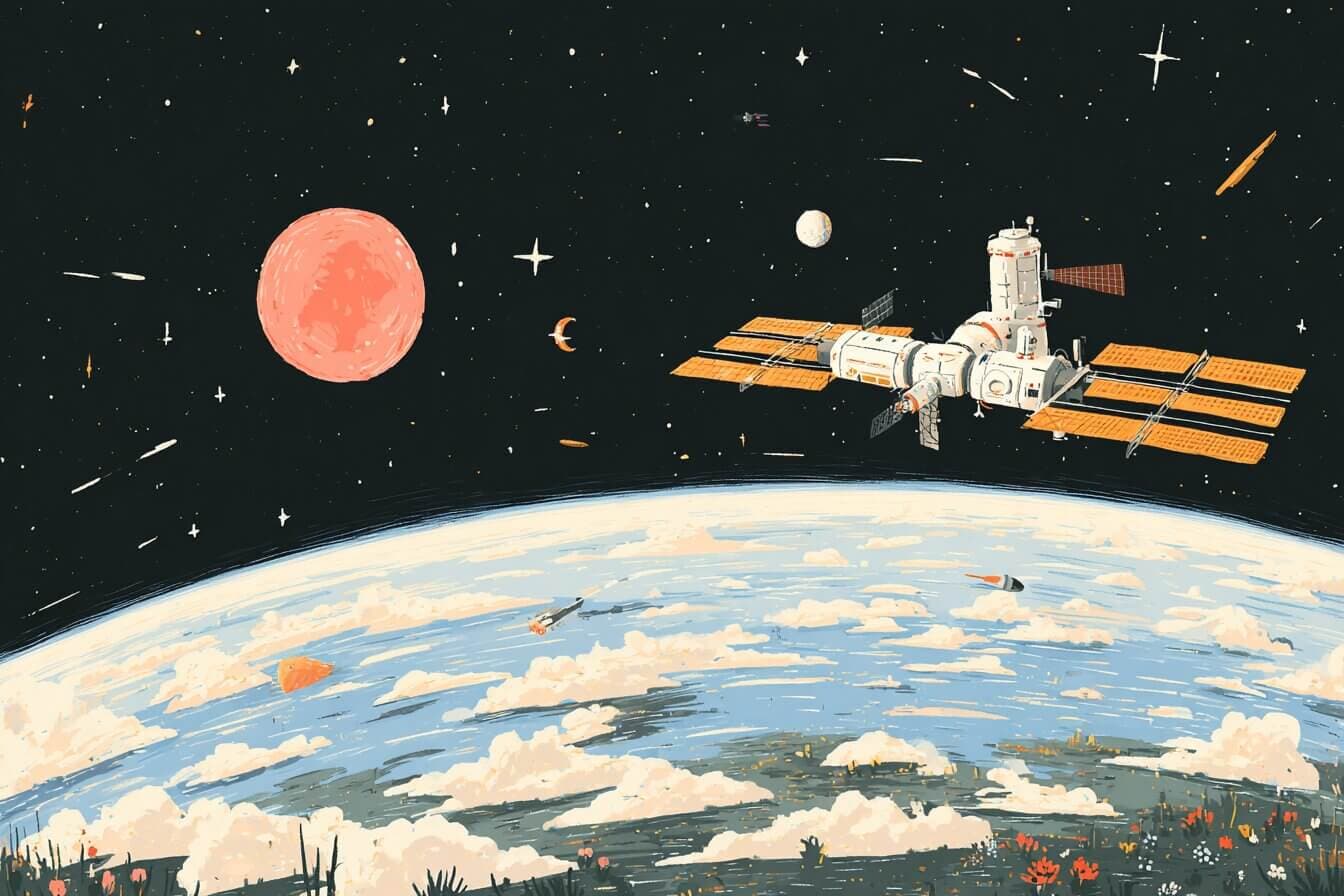
There is something about the hum of a spacecraft at night that makes even grown-ups want to close their eyes and drift. In this story, Captain Mia and her crew aboard Starlight Station try to send a goodnight wave down to Earth, but floating peas, runaway crumbs, and a stowaway spider keep interrupting the plan. It is one of our favorite space station bedtime stories, gentle enough for the smallest listeners and detailed enough to hold an older kid's imagination. If you want to build your own version with different characters, wishes, or planets, you can create one in minutes with Sleepytale.
Why Space Station Stories Work So Well at Bedtime
A space station is, when you think about it, the coziest possible setting for a story before sleep. Everything is enclosed, softly lit, and humming. The crew has a routine: check the panels, eat together, look out the window, zip into sleeping bags. For kids, that predictable rhythm mirrors their own bedtime rituals, and hearing it repeated in orbit makes brushing teeth and climbing under covers feel like part of something bigger.
There is also the quiet wonder of looking down at Earth from above. A bedtime story about a space station gives children a way to think about the whole world settling in for the night, not just their own room. It stretches their sense of belonging without adding any anxiety. The darkness outside the station is not scary; it is full of stars. And the crew always comes back to the window in the morning, which is exactly the kind of reassurance a child needs before closing their eyes.
Starlight Station's Goodnight Wave 10 min 16 sec
10 min 16 sec
Captain Mia floated to the wide window of Starlight Station and pressed her nose against the glass. It was cold, the kind of cold that makes your breath catch for half a second before you remember to exhale.
Below, the great blue Earth spun slowly, wrapped in cloud swirls that looked like sheep wandering across a meadow they could never quite reach the edge of.
She waved. She knew nobody could see her hand from down there, not really, but tonight was the night the station sent its special goodnight wave to everyone on the planet, and waving felt like the right way to start.
She pressed the silver button on the wall. Every light on the station blinked three times.
The radio crackled.
"Goodnight, Starlight Station, goodnight!" Happy voices from mission control tumbled over each other.
Mia giggled, her hair drifting around her face like seaweed that had forgotten which way was up, and she hurried down the corridor to gather her crew.
First she found Dr. Leo, the station's scientist, chasing runaway peas around the galley. They had escaped from a pouch during dinner prep and were now orbiting Leo's head in a slow, smug parade. Together, Mia and Leo scooped the floating green pearls one by one, dropping them back into the pouch with little satisfying clicks.
"Pea soup tomorrow," Leo said, sealing it shut.
Next they woke Pilot Zoe, who had fallen asleep strapped to the wall with a book hovering open in front of her nose. The page had drifted to chapter nine. Zoe rubbed her eyes, tucked the book into a Velcro pocket without marking her place (she always remembered anyway), and followed Mia through the round doorway into the observation dome.
Engineer Raj was already there, polishing the giant lens that let them see whole continents at once. He greeted them with a thumbs up and pointed to the sunset line creeping across the Pacific Ocean. It moved like a golden zipper, slow and steady, closing the day behind it.
Mia tapped the intercom and spoke in her gentlest voice.
"This is your captain speaking. Goodnight to the children in Tokyo. Goodnight to the crickets in Kenya. Goodnight to the puffins in Iceland. And goodnight to the kangaroos in Australia."
Each crew member took a turn. Leo named the elephants in Thailand. Raj named the fireflies of the Appalachian mountains, even though he was not entirely sure they were in season. Zoe named the stray cats of Istanbul because she had read about them in chapter four.
With every name, the station's lights blinked again, sending tiny winks of starlight down toward Earth.
When the list grew so long that Leo lost track, he simply said, "Goodnight to everyone we forgot." That covered it.
The station's robot helper, Tinker, rolled in on magnetic wheels, holding a tray of star-shaped cookies baked earlier that afternoon. They were a little lopsided. The oven on Starlight Station ran slightly hot on the left side, and nobody had figured out how to fix it, so every batch came out with one thick arm and one thin one.
The astronauts munched them while watching the last sliver of sun disappear behind the rim of the world. Crumbs drifted like miniature meteors until Tinker sucked them up with a gentle whoosh of its vacuum hose. It made a small satisfied beep when the last crumb was gone.
Mia opened the music box her daughter had packed in her launch bag. A lullaby tinkled through the cabin, the notes floating like silver bubbles. It was slightly out of tune now. Something about the altitude, or maybe the years. Mia liked it better that way.
Outside, the first stars of Earth's night side sparkled into view, and the solar panels turned to follow the final rays of sunlight.
Zoe pointed.
A shooting star blazed a bright green trail across the atmosphere.
They all went quiet, making wishes.
Raj wished that every child down there would dream of visiting space one day.
Leo wished that every runaway pea would find its way into a happy bowl of soup.
Zoe wished that books would never lose their pages in zero gravity.
Mia wished that the goodnight wave would keep traveling even after they were all asleep, bouncing off rooftops and treetops and the curved backs of sleeping whales.
Tinker recorded their heartbeats and beamed them down as a quiet drumbeat of comfort to anyone still awake. If you had very good ears, and you stood outside at just the right moment, you might have heard it. Probably not. But maybe.
The lights inside the station dimmed to amber, the color of fireflies on a summer lawn.
One by one the astronauts floated to their sleeping bags and Velcroed themselves to the walls. Leo's bag was blue. Raj's was green. Zoe's was red with a small ink stain near the zipper from a pen that had exploded during launch. She called it her racing stripe.
Mia zipped herself in last. She reached out and tapped the window once more, the glass cool under her fingertip.
"See you tomorrow, Earth."
She closed her eyes.
Outside, the station continued its circle, a silver guardian orbiting the sleeping world. Cities lit up below like scattered diamonds on dark velvet. The only sounds were the soft whir of fans and the occasional clink of equipment settling for the night.
In mission control, a lone operator smiled at the silent monitor, whispered, "Goodnight, Starlight Station," and clicked off the main console. The screen went dark, then showed one blinking cursor, patient as a heartbeat.
Dreams drifted between the station and the planet. Children rode past Mars, past Jupiter, all the way to the edge of the Milky Way where candy comets sailed in lazy arcs.
Mia dreamed of her daughter's laughter echoing through the modules, loud and bright and bouncing off every wall.
Leo dreamed of peas dancing in a pot of bubbling starlight.
Zoe dreamed of reading bedtime stories to the Moon, which listened very politely and never interrupted.
Raj dreamed of building a bridge of light that would let children walk safely up to the station for a visit, their sneakers squeaking on the rungs.
Tinker dreamed of electric sheep jumping over lunar craters. It did not know why. It was a robot. But the dream came anyway.
As the night deepened, the orbit carried them across silent oceans and sleeping forests, and the goodnight wave kept rippling outward, touching every rooftop, every tent, every boat on every dark sea.
Polar bears paused on their ice floes and looked up at the steady dot of light crossing the sky.
Penguins turned their heads. Whales sang softer songs, as if they understood.
Somewhere over the Sahara, a caravan driver made a wish on the bright dot gliding overhead.
Over the Amazon, a jaguar cub curled tighter against its mother.
Over the Arctic, a grandmother told her grandchild that the light was friends waving from a home among the stars.
Back on the station, the life support systems hummed. Clean air, steady warmth.
The vegetables in the hydroponic garden stretched their leaves toward the dimmed grow lights. The lettuce was doing well. The tomatoes were being difficult, as tomatoes tend to be.
A tiny spider that had accidentally stowed away on the last supply shuttle spun a web in the corner of the storage locker, its silk shimmering like frost. Nobody had the heart to relocate it.
Mia floated out of her sleeping bag one last time, unable to resist.
She saw the sunrise line returning on the far edge, a thin ribbon of gold.
Earth spun on below her, beautiful and fragile, a marble of life in a vast dark sea. She pressed her palm flat against the window, felt the coolness seep into her skin, and sent one last thought downward: "Thank you for looking up."
Then she returned to her cocoon, closed her eyes, and let the gentle tug of orbit rock her to sleep.
The goodnight wave completed its circle.
And the universe, for one quiet moment, felt smaller, kinder, and wonderfully connected.
When morning came, the station's lights brightened slowly, like a sunrise played in reverse. Mia stretched, unzipped, and floated to the window.
Earth greeted her with swirling blues and whites.
She knew tonight they would wave once more.
The Quiet Lessons in This Space Station Bedtime Story
This story is built around the idea that paying attention to others, even from very far away, is a kind of love. When each crew member names a different place and animal during the goodnight wave, children absorb the habit of thinking beyond their own room, their own street, their own country. There is also a gentle thread about small imperfections being perfectly fine: the lopsided cookies, the out-of-tune music box, the stowaway spider nobody removes. Kids pick up on that. It tells them that things do not have to be flawless to be wonderful. And Leo's cheerful acceptance of chasing escaped peas, rather than getting frustrated, shows that patience with little messes is its own kind of strength. All of this arrives softly, without a lecture, which is exactly what a child needs to hear before sleep.
Tips for Reading This Story
Try giving each crew member a slightly different voice: Mia calm and warm, Leo a bit goofy and earnest, Zoe sleepy and dry, Raj steady and kind. When the story reaches the part where they list places and animals for the goodnight wave, slow down and let your child jump in with their own additions. At the moment Tinker beams the heartbeats down to Earth, press a hand gently on your child's chest so they can feel their own heartbeat and imagine it traveling all the way to space.
Frequently Asked Questions
What age is this story best for?
It works well for children ages 3 through 8. Younger listeners love the floating peas, the star-shaped cookies, and Tinker the robot, while older kids connect with the wishes the crew makes on the shooting star and the idea of a goodnight wave circling the whole planet. The vocabulary is simple enough for a three-year-old but the details are layered enough to hold a seven-year-old's attention.
Is this story available as audio?
Yes. You can press play at the top of the story to listen. The audio version brings out moments that land especially well when heard aloud, like the rhythm of Mia's goodnight announcements rolling from Tokyo to Kenya to Iceland, and the quiet hum of the station settling in for the night. Tinker's little beep after vacuuming crumbs is the kind of detail that makes kids smile every time they hear it.
Why is a space station such a good setting for a kids' story?
A space station combines two things children naturally love: the adventure of being somewhere extraordinary and the comfort of a small, enclosed, routine-driven space. In this story, Starlight Station feels like a cozy home that just happens to orbit the Earth. The crew eats together, tidies up, says goodnight, and zips into sleeping bags, all familiar actions transported somewhere thrilling. That blend of the ordinary and the extraordinary helps kids feel brave about the big world while still feeling safe in their own bed.
Create Your Own Version
Sleepytale lets you build your own orbiting bedtime adventure with the same cozy rhythm and gentle pacing. Swap Captain Mia for your child's name, replace Starlight Station with a moon base or a satellite shaped like a treehouse, or change the crew into siblings, pets, or friendly aliens. In a few taps you will have a personalized story to read again and again, with a tone that makes bedtime feel as calm as floating past the stars.
Looking for more kid bedtime stories?
Bedtime Poems For Kids
Discover short bedtime poems for kids through a story where a boy says goodnight to kettles, slippers, stars, and a goldfish named Planet.
Scary Story Ideas For Kids
Looking for short scary story ideas for kids that feel cozy, not overwhelming? Meet Sir Boop, a bow tie wearing ghost who judges spooky slips from an Idea Jar.
Interactive Children's Stories
Discover short interactive children's stories where a girl named Wren makes choices guided by a paper fox bookmark called Flip.
Ghost Stories For Kids
The scariest thing about Puddle the ghost is his giggle, not his boo, in one of the sweetest short ghost stories for kids.

Adventure Stories For Kids
A folded map hidden inside a library book sends two friends a treasure hunt in one of our favorite short adventure stories for kids.
Native American Stories For Kids
Discover short native american stories for kids through a fireside tale of geese, gratitude, and a grandfather's gentle wisdom.