
Ramadan Bedtime Stories
By

Dennis Wang, Bedtime Story Expert
9 min 12 sec
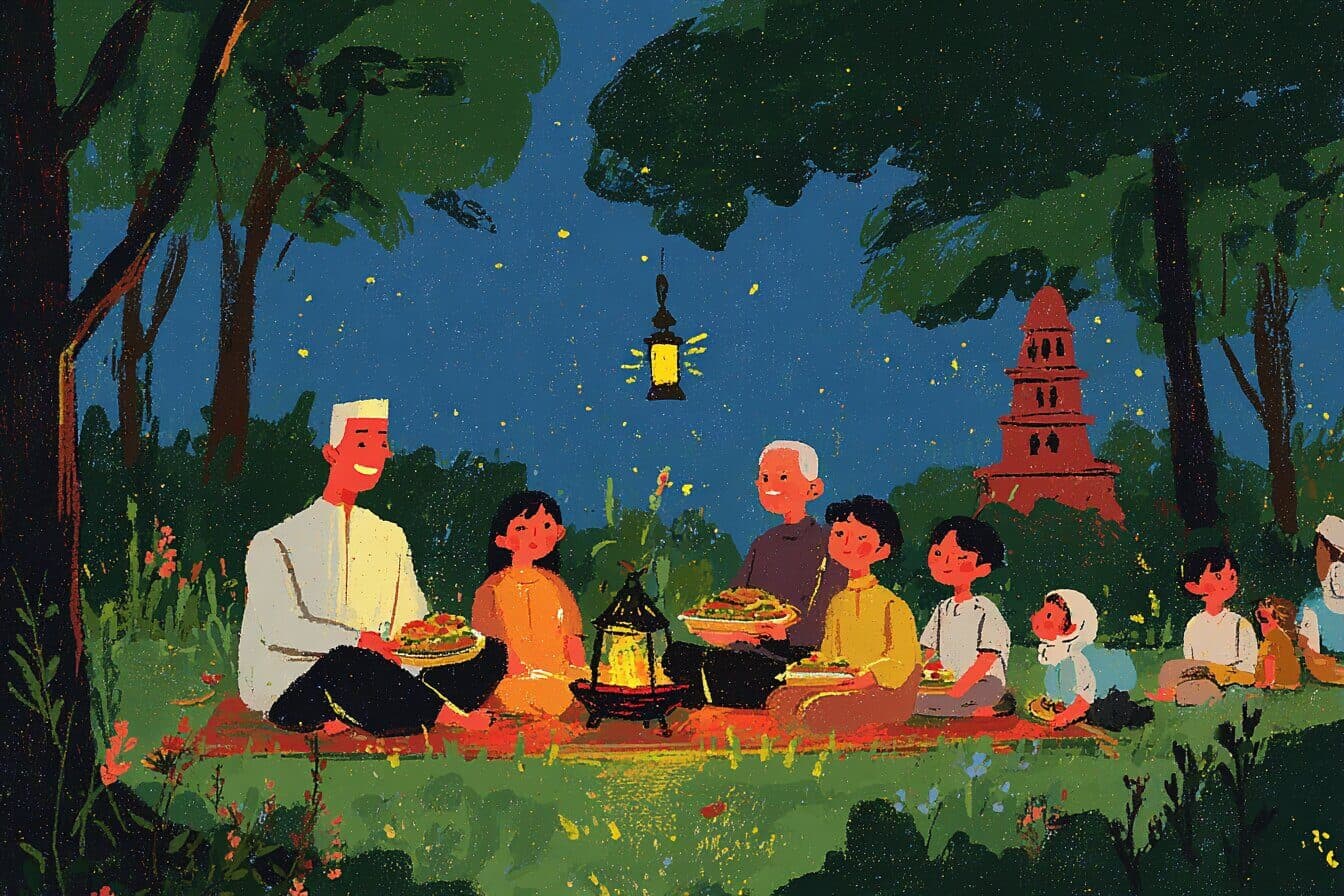
There is something about the smell of warm rice and dates drifting through a house at dusk that makes everything feel unhurried, like the whole evening is holding its breath for you. Tonight's story follows a girl named Leila who wants to carry the family's iftar tray to the neighbors and discovers that sharing, even in the smallest amounts, has a way of circling back as light. It is one of our favorite Ramadan bedtime stories for winding down during the holy month, when kindness and gratitude are already in the air. If you would like a version with your child's name and your own family traditions woven in, you can create one with Sleepytale.
Why Ramadan Stories Work So Well at Bedtime
Ramadan already reshapes the rhythm of a family's day, and by evening, children are tuned into something quieter and more reflective than usual. A bedtime story set during Ramadan meets them right where they are. The familiar rituals of iftar, the lanterns in the lane, the call to prayer at dusk, all signal safety and belonging, which is exactly the feeling a child needs before sleep.
Stories about Ramadan at bedtime also give kids a gentle way to process big ideas like generosity, patience, and community. When those ideas arrive inside a cozy plot with characters their own age, children absorb them without any pressure. The slow pace of shared meals and neighborhood visits mirrors the slow pace of falling asleep, so by the time the story ends, the transition to rest feels natural.
The Lantern of Sharing 9 min 12 sec
9 min 12 sec
In the desert town of Moonrise Oasis, little Leila pressed her nose against the cool window of her family's clay house until the glass fogged around her face in a small circle.
The crescent moon hung above the minaret like a silver cradle, and the first star of the evening appeared so suddenly it seemed to have been hiding behind nothing at all.
It was the first night of Ramadan.
This year, Mama had promised Leila could help carry the big tray of food to the neighbors, and Leila had been thinking about that promise since morning. She smoothed her blue hijab, the one Mama had embroidered with tiny gold stars, and tiptoed into the kitchen where cinnamon and steaming rice thickened the air until it felt like something you could lean against.
Mama lifted the lid of the largest pot. A cloud of fragrant steam curled up and drifted toward the ceiling fan, which chopped it into ribbons. Inside lay golden rice jeweled with carrots, raisins, and tender lamb that had been simmering since the afternoon call to prayer. Beside it waited a bowl of cool yogurt kissed with mint, a pyramid of honey glazed pastries, and a jug of pomegranate juice so red it looked like it was blushing.
Leila set the jug on the tray and it wobbled once before settling.
Papa checked the sky, then smiled. "It is time."
Together they stepped into the lane. Paper lanterns strung between the houses swayed on their wires, and one of them, a green one near the bakery, had a small tear that made the light spill out in a crooked stripe across the wall. Leila noticed it every time they passed and it always made her smile, though she could not have said why.
Their first stop was Mrs. Farah, the retired teacher who lived alone with her fluffy white cat, Snowpaw.
Mrs. Farah opened her door and gasped, pressing one hand to her chest. Her eyes shone behind silver spectacles. "Bless your hearts," she whispered, accepting the dishes with trembling hands. Then she insisted Leila choose the first date to break her fast. Leila bit into it. The sweetness was almost startling, warm and dense, and she felt it travel all the way down to her toes.
Next they visited Mr. Khalid, the carpenter who had hurt his wrist, and left him a bowl of soup that smelled of lemon and herbs Leila could not name. At every door, Leila watched the same quiet bloom cross people's faces, like a candle being lit behind their eyes.
After seven houses, the tray was empty. Leila felt fuller than she had before they left.
They turned toward home, and the moon seemed to follow. Back in the courtyard, Leila spotted a small lantern she had never seen, sitting on the low wall as if it had always been there. Its glass panes were painted with tiny hearts, and inside flickered a flame that danced even though there was no wind.
Nobody had signed it. Nobody had knocked.
Mama knelt beside her and said, "During Ramadan, kindness has a habit of returning in secret."
That night Leila dreamed of trays that multiplied into hundreds, enough to feed the whole world. She woke with a plan and a crick in her neck from sleeping funny.
The next evening she asked Papa if they could invite someone new to share their iftar table. Papa's eyes crinkled, and together they wrote an invitation on rose scented paper. They walked to the edge of town where the date palms rustled and the houses sat lower to the ground.
There lived Amina, a girl Leila's age who sold woven bracelets by the well. Amina's family had no stove, so they often broke their fast with dry bread and water. When Leila held out the invitation, Amina read it twice before looking up. Her face glowed brighter than the lanterns overhead.
On the third night, Amina arrived wearing a sky blue frock with tiny yellow flowers stitched by her grandmother. Leila greeted her with a hug so tight she heard Amina's shoulder pop.
"Sorry."
"Do it again," Amina said, laughing.
The table was spread with lentil soup, spinach pies, and sesame cookies shaped like crescent moons. Amina tasted everything with her eyes closed, and when she opened them after the spinach pie she said, "That tastes like springtime folded into pastry." Leila decided she would remember that sentence forever.
After eating, the girls helped Mama wash the dishes. Soapy bubbles floated up and wobbled in the lamplight.
"That one looks like a heart chasing a star," Amina said, pointing.
"Love is like that," Leila said, and then felt her cheeks go warm because she was not sure where the words had come from.
When the call for the night prayer echoed over the rooftops, they climbed to the terrace. The town glimmered below like scattered treasure. Amina pointed to the mosque dome shining gold under the moon, and Leila pointed to the houses where their trays had traveled, each window holding a small glow.
They made a secret promise: share food every remaining night of Ramadan, no matter how small the portion.
The following evening they filled a tiny painted box with three dates, two almonds, and a folded note that read, "From our hearts to yours." They tiptoed to the home of Mr. Hamza, the night watchman who guarded the orchards.
Mr. Hamza's face, weathered by years of sun and wind, softened when he opened the box. He stood there looking at it for a long time. Then he told them that years ago his own daughter used to bring him treats before bed, but she had grown up and moved across the sea.
After that, the girls visited him nightly. Olives one night, cheese the next, a single rose from Leila's garden on the night they had nothing else.
On the tenth night, clouds gathered and hid the moon. Wind rattled the shutters so hard Leila's little brother ran to Mama's lap. Leila worried the lantern of sharing might blow out, but inside every home they visited, lamps burned steady.
She stood in the doorway of Mrs. Noura's house, wrapped in an embroidered shawl that smelled like cedar, and realized something she did not quite have words for yet. Love was a shelter. It did not care about storms.
Rain began to fall, soft and insistent, and the girls skipped through puddles that reflected lantern light in broken gold shapes. Mrs. Noura told tales of her childhood when families shared everything, even laughter that was not theirs to keep. Leila stored each story in her heart and did not try to organize them.
By the twentieth night, doors opened before they even knocked. Neighbors pressed small gifts into their hands: a sugared almond, a paper bird, a marble swirled with green and copper. Leila lined these treasures on her windowsill where the morning sun would find them.
One afternoon, while fasting, Leila felt tired and thirsty. Her lips were dry and the shade did not feel cool enough. She sat on the step and thought about quitting. Then she remembered Mr. Hamza's face when he opened the little painted box, and she stood up again. Amina squeezed her hand. "Our hearts are bigger than our hunger," she said, and Leila believed her because Amina never said things she did not mean.
On the final night of Ramadan, the town square hosted a communal feast. Long tables stretched beneath strings of colored bulbs, and the air hummed with chatter, laughter, and the particular sound of dozens of spoons tapping the rims of bowls at once.
Leila and Amina carried their special tray, piled high with Mama's famous honey pastries shaped like tiny lanterns. They set it between platters of couscous, roasted chickens, and towers of golden baklava that listed slightly to the left.
When the cannon sounded at sunset, the square fell into a silence so complete Leila could hear the bulbs buzzing overhead. Everyone raised a date to their lips.
After prayer, they ate together. Strangers and friends shared forks, tasting from one another's plates as if every dish belonged to everyone. Leila saw Mrs. Farah teaching Amina to weave palm fronds into tiny baskets. She saw Mr. Hamza tossing children into the air, each one shrieking that they had nearly touched the moon.
The mayor presented the girls with a silver pin shaped like an open hand. Leila pinned hers on Amina's dress, and Amina pinned hers on Leila's hijab. They did not say anything. They did not need to.
When the new moon of Eid appeared, thin as a drawn bow, the town celebrated with games, songs, and small envelopes of money that children clutched like winning lottery tickets. Leila gave half her envelope to Amina's family. Amina gave half her bangles to Leila's little brother, who immediately put three on one wrist and none on the other.
That night, Leila placed the mysterious lantern on her bedside table. Its painted hearts glowed softly. She stared at it for a while and understood, without anyone telling her, that the flame was not oil or wick. It was the collected light of every shared meal, every quiet smile, every prayer whispered into cupped hands.
She turned on her side. The lantern flickered once.
Outside, the moon crossed the sky the way it always does, steady and unhurried, always returning to light the way home.
The Quiet Lessons in This Ramadan Bedtime Story
At its heart, this story is about generosity that does not demand a stage. When Leila carries the tray to seven houses and comes home feeling fuller instead of emptier, children absorb a truth about giving that no lecture could deliver. Amina's line about hearts being bigger than hunger gently addresses patience and perseverance during fasting, showing kids that discomfort can coexist with purpose. There is also a thread of inclusion running through the plot: Leila does not just help people she already knows, she walks to the edge of town and invites someone in. These are reassuring ideas to carry into sleep, the kind that make tomorrow feel like a place where small, generous choices actually matter.
Tips for Reading This Story
Give Mrs. Farah a wobbly, delighted whisper when she says "Bless your hearts," and let Amina sound bright and sure of herself, especially when she delivers the line about hearts being bigger than hunger. When Leila bites into the first date, pause and ask your child what their favorite iftar food tastes like. Slow your pace during the rainy tenth night and let the descriptions of puddles and lantern light stretch out, so the cozy feeling has room to settle before the story moves on.
Frequently Asked Questions
What age is this story best for?
It works well for children ages 3 to 8. Younger listeners love the sensory details like the soapy bubbles and the crescent moon cookies, while older kids connect with Leila and Amina's friendship and the idea of choosing to share even when it costs something. The gentle pacing and repetitive structure of nightly visits makes it easy for little ones to follow without getting lost.
Is this story available as audio?
Yes. You can press play at the top of the story to listen. The audio version brings out the rhythm of the nightly visits beautifully, and moments like the cannon sounding at sunset and the sudden silence in the town square have a real impact when you hear them rather than read them. It is a lovely option for listening together after iftar.
Can this story be read on nights outside of Ramadan?
Absolutely. While the setting is specific to Ramadan, the themes of sharing food, welcoming new friends, and noticing who in your neighborhood might need company are relevant any time of year. Leila and Amina's promise to share no matter how small the portion is a lesson that fits any season, and the cozy desert town setting works as a bedtime backdrop whenever your family wants a warm, gentle story.
Create Your Own Version
Sleepytale lets you reshape this story to match your family's own traditions and routines. You can swap the desert oasis for your neighborhood, replace the brass tray with a basket or a slow cooker, or turn Leila and Amina into siblings, cousins, or your child's own friends. In a few moments you will have a personalized bedtime story with the same gentle spirit of sharing, ready to read or listen to tonight.
Looking for more holiday bedtime stories?

Palm Sunday Story For Kids
This short palm sunday story for kids reveals that the bravest choice in Jerusalem was made by a small, ordinary donkey.

Purim Story For Kids
Queen Esther's courage shines in this short purim story for kids, complete with spinning graggers and jam stained sleeves.

Valentines Day Bedtime Stories
Help kids drift off with short valentines day bedtime stories that feel warm and reassuring. Enjoy a gentle tale of kindness and learn how to make your own in Sleepytale.
Thanksgiving Bedtime Stories
Settle in with short thanksgiving bedtime stories that warm the heart with family, snow, and gratitude. Enjoy a gentle tale and learn how to make your own cozy version.

St Patricks Day Bedtime Stories
A tiny leprechaun searches a quiet village for missing coins and finds friendship under a soft rainbow. Settle in with short st patricks day bedtime stories for a peaceful night.

New Years Bedtime Stories
Settle in with short new years bedtime stories that soothe little minds and spark gentle hope. Read a cozy family wish craft and learn how to create your own with Sleepytale.