
Prague Bedtime Stories
By

Dennis Wang, Bedtime Story Expert
8 min 52 sec
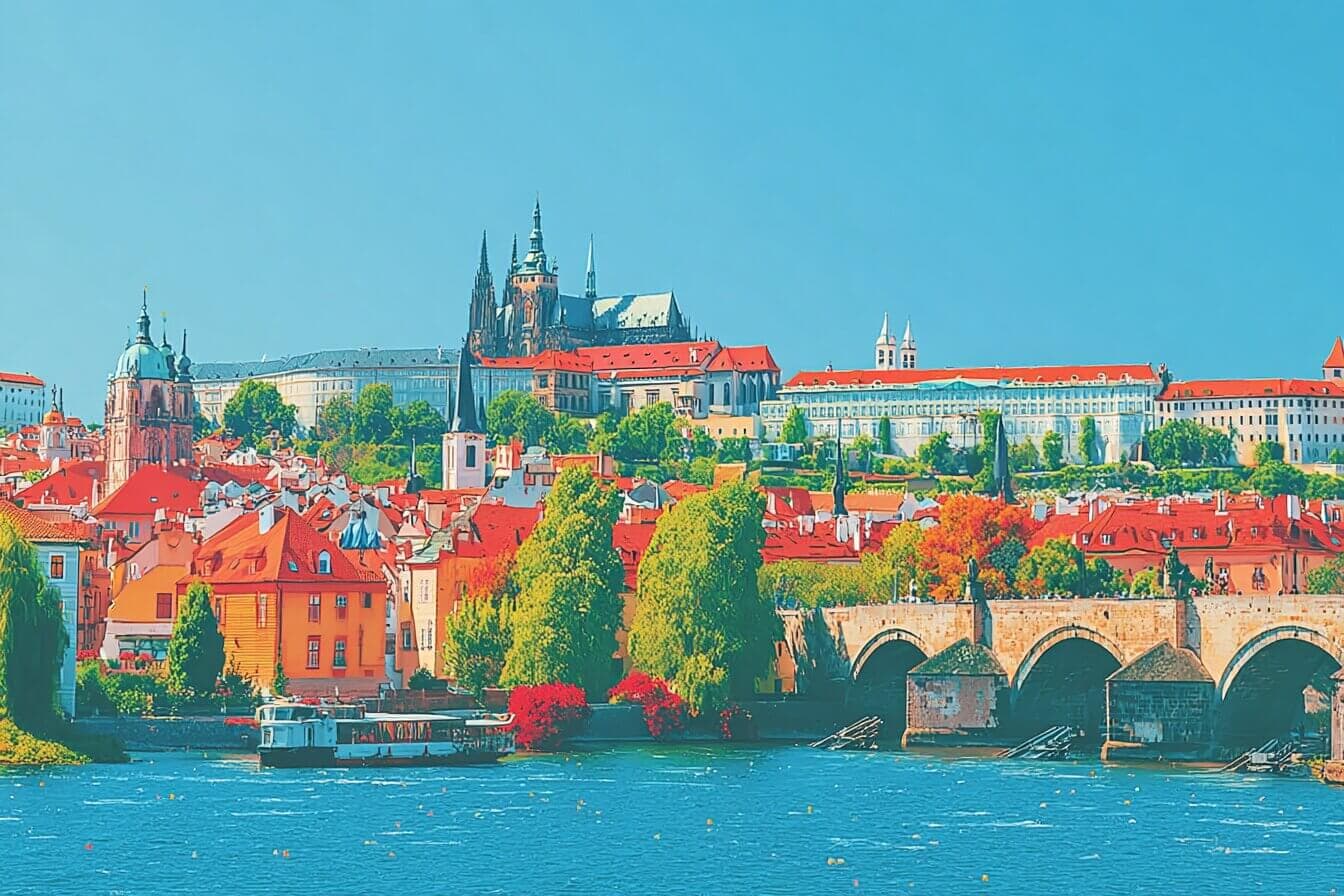
There is something about cobblestones and old clock towers that makes a child's eyes go heavy in the best way. The city feels like it was built for whispered stories, all winding lanes and river mist and statues that look like they might blink if you turn away. In this tale, a tiny clockwork mouse named Terezka teams up with a glowing firefly to solve a riddle and wake the sleeping statues of Charles Bridge for one gentle midnight dance, the kind of Prague bedtime stories that keep wonder soft enough for drifting off. If your child loves a little magic mixed with real places, you can create your own version with Sleepytale.
Why Prague Stories Work So Well at Bedtime
Prague already feels like a place that exists half inside a fairy tale. The bridges, the castle on the hill, the astronomical clock with its little mechanical figures, all of it gives children a sense of being somewhere ancient and safe at the same time. When a bedtime story is set in Prague, kids can picture stone walls still warm from the day's sun and a river reflecting lamplight, and that combination of coziness and mystery helps the mind slow down.
There is also something grounding about a real city. Children know Prague is an actual place on a map, so even when the story adds magic, the setting stays tethered to something solid. That balance between the familiar and the fantastical is exactly what works at bedtime, enough imagination to feel transported, enough reality to feel secure.
The Midnight Parade of Prague 8 min 52 sec
8 min 52 sec
In the silver hush of a moonlit Prague night, tiny Terezka the clockwork mouse wound her way up the cobbled path toward the castle on the hill. Her copper key tail twitched every few steps, clicking faintly against the stones. She had heard the old legends, the ones the clockmaker muttered to himself while polishing gears, that when the astronomical clock struck twelve, the statues on Charles Bridge would wake and dance.
She had waited exactly one hundred nights to see it. Counted every single one.
At the castle gate she met Vojta, a firefly wrapped in a cloak of dark velvet whose glow pulsed in a slow, steady rhythm, like breathing. He landed on the iron latch and bowed so deeply his antennae brushed the ground.
"The statues won't rise," he said, straightening up, "unless someone solves the riddle of the stone lion first. I would have tried myself, but I'm terrible with riddles. Last time I guessed 'cheese' and the lion just stared at me."
Terezka squeaked. Riddles were her favorite game, better even than finding dropped crumbs beneath the clockmaker's workbench.
Together they scampered through quiet courtyards where the guards snored in their sentry boxes, past towers whose shadows fell across them like dark blankets. The air smelled of damp stone and, faintly, of the river. When they reached the lion carved beside the drawbridge, Terezka noticed its mane was chipped on one side, as if someone very long ago had tried to knock a piece loose for a souvenir.
The lion's eyes shimmered with starlight.
"Little mouse," it rumbled, and the voice seemed to come from somewhere deep in the hill itself, "what turns without moving and shines without light?"
Terezka closed her eyes. She thought of her own tiny gears, the way they spun inside her chest but never traveled anywhere. She thought of the clockmaker's face when he talked about his daughter, who had moved to a city far away. The way his eyes would go bright even though the shop was dim.
"A memory," she whispered.
The lion's mouth opened wide, and inside, where a throat should have been, a spiral staircase glowed gold.
Vojta clapped his wings together so fast they made a sound like shuffling cards. "Brilliant. Absolutely brilliant. I would never have gotten that."
They descended into the heart of the hill. The steps were worn smooth in the center from centuries of feet that Terezka could only guess at. At the bottom they found a cavern filled with forgotten statues: saints with their hands raised, heroes leaning on chipped swords, and mythical beasts draped in dust and spider lace so fine it looked almost intentional, like someone had tried to decorate.
A gentle voice echoed from the ceiling, or maybe from the walls, or from everywhere. "The statues can only awaken if given a gift of true wonder."
Terezka reached into her pocket and pulled out a single sunflower seed. She had been saving it for winter, tucking it away the day the clockmaker dropped a handful near the window. It was not much. It was not grand. But she placed it in the stone palm of a child knight whose visor was lifted to show a face no older than seven.
The seed began to glow.
Warm light rippled outward through every statue in the cavern, like a stone dropped in still water. One by one they stirred. A gryphon unfurled granite wings and shook dust from its beak. A bronze mermaid ran fingers through her tangled hair, looking annoyed about the cobwebs. The child knight lifted his sword in salute, and the blade caught the light so that for a moment the whole cavern seemed full of sunrise.
They formed a silent procession and followed Terezka up the staircase into the moonlit streets. The city below was still. The river Vltava shimmered like a ribbon someone had crumpled and then smoothed out, not quite flat, still catching light at odd angles.
Vojta flew ahead to the bridge, landing on the crucifix at its center. He signaled with three bright flashes, quick, quick, slow.
The statues lining the parapets turned their heads.
Trumpets of frost sounded from somewhere no one could see, and the stone saints stepped down from their pedestals. Their joints creaked like old wood, like the floorboards in the clockmaker's shop on cold mornings. They welcomed the newcomers with solemn nods, the way old friends greet each other when words would say too little.
Together the statues formed a circle.
The child knight knelt and asked Terezka to lead them in a dance. She froze. Her gears made a tiny grinding sound that she hoped nobody heard. She had never danced. Not once. She was a mouse the size of a thimble with copper feet.
Vojta landed on her shoulder. "Courage," he said quietly, "is just another kind of step."
So she placed her tiny paw into the knight's stone hand, and she began to twirl. It was clumsy at first, her tail clanking against the cobblestones. But then the rhythm found her, or she found it, and the statues followed. They moved in perfect silence across the bridge, their feet tapping patterns older than Prague itself, older than the river, older maybe than the hill.
Each step sent sparks of moonlight into the air. Pale colors no human eye had ever seen painted themselves across the sky and faded just as quickly.
Terezka laughed, and her voice rang out like a bell so small you would need to hold it to your ear.
As they danced, memories long buried in stone began to surface. A dragon remembered flight, the actual feel of wind under its wings. A saint recalled a kind word spoken to him by a stranger on a road he could no longer name. A queen remembered the laughter of her people during a harvest festival, the smell of bread and apples. These memories did not belong to Terezka, but she felt them pass through her like warmth through glass.
The joy grew so bright that the clock tower itself began to glow.
When the bell finally tolled one, the statues paused. They looked toward the castle. Their time was ending.
But none of them were sad. That was the strange part. They had carried emptiness for so long, and now they carried something else instead.
One by one they returned to their places, folding back into stillness like pages in a closing book. The child knight was last. He knelt again and held out his tiny stone helmet, no bigger than an acorn, as thanks.
Terezka accepted it with a curtsy. He smiled, a real smile that cracked the corner of his stone mouth just slightly, and then he was still.
Vojta escorted Terezka home, lighting her path with gentle pulses. A cat watched them from a windowsill, yawned enormously, and went back to sleep.
At her hole beneath the clockmaker's shop, Terezka placed the helmet beside her bed of cotton and stray thread. Vojta promised to meet her every full moon so they might discover new wonders together. "Though next time," he added, "maybe somewhere with fewer riddles."
Dawn painted the sky peach. Terezka wound her key twice, settled into her cotton nest, and fell asleep dreaming of silent trumpets and dancing stone.
Years later, children still tell of a faint bell like laugh echoing over the river whenever the moon is full. If you visit Prague and stay awake until midnight, you might see a tiny copper mouse darting along the bridge, a firefly glowing above her like a lantern someone forgot to put out.
And if you listen, not with your ears but with the quieter part of you, you may hear the statues whisper.
They say the city keeps her secret. That the stones remember how to dance. That the smallest gift, given honestly, can wake the oldest magic.
So when the wind rattles the shutters and the moon rides high, think of the mouse, the firefly, and the parade that still marches, silent and shining, across the bridge of dreams.
The Quiet Lessons in This Prague Bedtime Story
Terezka's adventure weaves together courage, generosity, and the idea that small things carry more weight than they appear to. When she offers her only sunflower seed, a tiny treasure she had been saving for herself, children absorb the notion that giving something you actually value matters more than giving something grand. Her moment of freezing before the dance, gears grinding, unsure of her own feet, shows kids that bravery is not the absence of doubt but the willingness to try anyway. And the statues' gratitude, quiet and wordless, suggests that real kindness does not need applause. These are exactly the kinds of reassurances that settle well at bedtime, the feeling that tomorrow you can be small and still do something that matters.
Tips for Reading This Story
Give Vojta a slightly breathless, chatty voice, especially when he admits he once guessed "cheese" for the riddle, and let Terezka sound careful and precise, the way a tiny clockwork creature might. When the stone lion rumbles his riddle, slow your voice way down and drop it low so the question hangs in the air for a moment before Terezka answers. At the scene where the statues begin to stir, tap gently on the mattress or the book to mimic their feet on cobblestones, and pause when the child knight smiles before going still so your child can sit with that quiet image.
Frequently Asked Questions
What age is this story best for? This story works well for children ages 4 to 8. Younger listeners love the idea of a mouse small enough to fit in a teacup solving a riddle that stumps everyone else, while older kids appreciate the detail of the statues recovering their own lost memories during the dance. The gentle pacing and the clear journey from castle to cavern to bridge and back home gives even restless listeners a satisfying path to follow.
Is this story available as audio? Yes, you can press play at the top of the story to listen. The audio version brings out moments that really benefit from being heard aloud, especially the lion's deep rumble when he poses his riddle and the contrast with Terezka's small, careful whisper when she answers. Vojta's chatty energy also comes alive in narration, and the quiet stretch after the final bell toll feels perfectly paced for drifting off.
Does my child need to know anything about Prague to enjoy this story? Not at all. The story introduces the Charles Bridge, the castle, and the astronomical clock naturally through Terezka's journey, so children build a picture of the city as they listen. If anything, the tale often sparks curiosity about Prague, and some parents find it fun to look at photos of the real bridge statues together the next day to see which ones might have danced.
Create Your Own Version
Sleepytale lets you turn a few favorite details into a cozy bedtime story set wherever your child's imagination wanders. You could swap Charles Bridge for a lantern lit alley near the river, trade Terezka for a curious kitten with a compass around its neck, or change the gift from a sunflower seed to a smooth pebble or a folded paper star. In just a few moments you will have a soothing tale ready to replay at bedtime whenever your family wants that same gentle sense of wonder.
Looking for more travel bedtime stories?
Washington Dc Bedtime Stories
Ellie steps into bright marble streets and learns how big ideas become kind choices in short washington dc bedtime stories. A calm tour turns curiosity into comfort.

Tokyo Bedtime Stories
Looking for short tokyo bedtime stories that feel calm, magical, and easy to read aloud? Want a gentle tokyo bedtime story you can replay at bedtime.

Singapore Bedtime Stories
Lily arrives in Singapore and discovers rooftop gardens that float between towers in short singapore bedtime stories. She follows a humming seed to a gentle riddle and a citywide bloom.

Shanghai Bedtime Stories
Looking for short shanghai bedtime stories that feel calm and magical for kids? Read a gentle shanghai bedtime story and learn how to make your own cozy version in Sleepytale.

Sf Bedtime Stories
A foggy bridge becomes a quiet portal where a child rescues drifting dreams. Read short sf bedtime stories that glow with wonder and end in calm.

Seoul Bedtime Stories
Soothe bedtime with short seoul bedtime stories that blend gentle city sights, kind choices, and cozy calm for kids. Read a quiet Seoul adventure that settles little minds fast.