

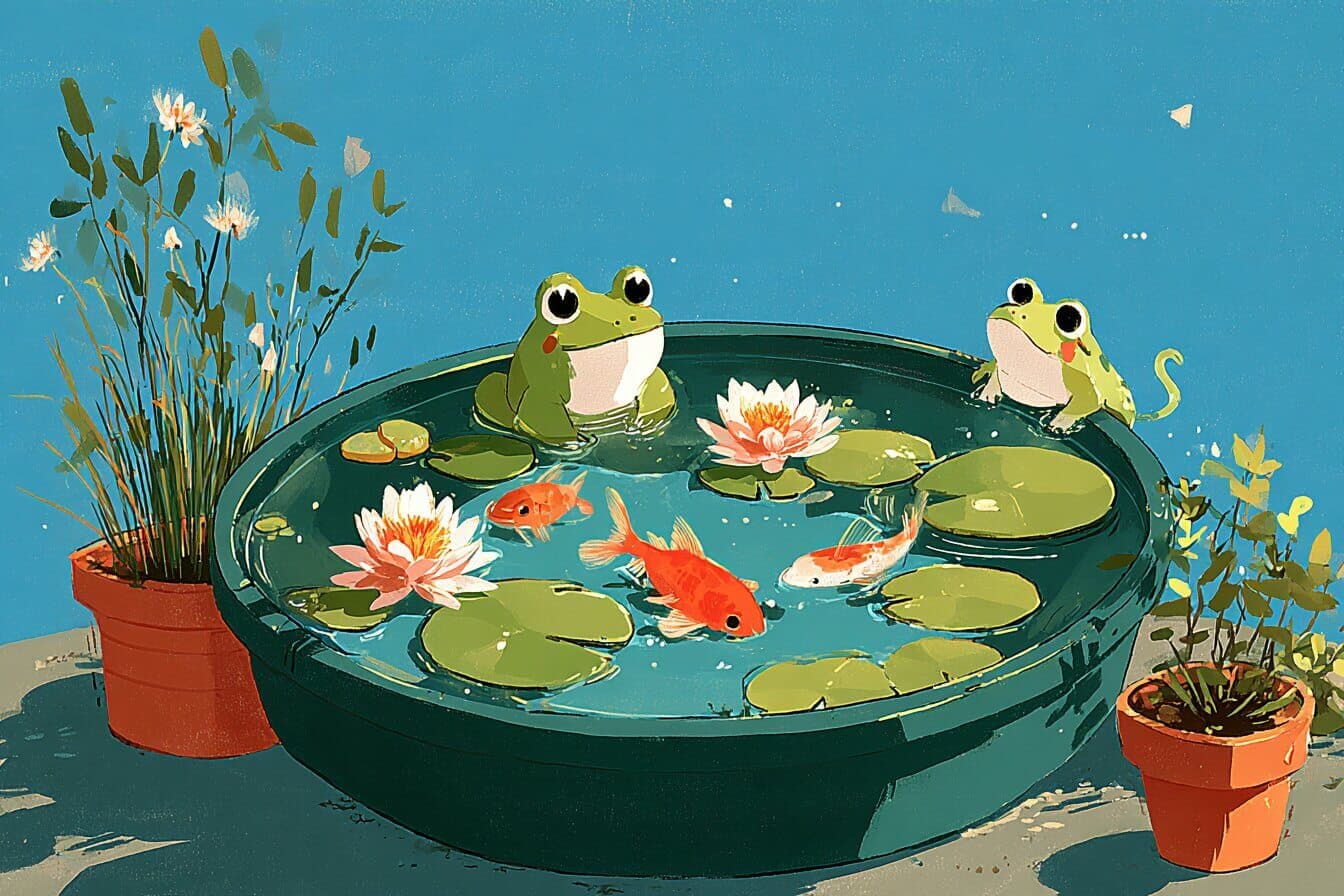
There is something about water that makes a child go still. The way light bends on the surface, the way frogs call from somewhere you can't quite see, the way everything at the edge of a pond seems to hum at a slower speed. This collection of pond bedtime stories follows a girl who discovers that a small garden pond holds an entire world of quiet company, from lazy fish to bugs balanced on lily pads. If your child loves nature at nighttime, you can create your own version with Sleepytale.
Why Pond Stories Work So Well at Bedtime
Ponds are small enough for a child's imagination to hold completely. Unlike the ocean, which can feel vast and unpredictable, a pond fits inside a garden. It has clear edges. Everything in it is close enough to watch: the frog on the rock, the fish turning just beneath the surface, the dragonfly that taps the water once and lifts away. That sense of a contained, safe little world mirrors what kids need when they are winding down, a feeling that everything important is right here, within reach.
A bedtime story about a pond also moves at the right pace. Nothing in a pond rushes. Fish drift, lily pads rotate slowly with the breeze, and sounds arrive one at a time, a croak, a splash, a cricket starting up. That natural slowness teaches a child's breathing to match it. By the time the story reaches nightfall and the stars begin showing up on the water's surface, most kids are already halfway to sleep.
The Peaceful Pond 5 min 10 sec
5 min 10 sec
In a quiet corner of the garden, where the fence leaned slightly and moss had taken over the lowest stones, there was a pond.
Not a large one. You could walk around it in thirty steps if you didn't stop to look at anything, but nobody ever managed that.
Frogs lived there, four or five of them, though it was hard to get an exact count because they kept tucking themselves behind the rocks.
Fish lived there too, slow orange ones that moved like they had all the time left in the world.
And lily pads floated across the surface, broad and green, each one carrying a passenger or two: tiny beetles, resting gnats, sometimes a spider that had wandered out too far and decided to stay.
In the mornings the pond caught the first light before the garden did.
The water would go from grey to gold in about ten minutes, and the frogs would begin croaking, not loudly, more like someone clearing their throat in another room.
The fish rose toward the warmth.
Their scales flashed when they turned, copper and white, and then they sank again.
A dragonfly arrived most mornings around the same time, hovering above the center of the pond with its wings going so fast they disappeared. It would dip once, touch the water with the tip of its body, and the ripples would spread outward in circles so perfect they looked drawn.
One frog, the largest one, always sat on the same flat rock near the willow.
He blinked slowly at the dragonfly, at the fish, at the beetles on the lily pads. He did not seem impressed by any of it, but he never left either.
The beetles on the lily pads did not talk to each other.
They didn't need to.
The pond said everything for them, in ripples, in the small wind that came off the water, in the way the willow's branches trailed across the surface like fingers dragging through bath water.
By evening the light changed again.
The willow's shadow stretched all the way across the pond, and the frogs shifted from their daytime croak to something lower, something that rose and fell in a rhythm you could breathe along with if you tried.
The fish sank to where the water was cool and dark and still.
The lily pads drifted closer together, bumping gently, forming a loose green raft.
The beetles tucked their legs under their shells.
Night arrived without announcing itself.
Jasmine from the far side of the garden drifted over, and crickets started up, not all at once but one by one, like musicians joining a song that was already playing.
Stars appeared in the sky and then again on the water.
The pond held them perfectly, each white point doubled, so that for a moment it was hard to say which direction was up.
One frog leapt from a rock to a lily pad and landed with a sound like a single raindrop hitting a window.
The beetles on the pad shifted slightly but did not wake. Their tiny sides rose and fell.
The pond was full of breathing.
Then morning came back, the way it always did, pale and soft.
The frogs stretched. The fish rose. The lily pads bobbed as the beetles aboard them uncurled their legs.
A butterfly arrived, white with brown edges on its wings, and it landed on a lily pad and folded itself shut like a book.
The beetles watched it. Their antennae moved. Nobody said anything.
The biggest frog on his flat rock sang one note, clear and round, and the others answered, and for a few seconds the whole pond hummed.
Then it was quiet again.
A girl came that afternoon. She had been running, you could tell, because her cheeks were pink and her breath came fast. She sat down at the edge of the pond and pulled her knees up.
For a while she just looked.
The frogs watched her back. The fish drifted closer to her side of the pond, their mouths opening and closing like they were trying to say something polite.
A beetle on the nearest lily pad waved one antenna in her direction, then the other.
She dipped two fingers in the water.
It was colder than she expected. The cold moved up through her hand and into her wrist, and something in her shoulders let go.
She came back the next day. And the day after that.
She learned which frog sat on which rock. She gave the biggest fish a name, though she kept changing it. She noticed that one lily pad always spun in slow circles while the rest stayed still, and she never figured out why.
Seasons moved through the garden. Leaves dropped into the pond and floated for days before sinking. Snow fell once and melted on the water's surface almost instantly, as if the pond refused to be covered.
The frogs disappeared in winter and returned in spring, sitting on the same rocks as if they had never left.
One evening, the sky turned orange and pink at the edges, and the girl sat at the pond with her shoes off, her toes just touching the water.
She did not think about tomorrow.
She listened to the frogs begin their low song, watched the fish trace their slow paths below the surface, noticed the beetles settling in on their lily pads for the night.
The pond held all of them. It always had.
Somewhere in the garden the jasmine opened, and the air turned sweet, and the first cricket found its note.
The Quiet Lessons in This Pond Bedtime Story
This story is about learning to slow down without being told to. When the girl arrives with pink cheeks and fast breathing, she does not decide to be calm; the pond simply invites it, and her body follows. Kids absorb the idea that stillness is something you can find rather than force. The story also explores patience and attention: the girl returns day after day, learning which frog sits where and which lily pad spins, showing that noticing small things is its own kind of reward. And the pond's steady return through seasons, frogs reappearing on the same rocks each spring, offers reassurance that familiar, safe places endure. That is exactly the kind of thought that helps a child let go of the day and trust that morning will come back just fine.
Tips for Reading This Story
Give the biggest frog a low, unbothered voice, almost bored, and let the beetles stay completely silent so the contrast feels funny. When the girl dips her fingers in the water and the cold travels up her wrist, slow your reading way down and drop your voice, so the listener physically feels the shift. At the moment where the pond reflects the stars and you read "it was hard to say which direction was up," pause for a beat and let your child look at you, because that image tends to land best when there is a second of quiet after it.
Frequently Asked Questions
What age is this story best for? This story works well for children ages 3 to 7. Younger listeners enjoy the repeating rhythm of the frogs croaking, the fish rising, and the beetles tucking in, while older kids connect with the girl who keeps returning to the pond and names the fish. The gentle pacing and absence of conflict make it especially good for sensitive children who need calm before sleep.
Is this story available as audio? Yes, you can press play at the top of the story to listen. The audio version brings out the natural rhythm of the frog chorus and the cricket sounds beautifully, and the moment where night arrives "without announcing itself" has a quiet pause that works even better when heard aloud than read on a page.
Why does the story mention seasons changing? The shift through seasons shows the girl that the pond endures no matter what happens around it. Leaves fall, snow melts on the surface almost instantly, and the frogs return to their same rocks in spring. For children, this kind of gentle repetition across time is comforting because it mirrors the reliability they crave, the idea that their favorite places and routines will still be there tomorrow.
Create Your Own Version
Sleepytale lets you build a bedtime story set at a pond, a creek, a tide pool, or wherever your child feels most peaceful. Swap the girl for a little turtle, trade the lily pads for stepping stones, or set the whole scene in winter when everything is quiet and frosted over. In a few taps you will have a calm, personal story ready to read tonight.
Looking for more nature bedtime stories?
Sun Bedtime Stories
A valley stays chilly at dawn until a brave sunbeam gathers shared promises that warm the forest again, inside short sun bedtime stories. A sunrise seed becomes the twist that lingers.

Earth Bedtime Stories
Mira follows a soft blue glow to a space bus and joins a kind crew to help the ocean sing again in short earth bedtime stories.

Winter Bedtime Stories
Drift off with cozy short winter bedtime stories that soothe with gentle wonder and warm cocoa calm. Read a quiet tale and learn how to create your own with Sleepytale.
Windy Day Bedtime Stories
A breezy town turns into a gentle game day as one child follows the wind home. Discover short windy day bedtime stories that end with cocoa and a lullaby.

Wildflower Bedtime Stories
Moonlight slips through a window as a brave seed dreams of color beyond tidy gardens in short wildflower bedtime stories. Petal and a playful pebble spark a gentle parade of blooms.

Waterfall Bedtime Stories
Looking for short waterfall bedtime stories that feel calm, magical, and easy to read aloud? Discover a gentle tale set at a rainbow mist waterfall, plus tips to create your own.