
Fossil Bedtime Stories
By

Dennis Wang, Bedtime Story Expert
8 min 54 sec
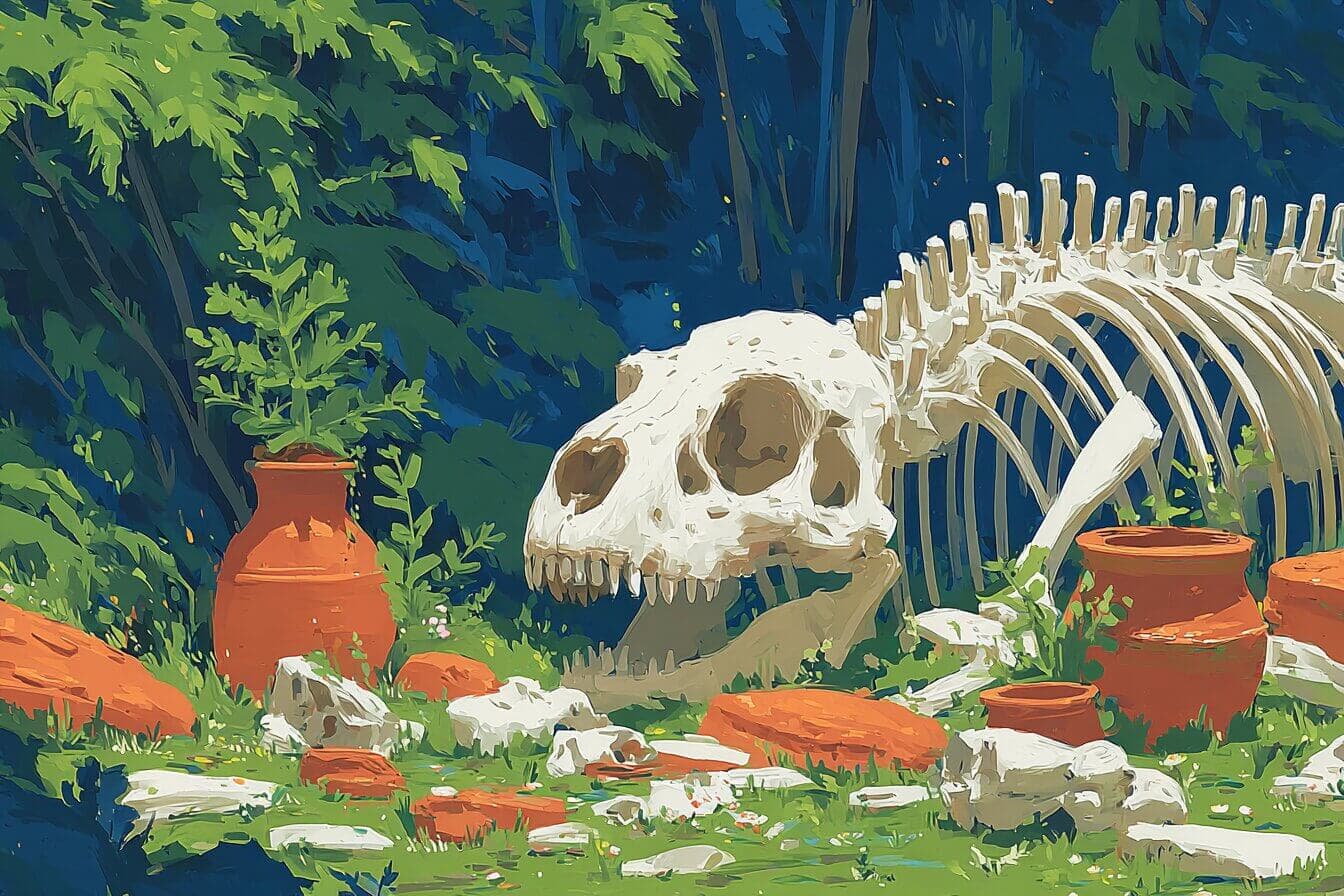
There is something about digging in the dirt that makes a child's whole body slow down, fingers pressing into cool soil, breath going quiet, attention narrowing to the one small thing half-buried beneath the surface. In this gentle story, a mouse named Milo and his friend Tilly the tortoise uncover a pale stone that holds the shape of a creature millions of years gone, and what they do with their find turns the whole meadow into something a little more magical. It is one of those fossil bedtime stories that trades excitement for wonder, the kind that lets a child's mind settle into curiosity rather than rev up before sleep. If you would like a version shaped around your own child's favorite animals and places, you can make one with Sleepytale.
Why Fossil Stories Work So Well at Bedtime
Fossils carry a particular kind of calm. They are ancient, unhurried, and they ask nothing of you except that you look closely. For kids winding down at the end of a long day, that invitation to slow observation is almost meditative. A bedtime story about fossils swaps loud action for small discoveries, the scrape of a paw against stone, the patient explanation of how bones become rock. The pace is built right in.
There is also something deeply reassuring about the idea that the earth keeps things safe for millions of years. Children who worry about change, about things disappearing, about tomorrow, can find comfort in the thought that even the smallest creature leaves a trace. Fossil stories ground kids in deep time, and deep time, oddly enough, makes the present moment feel gentler and more manageable.
The Magic in Old Bones 8 min 54 sec
8 min 54 sec
Milo the mouse loved digging in the garden behind the big red barn. Not for any particular reason. He just liked the feel of soil crumbling under his paws, the way it smelled different at every depth, dark and rich near the top, then sandy, then almost sweet where the clay began.
One morning his claws scraped something hard.
He brushed the dirt away carefully, the way Tilly had taught him, and uncovered a curved, ridged shape, pale as moonlight, cool to the touch even though the sun had been warming the ground for hours.
He sat back on his haunches and stared at it for a long time.
Then he ran to find Tilly.
Tilly the tortoise was resting near the brook with one eye open, which was how she did most things. She followed Milo back to the garden without hurrying, because Tilly did not hurry, and when she saw the shape half-buried in the soil her old eyes went soft.
"That," she said quietly, "is a fossil. A bone turned to stone by time itself."
"How does a bone become stone?"
Tilly settled beside the hole. "Millions of sunrises ago, a creature lived and breathed and wandered right where we are standing. When it died, its bones sank into the mud. Layers of earth pressed down, heavy as blankets stacked one on top of another. Water carrying tiny minerals seeped through, drop by drop, replacing the bone bit by bit." She tapped the fossil gently with her claw. "Until what was bone became rock. The shape stayed. The original bone did not."
Milo traced one of the ridges with his paw. He could feel the faintest grooves, like the lines on a leaf, only harder. "So this stone is a memory."
Tilly nodded. "A memory of a world older than any story either of us knows."
They sat together for a while after that, not saying anything, just looking. Somewhere behind the barn a wren was singing the same three notes over and over, and the fossil lay between them catching light.
It was Milo who suggested the museum.
They found a hollow log near the edge of the meadow, dry inside, with a faint smell of old bark. Milo gathered moss for display cushions while Tilly painted labels using berry juice and a blade of grass. The berry juice came out more purple than she expected, which bothered her at first, but then she decided she liked it.
They set the fossil at the center and waited.
Within an hour, a pair of ladybugs wandered in and asked if the ridges were tiny mountain ranges. A baby bunny wanted to know if the creature had hopped. Milo explained that scientists called paleontologists study fossils to understand how ancient animals moved, what they ate, where they slept. He pointed to small marks on the fossil where muscles had once attached, pressing his paw against the faint lines so the visitors could feel them too.
Tilly added that fossils are not always bones. "Shells. Leaves. Even footprints, pressed into ancient mud and held there."
The ladybugs looked at their own feet, then at the ground, then at each other.
Word spread the way things do in a meadow, carried on the breeze and passed along by creatures who cannot keep a good secret. By afternoon, animals had come from the brook, the ridge, and the thicket of blackberries that nobody remembered planting.
Milo told them that the spiral shell of a snail looks almost exactly like the spiral of an ammonite fossil, hinting at family ties that stretch across unimaginable stretches of time. He talked with his paws when he got excited, which was often.
When evening came, Tilly revealed something she had been saving. "Some fossils glow under moonlight," she said, "because the minerals inside catch and reflect faint rays." She waited until the moon cleared the top of the barn, then tilted the fossil.
A soft green shimmer.
The animals went completely silent. Even the baby bunny stopped wriggling.
Milo told them that every fossil is a time capsule. Its layers hold clues about the air, the plants, the temperature of the world that made it. He said that pollen grains trapped in nearby rock suggested this valley had once been a steamy swamp, full of ferns taller than the barn and dragonflies as long as your arm. "Well," he corrected himself, glancing at the bunny, "longer than your arm. About the length of mine, maybe."
A shy mole raised a paw from the back. "Is finding one rare?"
Milo smiled. "They are special. But if you learn to read the rocks, to notice unusual shapes and textures and weights, you will find them more often than four-leaf clovers." He paused. "Though I have never actually found a four-leaf clover, so take that how you will."
Tilly warned them that true fossils feel heavier than ordinary stones, because the minerals add weight. She also said, firmly, that you should only collect where the land says it is all right to collect.
The day ended with a twilight parade. Every creature carried a candle made from glowworm jelly and marched around the hollow log, singing songs about deep time in voices that were mostly out of tune but entirely sincere.
Milo stood still and felt something beneath his paws, not a vibration exactly, but a kind of presence. The valley's long, slow heartbeat.
That night he dreamed of seashells on mountaintops and tropical leaves frozen in ice.
The next morning, he and Tilly went back to the garden. They dug carefully this time, documenting each layer of soil in a tiny notebook made from birch bark. Milo's handwriting was terrible, which he blamed on the pen, which was a twig.
At lunch they found a leaf print pressed into gray shale.
Milo explained that leaves become fossils when they fall into still water, sink, and are quickly covered by fine mud. The leaf itself eventually decays, but its outline remains as a carbon shadow, a ghost of itself, thin as paper and older than anything either of them could count to.
Tilly held a living maple leaf beside the fossil and pointed out the veins. The same branching pattern, repeated across millions of years. She did not say anything about what that meant. She just held the two things side by side and let the silence do the talking.
They placed the leaf fossil beside the bone in their museum.
A bluebird asked if humans study fossils too. Milo nodded so hard his ears flapped. He told them about paleontologists who use brushes finer than whiskers and dental picks to free fossils from rock, about museums where children can press their palms against real dinosaur bones behind special glass.
Tilly mentioned that some fossils travel in padded suitcases to schools, so students can feel the texture of prehistory with their own hands. The animals imagined suitcases rattling with ammonites and trilobites, which made the baby bunny laugh for reasons he could not explain.
Later, a storm rolled in.
Rain drummed on the log museum. Inside, it was warm and dry and smelled like damp moss, which is one of the better smells in the world if you are small and safe and surrounded by friends.
Milo used the moment to explain how water helps create fossils. Rain carries minerals underground. Rivers bury bones in fresh sediment. Oceans preserve shells in their quiet depths. Even footprints can fossilize if filled with windblown sand that later hardens into stone.
Thunder cracked, and nobody flinched, because they were too busy listening.
When the storm passed, a rainbow arched above the garden. Milo gave each visitor a smooth pebble from the brook. "Carry this," he said, "and remember that every stone has a story, even if we cannot read it yet."
Tilly told them to keep asking questions. To read books. To visit museums when they could, and to turn over stones when they could not.
The meadow felt different after that. Quieter, but not empty. More like a place that knew its own age and was comfortable with it.
Weeks passed. The hollow log museum became a landmark. Milo painted a sign that read "Past and Present Meet Here," then repainted it because he had spelled "Present" wrong the first time.
Tilly started story circles where the older animals shared memories of floods, droughts, and shooting stars, weaving their own small histories into the valley's deep time.
One evening, a shooting star blazed across the sky.
Milo watched it disappear behind the ridge and made a quiet wish that every creature, big or small, might feel some connection to the ancient life beneath their feet. Tilly, beside him, said nothing for a while. Then, softly: "Wishes on stars are a little like fossils. Tiny records of hope, pressed into memory."
They sat together until the sky was fully dark and the frogs began their low chorus by the brook.
Years later, when Milo's fur had gone silver and Tilly's shell bore the weathered rings of many seasons, new generations still visited the museum. Young animals who had heard the story of the mouse and the tortoise would turn stones over in their paws, dreaming of creatures who lived when the moon was younger.
Milo and Tilly would sit nearby, not saying much, just watching.
They had shared the one secret that mattered: if you look closely enough, even the smallest, oldest, most ordinary thing becomes extraordinary. And curiosity, once lit, does not go out.
The Quiet Lessons in This Fossil Bedtime Story
This story weaves together patience, curiosity, and generosity in ways that settle naturally into a child's mind before sleep. When Milo carefully brushes soil from his find instead of yanking it free, children absorb the idea that the best discoveries reward slowness and care. When the two friends build their museum and welcome every creature without judgment, the story models sharing knowledge as an act of kindness rather than showing off. And when Tilly holds a living leaf beside a fossil leaf and lets the silence speak, kids learn that not everything needs to be explained aloud, that sometimes you simply notice and feel the wonder. These are the kinds of lessons that sit quietly in a child's chest at bedtime, making tomorrow feel like a place worth exploring.
Tips for Reading This Story
Give Milo a quick, eager voice that speeds up whenever he starts explaining something scientific, and let Tilly sound slow and gravelly, like someone who has all the time in the world. When the moonlight hits the fossil and it shimmers green, pause for a full breath before continuing, so your child has a moment to picture the glow. At the part where Milo admits he has never actually found a four-leaf clover, look at your child and shrug, because that small joke lands better with a little eye contact.
Frequently Asked Questions
What age is this story best for?
It works well for children ages 4 through 8. Younger listeners will enjoy the cozy rhythm of Milo and Tilly's friendship and the parade with glowworm candles, while older kids will latch onto the real science woven in, like how minerals replace bone or how leaf impressions form in shale. The gentle pacing suits both groups without talking down to either.
Is this story available as audio?
Yes. Press play at the top of the story to listen. The audio version brings out the contrast between Milo's eager chatter and Tilly's slow, measured explanations, and the storm scene, with rain drumming on the hollow log, has a rhythm that works beautifully when heard aloud rather than read silently.
Will this story teach my child real facts about fossils?
It does. Milo and Tilly cover how bones become stone through mineral replacement, how leaf fossils form as carbon shadows, and why real fossils feel heavier than ordinary rocks. The information is accurate and presented in small, digestible pieces throughout the plot, so your child absorbs it naturally rather than feeling like they are sitting through a lesson.
Create Your Own Version
Sleepytale lets you reshape this story into something that fits your family perfectly. Swap the meadow for a rocky beach, turn the hollow log into a cardboard box museum in someone's bedroom, or replace Milo and Tilly with a pair of curious siblings. You can adjust the length, the tone, and the details in just a few taps, so your child hears a cozy discovery story that feels like it was written just for them.
Looking for more educational bedtime stories?
Folklore Examples
Discover short folklore examples through a library night where Anansi the spider, a loyal crane, and a clever hare teach timeless lessons.

Children's Fable
A fast fox loses to a steady turtle in this short children's fable about patience, ripe pears, and the quiet power of one step at a time.
Science Stories For Kids
Leo and his mom explore twinkling stars with a flashlight and a jar of water in one of our coziest short science stories for kids.
Small Stories With Moral
A girl gives her red umbrella to a classmate in the rain, one of the best short small stories with moral for bedtime.

Short Christian Stories With Moral Lessons
Discover short christian stories with moral lessons like Pastor Eli's unplanned outdoor sermon that teaches kids faith grows in unexpected places.

Quick Stories With Moral Lesson
Marcus copies a science test but discovers short quick stories with moral lesson show that honest effort feels better than a perfect stolen score.