
Cute Bedtime Stories For Adults
By

Dennis Wang, Bedtime Story Expert
9 min 29 sec
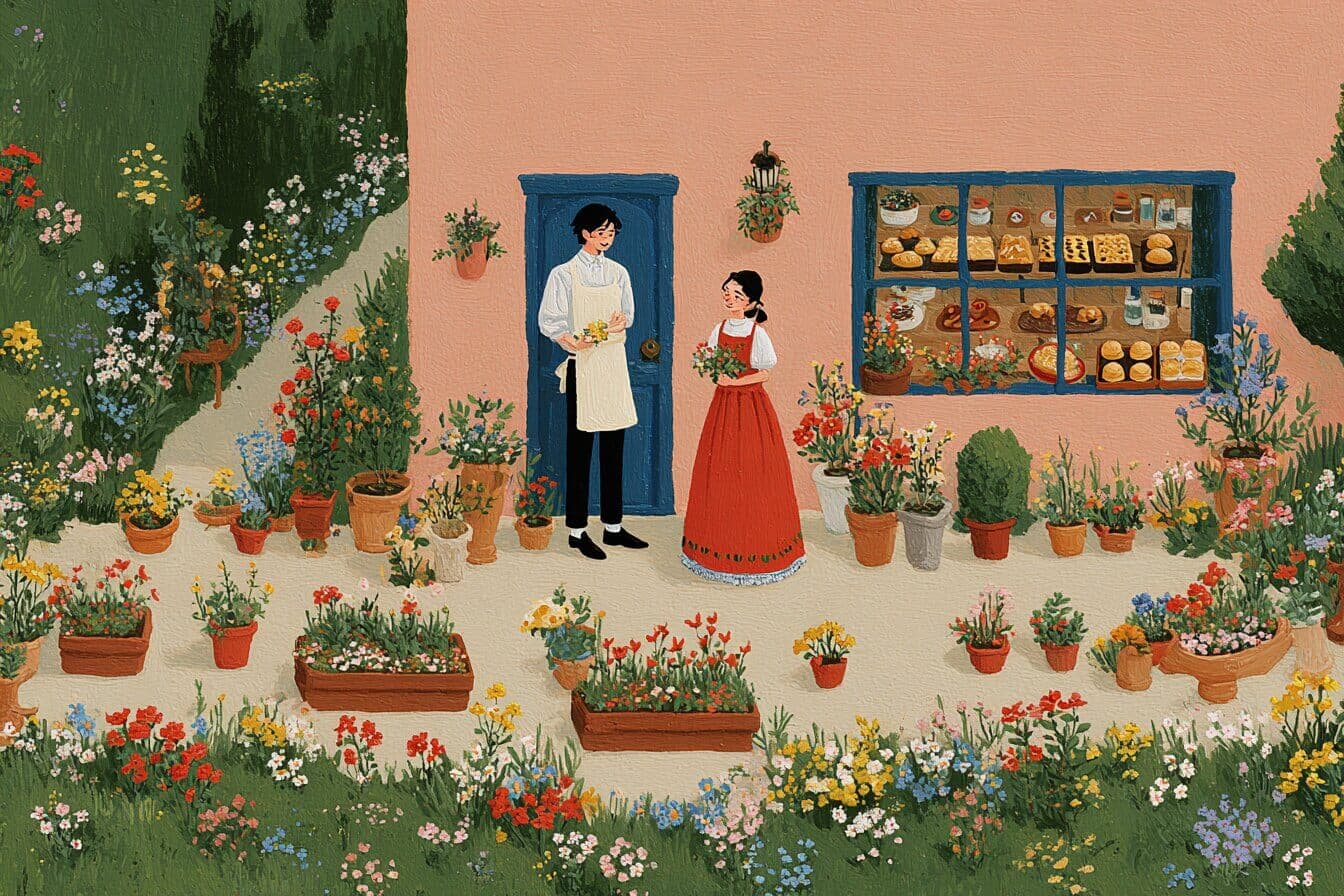
There is something about the scent of warm bread and a quiet street at midnight that makes the whole body exhale. This story follows Mr. Alder, a sleepless village baker who starts leaving secret pastries on a neighbor's doorstep, only to discover that the kindness circles back in ways he never expected. It is one of our favorite cute bedtime stories for adults, built around small gestures, soft rain, and the particular comfort of giving something away without needing credit. If you want a version tailored to your own tastes and mood, you can create one with Sleepytale.
Why Baker Stories Work So Well at Bedtime
Baking is one of those rare activities that engages every sense without raising anyone's pulse. The rhythm of kneading, the warmth of an oven, the patience of waiting for dough to rise. These are slow, repetitive motions that mirror the kind of winding down our brains crave before sleep. A story set in a bakery gives you permission to settle into that pace, measuring time in loaves instead of minutes.
There is also something reassuring about a baker as a character. Bakers work while the rest of the world sleeps, which makes them natural companions for anyone lying awake at odd hours. A bedtime story about a baker who shares what he makes taps into that late night quiet, the feeling of being the only person stirring in a still house. It turns insomnia from a lonely problem into a gentle adventure.
The Midnight Baker's Secret Gifts 9 min 29 sec
9 min 29 sec
In the village of Willowmere, where cobblestone streets curled beneath the moonlight like cats who had given up on catching anything, lived Mr. Alder. He was a baker. A good one. The kind whose cinnamon rolls made people close their eyes mid-bite, not out of politeness but because something in the flavor demanded it.
Every dawn he opened his shop. Every night he lay awake, staring at the ceiling, which had a water stain shaped vaguely like a pelican. He had tried warm milk, gentle music, counting sprinkles on cookies. Nothing worked. The night just sat on his chest like a guest who refused to leave.
One restless evening, while the whole village slept, Alder found himself mixing a small batch of honey almond croissants. He shaped them into crescents, wrapped them in blue paper, and before he could talk himself out of it, tiptoed past the fountain and left the parcel on the doorstep of the little yellow cottage across the lane.
No note. No name. Just a hope, vague and half-formed, that doing something generous might tire out whatever part of him refused to rest.
The next morning he found a single daisy tucked beneath his door. Its stem was slightly bent, as if someone had carried it in a hurry.
Alder smiled all day. He hummed while he kneaded, which he never did, and that night he baked again: raspberry thumbprint cookies, each center holding a jewel of jam so red it looked theatrical. He delivered them in secret. In the morning, a purple cornflower waited for him, delicate and a little defiant, leaning against the doorframe.
Days turned into weeks, and the exchange continued. His insomnia faded, replaced by something else, an eagerness that got him out of bed at midnight not to worry but to create.
He learned the rhythm of his mystery neighbor's tastes. Lemon cakes on Mondays. Chocolate twists on Tuesdays. Orange blossom buns on Wednesdays, because Wednesdays always needed something floral to survive. In return, bouquets appeared on his mat: buttercups, lupines, sweet peas, each bunch tied with a blade of grass instead of ribbon.
Alder began to imagine the hands that picked them. Soft and careful, he thought. Belonging to someone who loved colors more than words. Maybe a painter who gathered petals for pigments, or a retired schoolteacher with a greenhouse and too much time.
One Thursday he stayed up late to watch, but fog rolled in thick as buttercream and he saw only shadows. He went to bed annoyed, which was at least a different flavor of awake.
Friday brought thunderclouds, but he still baked. He shaped marzipan swans this time, each one slightly lopsided because his hands were cold. Rain drummed on the roof like impatient fingers. When the storm finally quieted to a whisper, Alder slipped outside, shoes squishing on wet stones, the sound almost comical in the silence.
At the yellow cottage gate, he paused.
A sniffle. Small and muffled, coming from inside.
Then a voice, so soft it might have been the wind: "Thank you."
Alder's heart did something complicated. He wanted to answer, but shyness pinned his tongue flat. Instead he placed the swans on the mat, added a tiny umbrella he had shaped from pastry dough on a whim, and hurried home through puddles that reflected the lantern light like scattered coins.
The next morning, instead of a flower, he found a folded paper boat floating in a saucer of rainwater on his doorstep. Inside the boat lay a drawing of the moon wearing a baker's hat and grinning.
Alder laughed. Actually laughed, standing in his doorway in a flour-dusted robe, loud enough that a pigeon on the bakery sign startled and left.
He pinned the picture above his counter, where it fluttered whenever someone opened the door. That night he baked star-shaped shortbread and tucked a note between two cookies: "For the artist who paints moonlight."
He left the parcel, then waited behind the fountain, heart going like a bread timer about to ding.
The cottage door cracked open. Out stepped not a painter, not a retiree, but a child no older than ten, clutching a sketchbook to her chest with both arms. Her hair was the color of maple sugar. She looked left, looked right with the exaggerated caution of someone who had seen too many spy films, then tiptoed to Alder's door, swapped the parcel for a tiny envelope, and darted back inside.
Alder counted to one hundred. He may have lost track around sixty and started over.
Inside the envelope: a drawing of him offering bread to a flock of paper birds. Beneath the picture, in careful pencil, she had written: "I cannot sleep either. My name is Poppy. Mama says dreams come to those who share."
Alder's eyes went blurry. He sat down on his shop step and held the drawing for a long time, watching the ink smudge slightly where a raindrop caught the corner.
He spent the afternoon crafting a reply: a cookie shaped like an open book, its pages made of sugar lace so thin it crackled when you breathed near it. Between the pages he tucked a note: "Dear Poppy, let us share dreams together."
That evening, clouds gathered again, but Alder felt lighter than meringue. He left the book cookie and waited beneath the baker's awning, rain tapping his umbrella.
Poppy appeared wearing a yellow raincoat the exact shade of her cottage. She carried a lantern made from a jar of fireflies, their glow unsteady and warm, like a pulse.
They sat on Alder's shop step. Silent at first. Passing the lantern back and forth, watching fireflies blink at a rhythm that seemed almost, but not quite, synchronized with their breathing. Alder offered her a cinnamon roll from his pocket, still faintly warm. Poppy shared a dandelion clock.
Together they blew the seeds into the rain, watching them swirl and stall and swirl again.
She told him how her mother worked nights at the hospital. How the house felt huge without her, especially the hallway, which made sounds she could never identify. How the flowers helped her feel less alone because picking them gave her hands something to do at 2 a.m. besides worry.
Alder told her about the loneliness of early mornings. How dough listened better than most people, because it never interrupted. How giving the pastries away had started as a trick to exhaust himself and turned into the thing he looked forward to most.
They laughed when their sentences stumbled over each other, and the sound filled the street like something spilling over.
After a while Poppy yawned, her eyes drooping. Alder wrapped her in his spare apron, carried her home, and tucked her into bed beneath a quilt patterned with calico cats. He left a nightlight shaped like a croissant glowing softly on her dresser. The bulb inside buzzed faintly, a sound so small it was almost a lullaby.
Outside, the rain stopped. Not gradually, just stopped, as though someone had simply turned off a faucet.
Alder looked up. The clouds parted, and the moon hung there, round and bright, looking very much like a cookie fresh from the oven. He breathed in. The air tasted faintly sweet, though that might have been the flour still on his collar.
Back in his own bed, sleep came at last. It arrived warm and unhurried, like bread rising in a covered bowl. He dreamed of wheat fields waving like golden seas, and of a small hand slipping into his, and of nothing else at all.
At sunrise he woke refreshed. He could not remember the last time that had happened.
He baked extra loaves, humming again, and opened his door to find Poppy already waiting, hair tousled, cheeks pink, holding a crown woven from clover and morning glory. She placed it on his head without asking, and it fit perfectly, which surprised neither of them.
Together they arranged wildflowers in tiny vases on every table in the shop. Customers arrived puzzled by the sudden color, but Alder just smiled and offered free samples of honey cloud bread. Poppy perched on a tall stool, sketching the scene, occasionally waving at neighbors who, she announced, "don't know it yet, but they're basically family."
That night, and every night after, Alder no longer paced.
Instead he and Poppy met beneath the moon. Sometimes baking. Sometimes planting flowers along the cobblestones, pressing seeds into gaps between the stones with their thumbs. Sometimes simply sitting in silence, which had stopped feeling empty and started feeling full.
The village noticed the change. Lights glowed softer. Laughter rang a beat longer than it used to. The scent of pastries drifted farther down the lane, as if it had somewhere important to be.
Alder kept a jar on his counter labeled "Dreams." It held no cookies. Just Poppy's drawings: moons in baker's hats, suns wearing aprons, a star shaped like a croissant that she insisted was anatomically correct.
Years later, when Poppy had grown tall and Alder's beard had turned the color of powdered sugar, they still met at twilight. A parade of children followed them now, clutching paper lanterns that bobbed like slow, earthbound fireflies. Together they left pastries on every doorstep and tucked wildflowers behind every ear, carrying the quiet secret that had started with one sleepless night and a batch of croissants wrapped in blue paper.
The Quiet Lessons in This Baker Bedtime Story
This story is really about two people discovering that generosity is not a one-way street. When Alder leaves his first parcel without a note, he is not expecting anything, and the daisy that appears in return catches him off guard in a way that shifts his whole outlook. Kids and adults alike absorb the idea that giving without expectation can still come back to you in unexpected forms. Poppy's confession that she cannot sleep either normalizes vulnerability; her willingness to say "I need this too" turns a secret exchange into a real friendship. At bedtime, that message is especially settling, the reassurance that admitting you are lonely or restless is not weakness but the first step toward connection. The story also gently suggests that routines built around care for others, baking, picking flowers, showing up, can replace the anxious loops that keep us staring at the ceiling.
Tips for Reading This Story
Give Alder a low, unhurried voice, the kind that sounds like it has flour on it, and let Poppy speak a little faster, with the breathless confidence of a ten-year-old who has been up past her bedtime. When the rain scene arrives and Alder hears the whispered "Thank you" from inside the cottage, pause for a full beat of silence before continuing; that gap lets the moment land. During the firefly lantern scene on the shop step, try slowing your pace to match the blinking rhythm described in the text, letting each sentence drift a little before the next one starts.
Frequently Asked Questions
What age is this story best for? Despite being written for adults, this story works well for listeners aged 16 and up, including older teens who relate to Poppy's nighttime restlessness and adults who recognize Alder's quiet insomnia. The vocabulary is simple, the plot moves gently, and there is nothing jarring, so it suits anyone looking for a calm wind-down rather than an adventure.
Is this story available as audio? Yes. You can press play at the top of the story to listen. The audio version works especially well here because the rhythm of Alder's nightly routine, baking, wrapping, delivering, repeating, creates a lulling cadence that settles in more deeply when you hear it aloud rather than read it. The rain scenes and the quiet exchange at the cottage door are particularly effective through a speaker in a dark room.
Why does baking appear so often in calming stories? Baking involves repetitive, sensory-rich steps, measuring, stirring, kneading, waiting, that naturally slow the mind. In this story, Alder's late-night sessions in the bakery give his restless energy somewhere productive to go, and the warmth and scent details help listeners imagine themselves in a cozy, low-stakes environment. It is one of the reasons bakery settings tend to show up in stories designed to help people relax before sleep.
Create Your Own Version
Sleepytale lets you reshape this kind of gentle, slow-paced story to fit your own evening. You could move the setting from a cobblestone village to a houseboat on a canal, swap the baker for a late-night florist, or change Poppy into an elderly neighbor who communicates through origami. In a few moments you will have a calm, personal story you can return to whenever sleep feels far away.
Looking for more adult bedtime stories?

Read This When You Can't Sleep
A lighthouse keeper heats milk in a dented copper pot in this short read this when you can't sleep, and the lamp's steady turning becomes its own lullaby.

Boring History For Sleep
Fog wraps a quiet canal town as a watchman counts barges and checks doors in this short boring history for sleep.
Sad Bedtime Stories For Adults
Nora places two mugs the table each morning in one of our short sad bedtime stories for adults about loss and love.
Happy Bedtime Stories For Adults
Discover short happy bedtime stories for adults like Harold and Edna's rainy walk from their favorite restaurant, full of warmth and quiet love.
Great Bedtime Stories For Adults
Fall asleep to short great bedtime stories for adults like The Sunday Painter, where a dusty paint box sparks a quiet morning of joy.
Scary Bedtime Stories For Adults
Discover short scary bedtime stories for adults where the 3 A.M. intruder is a seven year old calmly eating shredded cheese by flashlight.