

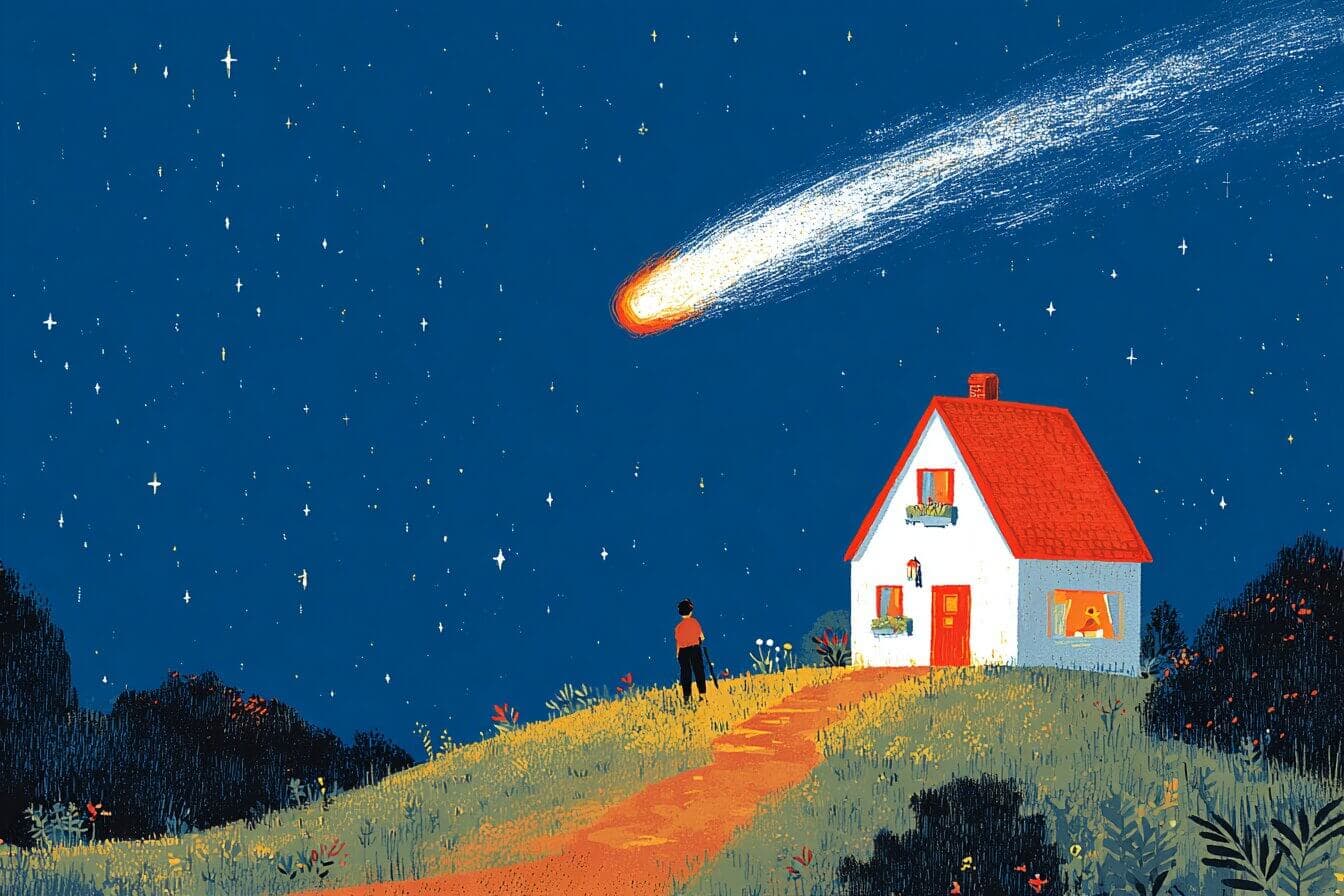
There is something about watching a bright streak cross the sky that makes a child go perfectly still, mouth open, blanket forgotten. That hush is exactly where this story lives. In "Comet's Cosmic Hello," a friendly comet zooms from planet to planet writing glowing greetings, only to discover his light is fading and that the kindness he gave away is the very thing that brings it back. If you love comet bedtime stories and want one shaped around your child's name, favorite planet, or sleepiest mood, you can make your own free version with Sleepytale.
Why Comet Stories Work So Well at Bedtime
Comets are slow and far away, which is exactly the kind of image a restless mind needs before sleep. A child can picture a bright tail trailing through silence, no loud noises, no sudden surprises, just steady motion across a dark, peaceful sky. That rhythm of quiet traveling mirrors the way breathing slows under warm covers, and it gives kids a mental path to follow instead of replaying the busy parts of their day.
A bedtime story about a comet also introduces the idea that something beautiful can appear, do its gentle work, and then drift away until next time. That coming-and-going pattern feels reassuring rather than sad. Kids who worry about endings can relax when the comet promises to return, the same way the moon always comes back and morning always follows night.
Comet's Cosmic Hello 8 min 31 sec
8 min 31 sec
Comet zoomed through the dark with a tail that glowed like a long golden ribbon unraveling behind him.
He loved saying hello.
Every planet, every moon, every tumbling rock got a wave, whether they noticed or not.
One night, as he zipped past Mars, his tail flicked a little too happily and smacked right into Phobos, the tiny moon that most travelers forgot about entirely.
Phobos giggled, which sounded like a handful of gravel being shaken in a jar, and started spinning like a top.
Comet giggled too.
"Sorry, friend! Keep spinning!" he called, and sped onward, leaving a trail of sparks that arranged themselves, almost accidentally, into the word HELLO.
Down on Earth, a few children who happened to be looking out their bedroom windows saw the bright letters and squealed.
One boy pressed his nose so hard against the glass it left a smudge shaped like a little planet.
Comet heard their joy the way you might hear a song from the next room, muffled but warm, and it settled somewhere deep inside him.
He decided, right then, to visit every planet and leave a glowing greeting for each one.
First stop, Jupiter.
The giant planet wore its belt of swirling storms like it was showing off. Comet swooped low and traced the word HI across the cloud tops, his tail sizzling faintly against the cold gas. The Great Red Spot rumbled, pleased, and burped up a crimson puff that looked, if you squinted, like a heart. Or maybe a jellyfish. Comet decided it was a heart.
Next he zipped toward Saturn, weaving between the icy rings like thread through a needle.
He wrote WELCOME in shimmering letters that clung to the rings and drifted there, slowly spinning.
The rings hummed a cheerful note, low and steady, and Comet hummed along without realizing he was doing it.
He looped around twice more, making sure every ice particle caught the glow.
Then he aimed for Uranus, which was rolling sideways along its orbit the way it always did, unbothered by anyone's opinion.
Comet skated across the pale blue surface and drew a glowing PEACE sign.
Uranus blushed a deeper teal.
A breeze of stardust drifted up and tickled Comet's nose, and he laughed so hard that little bits of light shook loose from his tail and became tiny shooting stars, tumbling gently toward Earth.
Children made wishes on those stars. Puppies. Ponies. Endless popsicles. One kid wished for a longer recess, which Comet thought was the most sensible wish of all.
He tucked every single one into his heart.
Off he sped toward Neptune, the windy blue giant.
There he wrote LOVE YOU in bright silver letters that curled around the planet's dark storms like ribbon around a gift. Neptune's winds picked up the words and sang them outward in a lullaby that traveled all the way to Pluto, where the little dwarf planet had been sitting quietly in the cold, feeling a bit left out.
Pluto wiggled its icy mountains.
Comet wiggled back.
By now, though, something was wrong.
Comet's tail had gone dim. Not dark, but thin and flickery, the way a candle looks just before it gives up. He had poured so much light into those messages that there was barely a glow left for himself. He slowed down. The silence of deep space pressed in around him, and for the first time all night he didn't feel like waving to anybody.
He floated there, uncertain.
Then a voice came from somewhere he couldn't quite pin down, quiet and unhurried, the way an old friend talks.
"Dear Comet, the light you give returns to you when friends remember your kindness."
He looked around.
And one by one, he saw them: tiny sparks lifting off from every planet he had visited. A gold flicker from Jupiter. A silver thread from Saturn's rings. A teal wisp from Uranus. They drifted toward him slowly, like fireflies finding their way home on a warm night, and gathered around his tail until it blazed brighter than it had been at the start.
He felt lighter. Faster. Like laughing feels.
He looped toward the Sun, the greatest light of all, and waved hello with a grand spiral that spelled THANKS so large you could have read it from another galaxy. The Sun beamed back, warm and enormous, and sent a gust of solar wind that carried Comet outward toward the farthest edges of the solar system.
There, in the cold quiet, he found Eris.
Eris was a lonely rock who had never, not once, received a greeting from anyone passing through.
Comet slowed. He wrote FRIEND in soft pink light across the little world's surface, gently, the way you write a name on a birthday card when you really mean it.
Eris quivered. A tiny crystal of ice broke free from its surface and floated up toward Comet, clear as a tear and shaped like a small, crooked star. Comet pressed it close to his chest and held it there.
He turned back toward Earth.
Along the way he passed the asteroid belt, where thousands of rocky friends tumbled and clattered against each other like marbles in a jar. He wove between them writing HELLO FRIENDS in every language he knew, plus a few made entirely of light patterns that only asteroids could read. The asteroids clapped together in celebration, knocking loose a shower of silver streaks that rained across Earth's sky.
Children pointed. Parents lifted little ones onto shoulders.
Comet dipped into Earth's upper atmosphere, where the air smelled, somehow, of pine needles and something baking.
He spelled GOODNIGHT in letters that hung like auroras, green and violet and slow.
Below him, children yawned.
Blankets were pulled up to chins.
A few sleepy voices whispered, "Thank you, Comet," though of course they were mostly talking to the ceiling.
He circled Earth once, twice, three times, leaving a trail that curved and looped like a lullaby written in light.
The Moon slid out from behind a cloud. "Will you come back tomorrow?"
Comet nodded, his tail sparking with promise.
He rose higher, and higher still, until Earth shrank to a marble of blue and green and white. From up there, he could see the whole solar system at once, every planet still carrying the faint glow of the words he had written. They pulsed gently, like a heartbeat.
Hello. Hello. Hello.
A soft breeze of stardust nudged him into a cozy orbit between Mars and Jupiter. He curled his tail around himself the way you pull a blanket up on a cold night, tight and slow.
He whispered one last thing across space, not a word exactly, more like a feeling: that he would always come back, that every night there would be a wave and a glow and a hello waiting.
The stars blinked.
The universe, for just a moment, smiled.
Comet's tail flickered softly as he slept, still writing HELLO across the dark, a promise no one had to read to understand.
The Quiet Lessons in This Comet Bedtime Story
This story carries a few ideas that land gently right before sleep. When Comet accidentally bumps Phobos and laughs it off with an apology, kids absorb the notion that small mistakes are fixable and even a little funny. The moment Comet's tail dims after giving away so much light explores generosity and its limits, showing children that it is okay to feel tired after being kind, because kindness has a way of coming back. And when Comet writes FRIEND across Eris, a world no one visits, children feel the power of noticing someone who has been overlooked. These themes, resilience, generosity, and inclusion, settle in quietly at bedtime, leaving a child feeling safe enough to be all of those things tomorrow.
Tips for Reading This Story
Give Comet a bright, slightly breathless voice, like someone who just ran up to tell you exciting news, and let the mysterious voice in the darkness sound slow and deep, as if it is coming from very far away. When Comet's tail dims and he floats alone in the silence, pause for a real beat before continuing; let your child sit in that quiet moment and wonder what happens next. At the part where Eris sends up the little ice crystal, try lowering your voice almost to a whisper, because that scene works best when it feels like a secret between Comet and the loneliest rock in the solar system.
Frequently Asked Questions
What age is this story best for?
It works well for children ages 3 to 7. Younger listeners enjoy the repeating pattern of Comet visiting each planet and writing a word, which is predictable enough to feel safe. Older kids in the range pick up on the moment when Comet's light fades and the sparks return, a concept that invites conversation about giving and receiving.
Is this story available as audio?
Yes. Press play at the top of the story to hear it read aloud. The audio version is especially nice for this one because the rhythm of Comet moving from planet to planet has a natural, almost musical pace. The scene where Neptune's winds sing a lullaby out to Pluto sounds lovely when spoken in a soft, drifting tone.
Why does Comet's tail dim partway through the story?
Comet shares so much of his glow writing greetings for every planet that his light starts to thin. It is a gentle way of showing kids that being generous can leave you feeling drained, and that is normal. The story resolves it by having each planet send a spark back, so children see that kindness is not a one-way loss but something that circles around and returns.
Create Your Own Version
Sleepytale lets you build a personalized story starring your child's favorite space traveler, whether that is a comet, a sleepy asteroid, or a rocket ship that writes messages in stardust. Swap out the planets for places your family has visited, change the glowing words into your child's name or a secret phrase, or shift the whole mood from adventurous to whisper-quiet. In a few moments you will have a cozy, starry tale ready to replay whenever bedtime needs a little extra glow.
Looking for more nature bedtime stories?
Sun Bedtime Stories
A valley stays chilly at dawn until a brave sunbeam gathers shared promises that warm the forest again, inside short sun bedtime stories. A sunrise seed becomes the twist that lingers.

Earth Bedtime Stories
Mira follows a soft blue glow to a space bus and joins a kind crew to help the ocean sing again in short earth bedtime stories.
Winter Bedtime Stories
Drift off with cozy short winter bedtime stories that soothe with gentle wonder and warm cocoa calm. Read a quiet tale and learn how to create your own with Sleepytale.
Windy Day Bedtime Stories
A breezy town turns into a gentle game day as one child follows the wind home. Discover short windy day bedtime stories that end with cocoa and a lullaby.
Wildflower Bedtime Stories
Moonlight slips through a window as a brave seed dreams of color beyond tidy gardens in short wildflower bedtime stories. Petal and a playful pebble spark a gentle parade of blooms.

Waterfall Bedtime Stories
Looking for short waterfall bedtime stories that feel calm, magical, and easy to read aloud? Discover a gentle tale set at a rainbow mist waterfall, plus tips to create your own.