
Calming Bedtime Stories
By

Dennis Wang, Bedtime Story Expert
7 min 31 sec
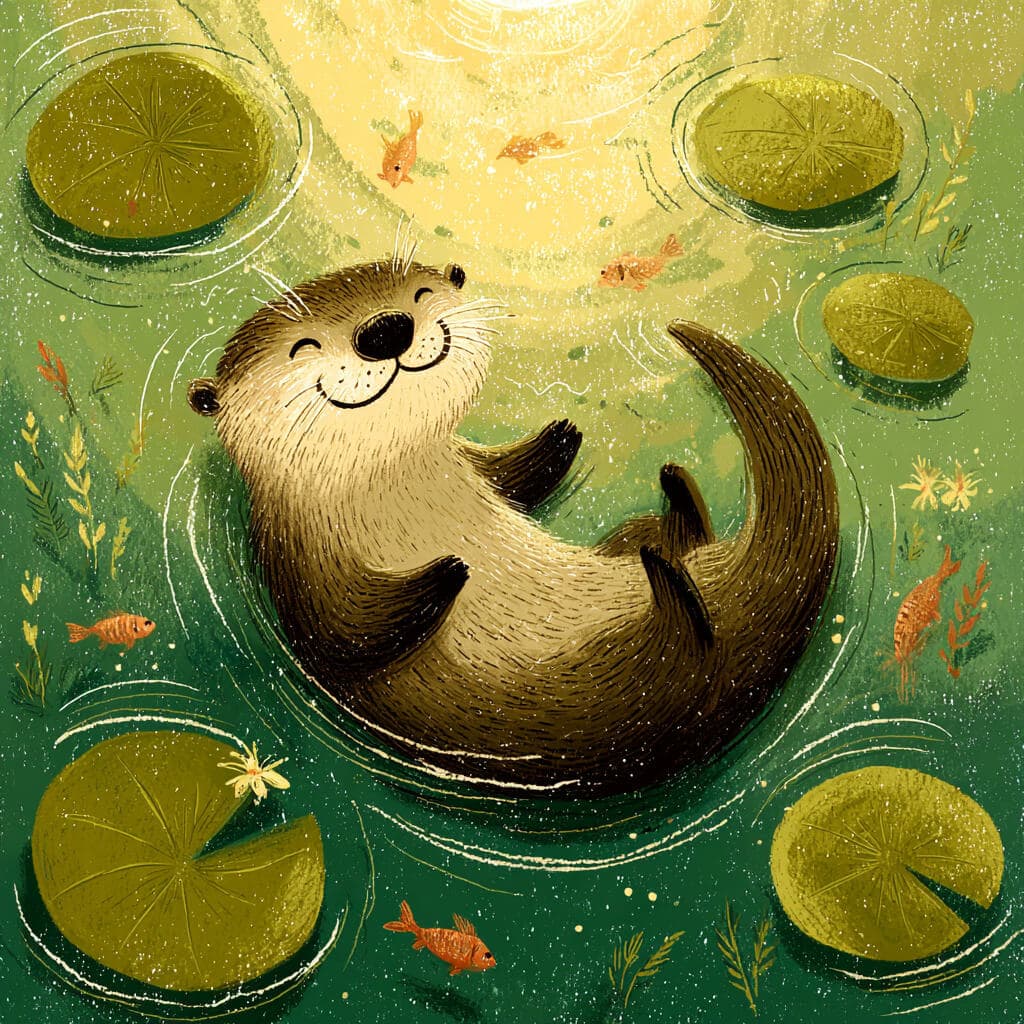
There is something about the sound of slow water that pulls a child toward sleep before the first page is even finished. This story follows Oliver, an otter who spends a quiet morning drifting on his back, opening mussels with a flat pebble, and sharing what he finds with the small creatures who paddle over to watch. It is one of those calming bedtime stories that never raises its voice, never introduces danger, and lets the river do most of the work. If you would like to build your own version with different animals or a different stretch of water, you can create one in minutes with Sleepytale.
Why Calming Stories Work So Well at Bedtime
When a story moves at the pace of a river, it gives a child's nervous system permission to slow down too. Gentle, repetitive rhythms, like floating and drifting and circling back, mirror the breathing patterns we naturally fall into before sleep. A calming story at bedtime does not need dramatic conflict to hold attention; it just needs enough sensory texture to keep a child's imagination softly occupied while the rest of the body unwinds.
That is why stories set on water tend to work especially well. The lapping of a current, the warmth of a sun-soaked stone, the shimmer of fish beneath the surface: these images are specific enough to picture but too gentle to excite. Children who struggle with busy thoughts at night often find that a slow, sensory scene gives their mind somewhere safe to land, and before long, the landing becomes sleep.
Oliver the Otter and the Gentle River 7 min 31 sec
7 min 31 sec
Oliver the otter liked almost everything about his river, but what he loved most was drifting.
Most mornings you could find him on his back, paws folded behind his head, letting the current carry him in slow loops while pale clouds slid by overhead. The clouds were pink at their edges and gold in the middle, like toast that had been left in the sun.
He listened to the soft rush of water against stones.
He listened to willow branches brushing each other.
He listened to a fish rise, hang in the air for half a second, and fall back with a sound like someone dropping a coin into a puddle.
Floating like that felt a little like dreaming with his eyes open. On the calmest days he barely moved a muscle, and the river did not seem to mind.
One smooth, bright morning his stomach rumbled, not loudly, just enough to remind him that even the most relaxed otter in the world still needs breakfast.
He rolled upright, sending a fan of small ripples out across the surface, and squinted downstream for his usual flash of silver scales. But the fish had tucked themselves deep into the cool shadows under the bank, and Oliver was not in the mood for chasing.
He never was, really.
Instead he paddled toward a sun-warmed stretch of shore where rounded stones lay stacked against each other like sleeping turtles. There, half hidden between the rocks, he noticed a cluster of mussels resting in the shallow water. Their dark shells were slightly parted, and the current washed through them with a faint, almost musical hiss.
Oliver had seen mussels plenty of times before. They always clamped shut the moment he nudged them with his nose, and he had always shrugged and moved on. But this morning one shell tilted just enough to show a pale sliver of the creature inside. He touched it again, gently. It sealed itself. He waited.
A dragonfly hovered nearby, its wings catching light in a way that made them look like tiny stained-glass windows. It dipped once to the surface, and the rings it sent outward widened and softened as they traveled, shrinking to nothing by the time they reached Oliver's belly fur.
He watched those circles disappear.
And a quiet idea arrived with them, as soft as they were.
If stones could shape the water, maybe a stone could also help with the shell. He chose a thin, flat pebble, the kind that would skip three or four times if you flung it right, and balanced it between his paws. Carefully, with the same patience he used for floating, he slid the pebble's edge into the seam of the mussel and gave the smallest twist.
A soft click.
The shell eased apart, not with a snap but with the slow motion of something deciding it was safe. Inside, the mussel meat gleamed pale and tender.
Oliver took a bite. The taste was mild, more like a calm sip of the sea than a burst of anything, and it suited the morning perfectly. He opened a second mussel, then a third, and stopped when his belly felt comfortably full. He sat on the warm stones for a moment, doing nothing at all, which was one of his best skills.
Soon the tapping of stone on shell drew company. A duckling paddled around the bend, her head tilted sideways like she was trying to hear a secret. Her small eyes widened when she saw Oliver working with his pebble.
"How did you do that without cracking it to bits?" she asked. Water beaded on her feathers and dripped from the tip of her beak.
Oliver showed her the stone and the slow twist he used. "Like turning a page," he said. "Not ripping it."
She tried with her beak, but the pebble slipped and plopped into the water. Oliver fished out another stone, a rounder one that was easier to grip, and set it on the bank in front of her. He did not say anything else. He just waited.
Her breathing slowed. She tried again.
This time the mussel opened neatly, and they shared it, one small nibble at a time. The duckling let out a sigh that seemed to come from her whole body, and Oliver thought it was probably the most contented sound he had heard all week.
A moss-backed turtle lifted his head nearby. He had been watching the whole lesson without moving, which turtles are excellent at.
He mentioned a place farther downstream where clams buried themselves beneath the sandbars, sometimes too deep for him to reach. He wondered aloud, in the unhurried way turtles wonder, whether Oliver's method might help there as well.
Oliver looked along the shining curve of the water and imagined sandbars glowing in early light.
He did not promise loudly. He just nodded and said he would visit when the day felt slow enough and the river's song was soft.
For now, he let his body sink low again, and the duckling paddled lazy circles that sent small waves across his fur.
As the sun climbed higher, turning the surface bright as polished glass, Oliver tucked his favorite flat stone under one arm and slipped downstream. He moved without hurry, stopping wherever someone seemed puzzled.
At a quiet bend, tiny minnows pecked at a mussel they could not budge.
Oliver used his pebble to open it, then stepped back. The little fish darted in and out, taking what they needed, their silver bodies flashing so fast they looked like sparks bouncing off the water. One minnow circled back and bumped Oliver's paw, which might have been a thank-you or might have been an accident. He chose to believe it was a thank-you.
Near a stand of cattails, a pair of grebes fretted about an empty breakfast spot where small snails usually gathered. Oliver showed them how a fallen reed could work as a gentle lever against a pond snail's shell. They practiced until the motion became slow and sure, fumbling twice, laughing once, and then there was enough to share.
Each time he helped, Oliver felt something settle in his chest, like a pebble finding the bottom of a deep, still pool. Nothing about the river became louder or faster. It simply felt a little more connected, the way a quilt becomes warmer when you tuck the edges in.
By evening the light softened to lavender and silver.
Oliver returned to his favorite eddy, the one that fit his body the way an old shoe fits a foot. He floated on his back, paws behind his head, the flat stone resting on his chest like a small, gray compass.
The river cradled him, circling and circling.
Somewhere upstream, a duckling practiced with her round stone.
Somewhere downstream, a turtle planned a calm morning at the sandbars.
Oliver's stomach was content. His muscles were loose. His thoughts moved no faster than the current, which was barely moving at all.
He watched the first star appear just above the tree line, a single bright point like a hole poked in dark paper. His eyes drifted half closed.
In that in-between place, not quite awake and not quite asleep, the water carried him in gentle loops. He could feel the stone still balanced on his chest, rising and falling with each breath.
And that was enough.
The Quiet Lessons in This Calming Bedtime Story
Oliver's story is built around patience, generosity, and the kind of gentleness that comes from not forcing things open. When he waits for the duckling's breathing to slow before she tries again, children absorb the idea that slowing down is not the same as giving up. When he steps back and lets the minnows take what they need without hovering, the story shows that sharing does not require an announcement. These are exactly the kinds of reassurances a child benefits from hearing before sleep, because they suggest that tomorrow's problems can be approached softly, without rushing, and that being helpful does not have to be loud or exhausting.
Tips for Reading This Story
Give Oliver a low, unhurried voice, almost sleepy, and let the duckling sound slightly breathless and curious by contrast. When Oliver opens the first mussel and hears that soft click, pause for a beat so your child can picture the shell easing apart on its own. At the very end, when he is floating in his eddy watching the first star, slow your reading to match the rhythm of his breathing, and let the last line land in near silence.
Frequently Asked Questions
What age is this story best for?
This story works well for children ages 3 to 7. Younger listeners will enjoy the gentle repetition of Oliver floating and helping, while older kids will appreciate the small details, like the duckling learning to use the stone herself and the minnow bumping Oliver's paw. The absence of conflict or danger makes it especially good for sensitive children who need a low-tension wind-down.
Is this story available as audio?
Yes. You can press play at the top of the story to listen. The audio version captures the rhythm of the river scenes especially well, and Oliver's quiet dialogue with the duckling comes alive when read aloud. The repeating pattern of drifting, helping, and drifting again has a lullaby-like cadence that works even better in narration than on the page.
Why are river settings so effective for bedtime stories?
Moving water provides a natural, repetitive backdrop that mirrors the slowing rhythms of falling asleep. In this story, the current carries Oliver without effort, and children instinctively match their breathing to that unhurried pace. The sensory details, like the hum of the dragonfly's wings and the warmth of the stones, give a child's imagination something specific to picture without anything exciting enough to keep them alert.
Create Your Own Version
Sleepytale lets you build a bedtime story with the same gentle pacing as Oliver's river, but shaped around whatever your child loves most. Swap the otter for a sleepy fox by a pond, move the setting to a quiet tide pool at dusk, or keep everything the same but add your child's name as one of the animals Oliver meets. You control the tone, the tension level, and the ending, so every night's story can feel just right.
Looking for more kid bedtime stories?

Bedtime Poems For Kids
Discover short bedtime poems for kids through a story where a boy says goodnight to kettles, slippers, stars, and a goldfish named Planet.

Scary Story Ideas For Kids
Looking for short scary story ideas for kids that feel cozy, not overwhelming? Meet Sir Boop, a bow tie wearing ghost who judges spooky slips from an Idea Jar.

Interactive Children's Stories
Discover short interactive children's stories where a girl named Wren makes choices guided by a paper fox bookmark called Flip.
Ghost Stories For Kids
The scariest thing about Puddle the ghost is his giggle, not his boo, in one of the sweetest short ghost stories for kids.

Adventure Stories For Kids
A folded map hidden inside a library book sends two friends a treasure hunt in one of our favorite short adventure stories for kids.

Native American Stories For Kids
Discover short native american stories for kids through a fireside tale of geese, gratitude, and a grandfather's gentle wisdom.