

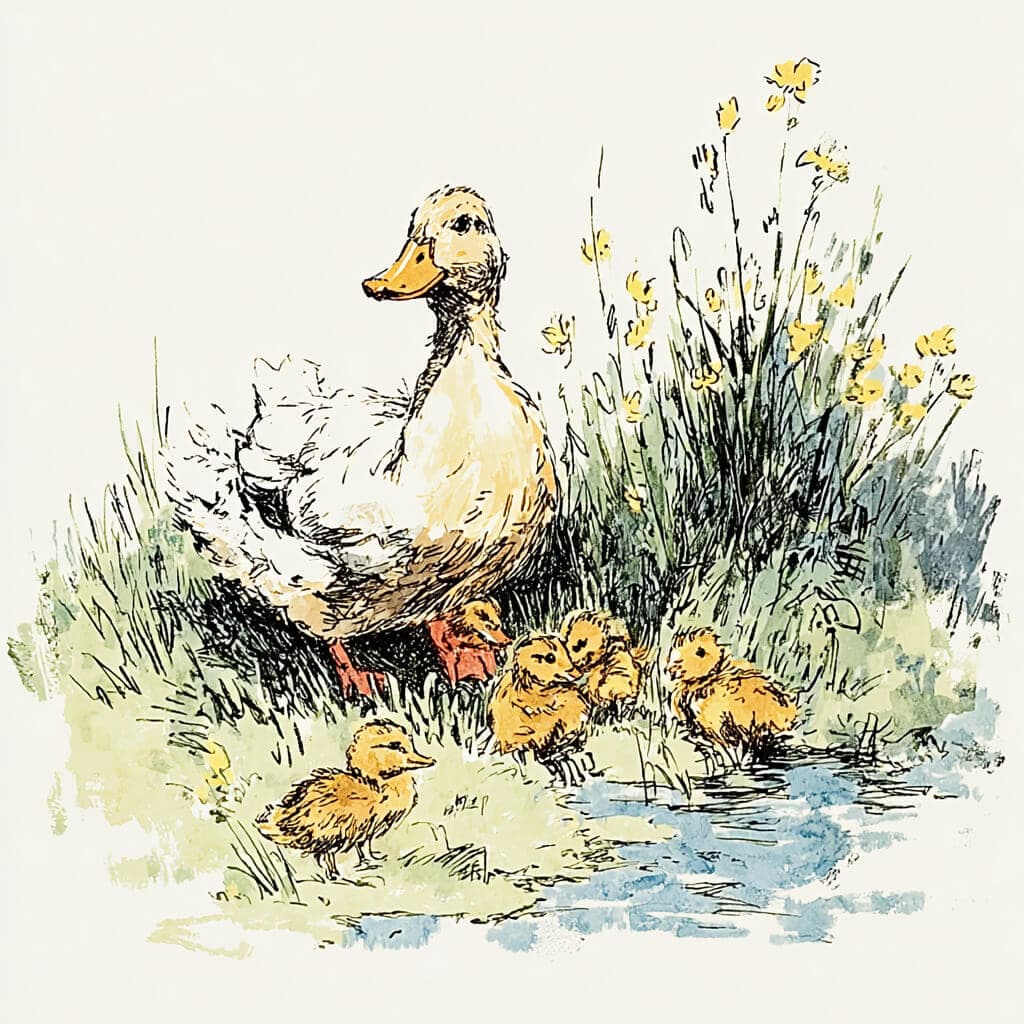
There is something about the sound of water and the rustle of reeds that settles a child's breathing before sleep even arrives. In this story, a mother mallard named Mallory guides her nine ducklings away from a destroyed pond and across an uncertain landscape, searching for somewhere safe to land. It is exactly the kind of tale you hope to find among the best bedtime story books: quiet enough to calm, honest enough to stay with you. If you want to shape a story like this around your own child's world, you can build one tonight with Sleepytale.
Why Book Stories Work So Well at Bedtime
A physical or digital story that reads like a chapter from a real book gives a child something screens and short videos rarely do: a beginning, a middle, and a landing place. That structure mirrors the shape of a bedtime routine itself. You brush teeth, you climb under covers, you arrive at sleep. When a story follows the same arc, the child's body starts to anticipate rest before the last page even comes.
That is why a bedtime story about journeys and safe arrivals can be especially powerful. The listener knows the character is heading somewhere, and that knowledge creates a kind of trust. The child relaxes into the momentum of the tale, letting the rhythm of sentences carry them forward without worry about what comes next.
The Last Pond 7 min 45 sec
7 min 45 sec
Mallory, a mallard with a chest the color of polished bronze, woke to a sound that did not belong in morning birdsong.
Metal screamed through bark. The ground shivered beneath her.
She lifted her head. Yellow machines were shoving tree trunks aside like straw, and her pond, the one wrapped in willow shade all summer, churned under grinding treads. Nine small ducklings pressed into her feathers. Their wide eyes reflected torn roots, muddy spray, a world cracking open.
By dusk the clearing was bare.
Where cattails and lily pads had floated that very week, there was only a rough hollow of churned earth and water the color of weak coffee. Mallory stood on the edge, ash clinging to the underside of her wing, and felt an old pull deep in her bones. Move. Fly. Find somewhere the noise cannot reach.
She murmured each duckling's name like a soft list of promises. Counted them twice. Then she stepped away from the ruined shoreline, and behind her the last glimmer of the old pond caught a strip of sky before it disappeared into shadow.
They crossed open ground, tiny webbed feet sinking into tire marks that smelled of oil. Beyond the stumps, pine trees rose again. The air cooled. Mallory gave her wings a low, guiding beat so the little ones could follow the whisper of her flight just above the dirt.
They walked until the village lights behind them shrank to a scatter of distant beads. She could have flown far ahead, but the ducklings could not yet rise, so she matched their pace, step after patient step, as the night wrapped itself around them like a second set of feathers.
When the smallest began to stumble, she searched for even the faintest glimmer of water. All she found was a shallow puddle in a track between roots, holding dead leaves and a few drifting insects. Not much.
But it was something.
She dipped her bill, showed them how to sieve food from the murk, then sheltered them under a fallen log until the sky paled.
Rain woke them. Soft at first, then harder, like fingers drumming on bark. They huddled under ferns while droplets gathered in rock hollows. Mallory drank, tasted stone and something faintly metallic, and drank again anyway. The ducklings copied her, small throats bobbing in unison. When the storm eased she shook out her wings, counted nine, and moved on.
The land dipped and soon the thin voice of a creek reached them. Her heart lifted. But when they arrived at the bank she saw a narrow ribbon of brown water slipping past a plastic bottle wedged between rocks. Still, it moved, and movement meant life. She showed the ducklings how to tip forward, tails up, to find tender green below the surface.
A heron stood farther downstream, tall and motionless, watching with one yellow eye.
Mallory flared her wings.
After a long moment the heron stepped aside, recognizing a mother who would not be argued with.
By noon the sun pressed down and steam rose from their backs. They followed the creek until it bent toward a road where cars rushed in gleaming lines. Each passing gust tugged at downy feathers. Mallory waited, listening for a lull, then hurried across with wings half open for balance. The ducklings pattered behind her, their trust louder than any engine.
On the other side a culvert yawned, dark and cool. Something in her bones warned of sudden water and sharp teeth, so she led them instead along a hedge where blackberries clung to sun warmed vines. They pecked at fallen berries and stained their bills a ridiculous purple, and for a few quiet minutes the world tasted sweet again.
An old wooden sign leaned at the edge of the hedge, paint cracked and curling. Mallory did not know the words, but a green frog had been carved into the wood. Something in her chest loosened. She guided the ducklings past it as the sky turned lavender.
The ground rose. The air sharpened with the smell of sap, and pines began to replace oaks. Her wings ached with the desire to take off and scout, but her family still needed the ground. So she climbed onto a stump, stretched her neck, and scanned the dimming slopes.
There.
A dark mirror tucked between hills, catching the last light. Water.
She slid down, called in a low, reedy voice, and the ducklings hurried after her along a narrow deer trail. Night insects sang. Something rustled in the brush, then slid away. Mallory walked without pause. Her calm stride spoke louder than any fear could.
When they reached the pond the surface lay still and round, cradling the stars. Cattails whispered. The air smelled of soil and algae, not smoke. She eased into the water, felt the cool weight of it lift her body, then guided each duckling onto a floating mat of roots and moss.
Frogs resumed their chorus as if nothing in the world had ever changed. Fireflies traced slow circles above the reeds. Mallory folded her wings around the little ones and, for the first time since the machines, let a full breath leave her chest.
Days stretched into weeks. The ducklings traded soft fluff for sleek feathers, their peeps deepening into awkward quacks that startled even themselves. Mallory taught them where tubers hid beneath the mud, how to read the shadow of a hawk on the water, how to settle into reeds so still that danger glanced past without a second look.
Sometimes visitors arrived: a pair of teal thin from long flight, a muskrat who had stories about ditches and pipes, a dragonfly whose pond had vanished under concrete. Mallory listened. She understood that this hidden place, too, might someday be asked to change.
When the moon swelled round again and the ducklings' wings finally caught and held the air, she gathered them at dusk. They rose together, circling the pond three times in a slow goodbye that felt more like gratitude than grief.
She turned her beak north toward a wide seam of water stitched across the old maps in her memory. They skimmed over farm fields where scarecrows crooked their arms to the empty sky, over towns where porch lights glowed even after stars came out.
At dawn they found a marsh that seemed to go on forever. A quilt of pools and tall grass. Redwing blackbirds flashed their bright shoulders and sang from the cattails. Mallory dropped toward a patch of open water ringed with sedge and felt the soft give of peat beneath the surface.
Here, reeds were taller than foxes, and the horizon stretched in every direction. She led her flock deep into the maze of green, past muskrat homes and the patient gaze of a deer standing knee deep in water.
They settled on a thick, floating mat of roots that rose and fell with their weight. Duckweed dappled the surface. Dragonflies stitched silver lines through the mist. Mallory knew this place would not be untouched forever, but it was big and wild and ready to hold them for a while.
One night, under curtains of green light shimmering across the sky, she watched her nearly grown ducklings sleep in a loose ring around her. Wind moved through the reeds like a slow tide. She thought of the first pond, now likely covered in gravel or framed in concrete. The ache was there. It would always be there. But layered over it was something else, quieter: continuation.
Just before dawn the water rippled with a heavy, steady splash. An old beaver surfaced, scars tracing pale lines across his fur. With the slap of his broad tail he told her of a dam farther down, of channels kept open so the marsh could breathe.
Mallory answered in low quacks. An agreement older than any machine.
They would both keep watch. They would both guard this stretch of water in the ways they knew.
When the sun finally climbed she led her young into the sky again, circling once above the reeds. Their wings beat in time, scattering droplets that caught the light like tiny glass beads.
Then they landed and began the gentle work of belonging: trimming algae, weaving nests, making space for whatever lives here next.
Mallory settled onto the floating mat and felt it rock with the slow inhale and exhale of the marsh. She closed her eyes. Frogs, wind, soft feathers, all of it folded together into one long, quiet sound that needed no name.
The Quiet Lessons in This Book Bedtime Story
Mallory's journey weaves together resilience, trust, and the courage to start over, three ideas that sit well in a child's mind right before sleep. When she matches her pace to her stumbling ducklings instead of flying ahead, children absorb a picture of patience that needs no explanation. The moment the flock circles the pond three times before leaving shows kids that you can honor something you loved and still move forward. These are reassuring thoughts to carry into the dark: that loss does not have to mean the end, and that someone steady is always nearby, keeping count.
Tips for Reading This Story
Give Mallory a low, steady voice throughout, but let it soften even further when she murmurs the ducklings' names at the ruined shoreline. Speed up just slightly during the road crossing scene where the cars rush past, then slow right down again when they reach the blackberry hedge. When the beaver surfaces near the end, try a gruff, unhurried tone and pause after the tail slap so your child can picture the sound echoing across the marsh.
Frequently Asked Questions
What age is this story best for?
This story works well for children ages 4 through 8. Younger listeners respond to the counting of ducklings and the sensory details like purple berry stains and fireflies, while older kids can follow Mallory's decisions and understand the weight of leaving a home behind. The gentle pacing keeps it accessible without talking down to anyone.
Is this story available as audio?
Yes. You can press play at the top of the story to hear it narrated aloud. The audio version brings out details that are easy to miss on the page, especially the shift in atmosphere when Mallory enters the final marsh and everything opens up. The steady, repetitive rhythm of the journey sections works almost like a lullaby when you hear it spoken.
Why does Mallory walk instead of flying with her ducklings?
Real mallard ducklings cannot fly for their first several weeks of life. Mallory stays on the ground because her young ones have not grown their flight feathers yet. This detail keeps the story grounded in how ducks actually behave, and it also creates the central tension: the journey takes longer and is more dangerous because Mallory chooses to stay with her family rather than scout ahead alone.
Create Your Own Version
Sleepytale lets you reshape a story like this around your child's world in minutes. Swap the ducks for foxes, rabbits, or a family of otters. Move the journey from marshes to mountains, a snowy coastline, or even a chain of rooftop gardens. You can adjust the tone from calm and reflective to gently adventurous, then save, listen, and come back to it whenever bedtime needs a story that feels made just for your family.
Looking for more kid bedtime stories?

Bedtime Poems For Kids
Discover short bedtime poems for kids through a story where a boy says goodnight to kettles, slippers, stars, and a goldfish named Planet.

Scary Story Ideas For Kids
Looking for short scary story ideas for kids that feel cozy, not overwhelming? Meet Sir Boop, a bow tie wearing ghost who judges spooky slips from an Idea Jar.

Interactive Children's Stories
Discover short interactive children's stories where a girl named Wren makes choices guided by a paper fox bookmark called Flip.
Ghost Stories For Kids
The scariest thing about Puddle the ghost is his giggle, not his boo, in one of the sweetest short ghost stories for kids.

Adventure Stories For Kids
A folded map hidden inside a library book sends two friends a treasure hunt in one of our favorite short adventure stories for kids.

Native American Stories For Kids
Discover short native american stories for kids through a fireside tale of geese, gratitude, and a grandfather's gentle wisdom.