
Pirate Ship Bedtime Stories
By

Dennis Wang, Bedtime Story Expert
3 min 23 sec
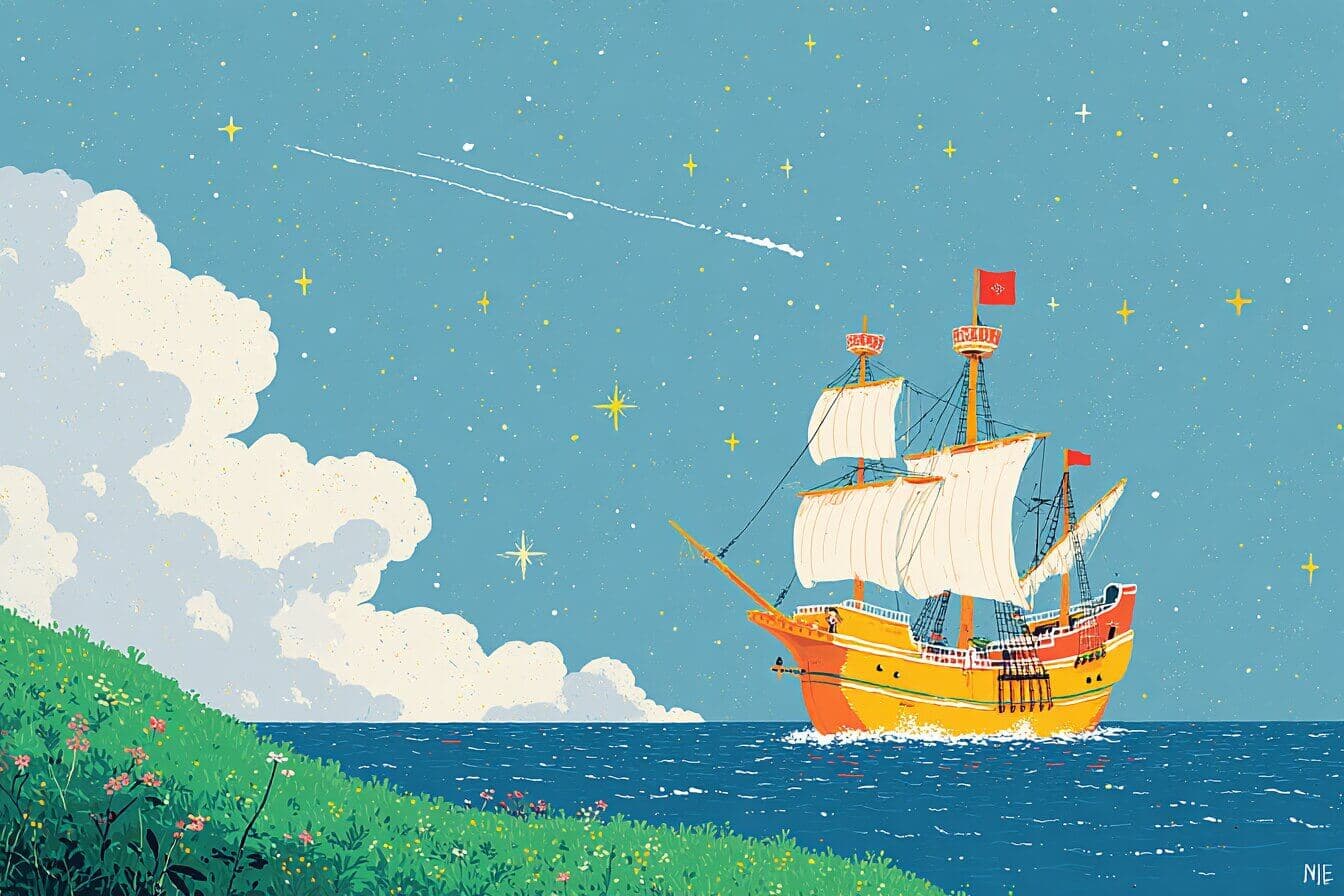
There is something about the creak of wood and the snap of canvas that makes a child's eyes go heavy in the best possible way. In this story, Captain Twinklebeard invites a crew of kids aboard the galleon Starwhisper for a voyage that lifts straight off the ocean and into the stars, threading through cloud dolphins and a chiming maze of moon rocks. It is one of those pirate ship bedtime stories that trades cannon fire for gentle wonder, so every scene drifts a little closer to sleep. If your child has opinions about the ship's name, the crew, or exactly which constellations they sail past, you can build your own version with Sleepytale.
Why Pirate Ship Stories Work So Well at Bedtime
A pirate ship is a small, enclosed world floating through something vast, and that combination mirrors exactly how a child feels tucked under the covers at night. The ship is safe, the crew is close, and the darkness outside is not frightening but full of possibility. When a bedtime story about a pirate ship drifts slowly through clouds and quiet water, it gives children a moving home to settle into, somewhere they can feel protected while still going on an adventure.
There is also a rhythm to sailing that lulls. Waves lap, rigging hums, timber groans in a low steady voice. These repeating sounds translate naturally into the cadence of a story read aloud, and they signal to a child's brain that nothing sudden is coming. The world is just rocking gently, carrying them forward, one calm wave at a time.
Captain Twinklebeard and the Sky Sailing Pirates 3 min 23 sec
3 min 23 sec
Captain Twinklebeard stood at the helm of the galleon Starwhisper.
His coat had buttons shaped like tiny moons, and one of them was sewn on slightly crooked, which he secretly liked best.
The night sky stretched overhead, enormous and quiet. Stars pricked through the dark like needle holes in a curtain with lamplight behind it.
He turned to his crew of children, who were lined up along the railing with wide eyes and bare feet on the cool deck planks.
"Ready to sail where maps show only clouds?" he asked.
They cheered. Every one of them had dreamed, at least once, that ships could fly.
And Twinklebeard believed it so fiercely that the hull had lifted clean off the waves at sunset. It rose past the gulls, who honked in confusion, and kept climbing until the ocean below shrank to a wrinkled blue quilt. The sails puffed out like happy cheeks, filled not with wind but with wishes, or so the captain claimed. He never explained the mechanics.
The youngest sailor was a boy named Milo. He had a toy boat in his pocket, a wooden thing with chipped paint and a mast made from a pencil stub.
"Can she come too?" he asked, holding it up.
Twinklebeard knelt down, studied the toy boat with the seriousness of a man appraising a real vessel, and then nodded.
He tied it to a length of kite string and let it out over the railing. It caught the air and sailed alongside like a tiny escort, bobbing and spinning.
Milo watched it for a long time, chin on his hands.
They passed lighthouses far below, blinking like sleepy fireflies. Fishing boats looked like crumbs on dark bread. Somewhere a foghorn sounded, low and far away, and then the sea was gone entirely.
The ship creaked.
That was all you could hear for a while, just the timber talking to itself, rope settling, a sail adjusting with a soft whump. It sounded like a house at night when everything is fine.
Ahead, a cluster of clouds shaped like dolphins leapt across the sky path. The captain steered straight through, and cool mist kissed every cheek. One girl stuck out her tongue and tasted it. "Like cold nothing," she reported, frowning as if that disappointed and delighted her equally.
Beyond the dolphins waited the Moon Maze, a spiral of floating moon rocks each no larger than a dinner plate, pale and rough around the edges. The Starwhisper threaded between them slowly, and wherever the hull brushed a rock, it rang out. A high clear chime, then another, then three at once.
Milo laughed. The sound bounced back from somewhere above, softened, like an echo that had taken a long trip home.
The crew began to sing. It was not a proper shanty, more like a song they were inventing as they went, something about comets and candy and a cat who lived on the moon. Their voices were small against all that dark sky, but the sails seemed to drink the sound in. The canvas brightened. Then the rigging. Then the whole ship glowed the way a lantern does when you cup your hands around it.
Nobody pointed it out. They just noticed, and kept singing, and the Starwhisper sailed on, warm and shining, toward the place where sky dreams are stored.
Milo's toy boat trailed behind on its string, spinning gently.
He had fallen asleep against a coil of rope, one hand still holding the line.
The Quiet Lessons in This Pirate Ship Bedtime Story
This story carries a few ideas that settle well into a child's mind right before sleep. When Milo worries his small, chipped toy boat does not belong on a grand voyage, and the captain kneels down to treat it with real respect, children absorb the notion that nothing they love is too small to matter. The crew's improvised singing, imperfect and made up on the spot, quietly shows that you do not need to be polished to contribute something beautiful. And the fact that the ship glows brighter without anyone demanding an explanation lets kids sit with wonder instead of needing answers. These are reassuring ideas to carry into the dark: that you belong, that your voice counts, and that not everything needs to be figured out tonight.
Tips for Reading This Story
Give Twinklebeard a low, gravelly warmth, the kind of voice that sounds like it has spent years at sea, and let Milo's lines come out quieter, a little hopeful. When the Starwhisper passes through the cloud dolphins, slow your pace and drop your volume so the mist feels real. At the moment the moon rocks chime, you can tap a fingernail lightly on your child's headboard or nightstand, once, twice, three times, to bring the sound into the room.
Frequently Asked Questions
What age is this story best for?
It works beautifully for children ages 3 to 7. Younger listeners love the sensory details like the chiming moon rocks and the cloud mist, while older kids connect with Milo's quiet worry about whether his toy boat belongs. There is no conflict or danger, so even the most sensitive listeners can relax into it.
Is this story available as audio?
Yes. Press play at the top of the story to listen. The audio version captures the rhythm of the sailing scenes especially well, and the moment when the crew starts singing feels natural and warm when heard aloud. Twinklebeard's voice comes through with the kind of gentle authority that makes kids feel safe enough to close their eyes.
Why does the ship fly on wishes instead of wind?
Captain Twinklebeard never explains the mechanics on purpose, and that is part of the charm. In the story, the sails fill the moment the crew believes, and they glow brighter when the children sing together. It gives young listeners the sense that hope and imagination are real forces, which is a comforting thought to drift off with.
Create Your Own Version
Sleepytale lets you reshape this kind of sky sailing adventure into something that fits your child perfectly. Swap the galleon for a tiny raft or a submarine, trade the moon rocks for glowing jellyfish, or turn the crew into your child's siblings, best friends, or a row of stuffed animals lined up on the deck. In a few taps you will have a gentle, personal voyage ready to play at bedtime whenever you need it.
Looking for more kid bedtime stories?
Bedtime Poems For Kids
Discover short bedtime poems for kids through a story where a boy says goodnight to kettles, slippers, stars, and a goldfish named Planet.
Scary Story Ideas For Kids
Looking for short scary story ideas for kids that feel cozy, not overwhelming? Meet Sir Boop, a bow tie wearing ghost who judges spooky slips from an Idea Jar.

Interactive Children's Stories
Discover short interactive children's stories where a girl named Wren makes choices guided by a paper fox bookmark called Flip.
Ghost Stories For Kids
The scariest thing about Puddle the ghost is his giggle, not his boo, in one of the sweetest short ghost stories for kids.

Adventure Stories For Kids
A folded map hidden inside a library book sends two friends a treasure hunt in one of our favorite short adventure stories for kids.

Native American Stories For Kids
Discover short native american stories for kids through a fireside tale of geese, gratitude, and a grandfather's gentle wisdom.