
Mermaid Bedtime Stories
By

Dennis Wang, Bedtime Story Expert
8 min 5 sec
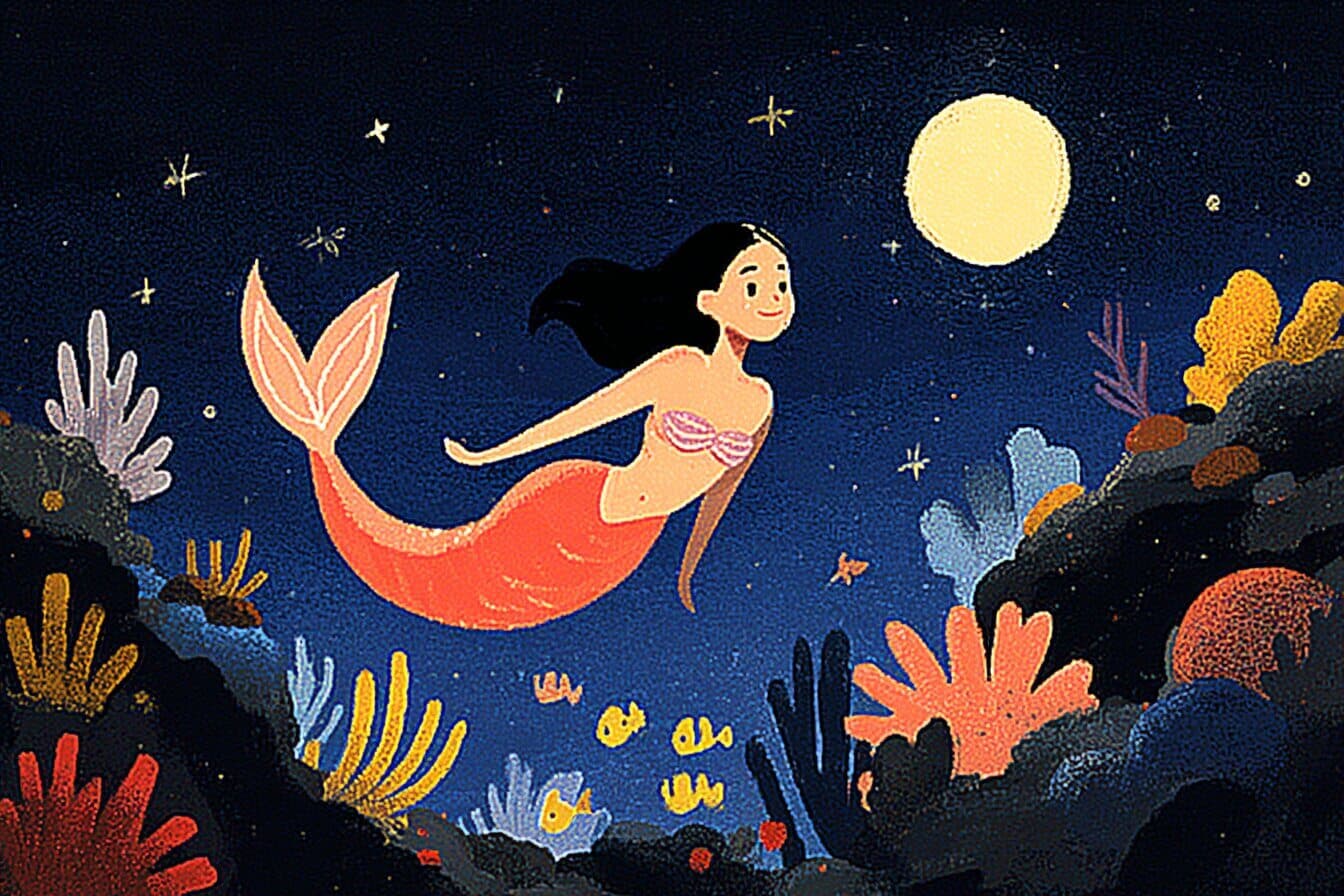
There is something about the ocean at night that slows a child's breathing down before a single word is read. The cool darkness, the hush of waves, a flash of silver beneath the surface. In tonight's story, a young mermaid named Marina hears a lullaby drifting down through the water and decides, one brave night, to swim up and find the singer. It is one of our favorite mermaid bedtime stories, and if your child wants a version with their own name or a different ocean, you can create one free with Sleepytale.
Why Mermaid Stories Work So Well at Bedtime
Mermaids live in a world that already feels like sleep. Everything moves slowly underwater: hair drifts, light bends, sounds arrive muffled and soft. For a child lying in bed, imagining that world is almost like sinking into the mattress itself. The rhythm of tides and currents gives a bedtime story about mermaids a built-in pulse that matches the way a body relaxes, rising and falling, rising and falling.
There is also something reassuring about a character who belongs to two places at once. Mermaids can swim to the surface and then return home, which mirrors what children do every night when they travel into dreams and come back in the morning. That sense of always having a safe place to return to is exactly what kids need to hear before they close their eyes.
Marina and the Moon's Silver Song 8 min 5 sec
8 min 5 sec
Far beneath the coral towers and pearl-paved streets of Aquaria, a young mermaid named Marina pressed her cheek against a sea rock and listened.
The rock was cold in the way that felt good, like the underside of a pillow. Every evening she heard the same soft hush drifting down through the waves, a lullaby that seemed to know her name.
It was the Moon singing to the sea.
Marina longed to see the singer instead of only hearing the song. Grandmother Pearl had warned her once, voice low, hands busy braiding kelp, that surfacing after sunset was dangerous for merfolk. But the Moon's voice did not sound dangerous. It sounded like someone humming in another room, the kind of sound that makes you lean toward the doorway.
Marina's heart fluttered whenever she imagined the sky. A place where water simply stopped and something called air began, where stars scattered the dark like broken shells on a beach she had never walked. So on the night of the summer solstice, when the currents ran gentle and lantern fish floated past like tiny glowing balloons bumping into one another, Marina decided to follow the song.
She gathered courage the way children gather seashells, one small piece at a time, until her basket of bravery felt full enough.
She slipped past sleeping sea turtles. She waved good night to a shy octopus who blinked one enormous eye and then tucked itself deeper into its crevice. She rose toward the silver mirror of the surface, and the water grew lighter around her, warmer, until her fingertips tingled.
Then her head broke through.
The world above was painted in moonlight and silence. Marina blinked. The Moon hung there, round and radiant as a polished opal, and it seemed to be looking right at her. Her tail shimmered turquoise under the beams, and she felt her heart skip the way a flat stone skips across still water. The Moon's light brushed her hair, and in that gentle glow Marina understood something. She was in love. Not with a person, but with the quiet beauty that watched over the night while everyone else slept.
She floated on her back, letting the waves rock her. Above, the Moon continued its silver song, a melody made of comfort and distance and half-remembered dreams. Marina whispered that she would come back every night, and the Moon seemed to glow a fraction brighter, as if it had been waiting ages for someone who could actually hear its music.
Back in Aquaria, Marina's eyes sparkled with secrets.
Every night after that she rose to trade silent stories with her distant beloved. She told the Moon about the eel who always stole Grandmother Pearl's best cooking spoon. The Moon told her, in shifts of light and shadow, about clouds that looked like whales and cities that glittered on the shore.
One evening a misty storm blurred sky and sea together until Marina could not tell where one ended and the other began. She surfaced anyway. The Moon hid behind clouds, its song muffled to almost nothing. Marina did something she had never tried before. She sang back, sending ripples of her own voice upward, a clumsy little tune that wobbled in the open air.
The clouds parted like curtains yanked aside by an impatient hand. There was the Moon, smiling. Marina laughed so hard that bubbles raced around her and a startled fish darted away.
She began bringing tiny gifts. A spiral shell that hummed when you held it to your ear. A piece of rainbow coral no bigger than her thumb. A strand of kelp she had braided into a lopsided heart that kept unraveling on one side no matter how many times she retied it. The Moon bathed each gift in light, turning them silver, and Marina felt her love reflected back, not smaller for the distance but somehow larger.
Grandmother Pearl noticed the change, the way Marina drifted through the day with a quiet half-smile, forgetting to eat her sea-grape breakfast twice in one week. She asked what miracle had visited her granddaughter's dreams.
Marina simply hummed the Moon's lullaby.
Grandmother Pearl's hands went still over her kelp braid, and she nodded slowly, because she too had once loved something distant and beautiful.
Seasons turned. Marina learned that love does not always mean holding. Sometimes it means reaching toward something you will never quite touch, and feeling full anyway. The understanding arrived not all at once but in pieces, the way sand settles after a wave.
One autumn night, when the sea grew colder and the sky turned sharp and clear, Marina found a baby seal tangled in fishing net near the surface. It cried in short, raspy barks, its flippers twisted at bad angles. She worked carefully, chewing through the rough ropes one strand at a time while the Moon hung low and poured light over her hands so she could see every knot.
The last strand snapped. The pup wriggled free, barked once, softly, and dove.
Marina watched it disappear and realized her love for the Moon had just deepened again, because its light had helped her save a life. Love, even from far away, could make her braver and kinder in her own world beneath the waves.
She began telling other sea creatures about the silver song. Soon dolphins practiced gentle jumps to its rhythm, their splashes catching moonlight. Whales hummed low harmonies that vibrated through the deep. The ocean itself seemed to glow with shared affection, and Marina's heart felt like a lantern carried between two realms, one of water and one of air.
One winter evening, when the sea turned silver with frost and the Moon hung so low and large it looked close enough to touch, Marina swam higher than she ever had before. She breached the surface in a single leap that sent droplets sparkling like tiny moons all around her. For one heartbeat she hung suspended between her two homes, tail dripping, arms open, the cold air sharp in her lungs.
The Moon's light wrapped around her like something warm.
She whispered a promise to always be a bridge between the deep and the sky, and then she slipped back into the welcoming waves.
Below the surface, the Moon's song followed her, a new verse this time, softer, closer, as if it too had fallen in love with a mermaid who listened with her heart.
Marina returned to the coral towers, her tail glowing faintly. Every creature she passed felt a little moonlight settle in their own chest, a warmth they could not quite explain. Grandmother Pearl was sitting outside her door, waiting, and she did not ask a single question. She just opened her arms.
From that night on, whenever a child on a dark beach looked up at the Moon and felt suddenly, unexpectedly calm, Marina knew her love had traveled farther than any ocean could hold, carried on silver beams and a song that never stopped.
The Quiet Lessons in This Mermaid Bedtime Story
Marina's journey carries a handful of ideas that settle gently into a child's mind before sleep. When she gathers courage "one small piece at a time," kids absorb the notion that bravery is not a single dramatic act but something you build slowly, the same way they might work up the nerve to try something new tomorrow. Her decision to sing back at the storm, clumsy and imperfect, shows that reaching out matters more than getting it right, a comforting thought for a child who worries about mistakes. And the thread running through everything, that you can love something you cannot hold, gives children language for feelings they already have, missing a grandparent, adoring the stars, treasuring a place they visited once. These are reassuring ideas to carry into sleep, because they promise that distance and darkness do not erase the things that matter.
Tips for Reading This Story
Give Grandmother Pearl a slow, low voice and let her pauses stretch a beat longer than feels natural; that silence is where the warmth lives. When Marina breaks the surface for the first time, try lifting your own voice slightly, almost to a whisper, so the shift from underwater to open air feels real. At the moment the baby seal is freed and barks once before diving, pause and let your child fill the quiet, they might want to bark back or ask if the seal found its mother, and either reaction is the right one.
Frequently Asked Questions
What age is this story best for?
It works well for children ages 3 to 8. Younger listeners love the sensory details like the lantern fish and the baby seal rescue, while older kids connect with Marina's more complex feelings about loving the Moon from a distance. The simple, looping structure, surface and return, surface and return, keeps even restless three-year-olds oriented.
Is this story available as audio?
Yes. Press play at the top of the story to hear it read aloud. The audio version captures the rhythm of the ocean scenes especially well; the moment Marina sings back at the storm feels almost musical when narrated, and the quiet final verse of the Moon's song is a perfect wind-down for listeners already curled up in bed.
Why do kids connect so strongly with mermaid characters?
Mermaids live between two worlds, and children understand that feeling instinctively because they navigate their own "two worlds" every day, home and school, waking and dreaming. Marina's nightly journey to the surface and back mirrors the bedtime routine itself, an adventure into something mysterious followed by a safe return home.
Create Your Own Version
Sleepytale lets you build a personalized ocean story with the same gentle rhythm as Marina's adventure. Swap Aquaria for a kelp forest or a sunken castle, replace the Moon's lullaby with a star's whisper, or add a dolphin companion who swims alongside your child's character. In a few moments you will have a calm, original story ready to replay whenever bedtime needs a little silver light.
Looking for more kid bedtime stories?
Bedtime Poems For Kids
Discover short bedtime poems for kids through a story where a boy says goodnight to kettles, slippers, stars, and a goldfish named Planet.

Scary Story Ideas For Kids
Looking for short scary story ideas for kids that feel cozy, not overwhelming? Meet Sir Boop, a bow tie wearing ghost who judges spooky slips from an Idea Jar.

Interactive Children's Stories
Discover short interactive children's stories where a girl named Wren makes choices guided by a paper fox bookmark called Flip.

Ghost Stories For Kids
The scariest thing about Puddle the ghost is his giggle, not his boo, in one of the sweetest short ghost stories for kids.

Adventure Stories For Kids
A folded map hidden inside a library book sends two friends a treasure hunt in one of our favorite short adventure stories for kids.

Native American Stories For Kids
Discover short native american stories for kids through a fireside tale of geese, gratitude, and a grandfather's gentle wisdom.