
Coloring Bedtime Stories
By

Dennis Wang, Bedtime Story Expert
8 min 6 sec
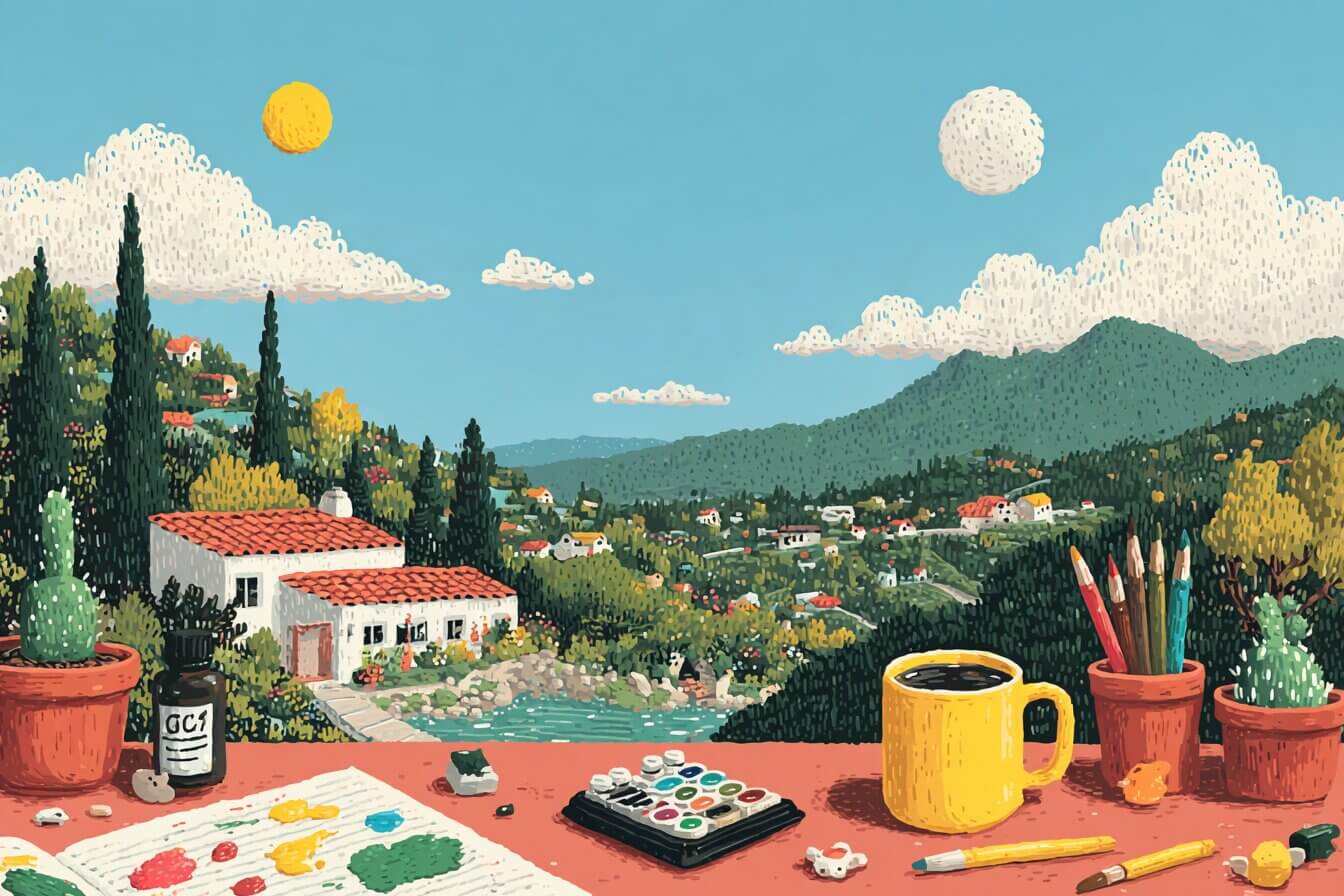
There's something about the slow drag of a crayon across paper that quiets a busy mind, especially when the house is getting still and the lights are going low. In this coloring bedtime stories adventure, a girl named Lily discovers that her careful, inside-the-lines pictures aren't the only way to draw, and that a single purple dot outside the border can change everything. It's a story about permission, really, the kind kids need before they can relax into sleep. If you'd like a version shaped around your own child's favorite colors and worries, you can create one with Sleepytale.
Why Coloring Stories Work So Well at Bedtime
Coloring is already one of the calmest things a child can do. The repetition, the focus on one small patch of color at a time, the way the world narrows to a crayon tip and a blank space. A bedtime story about coloring taps into that same rhythm. It slows the brain down the way the activity itself does, letting kids picture soft strokes and gentle color rather than anything that spikes adrenaline.
There's also something reassuring about a story where the biggest risk is drawing outside a line. The stakes feel manageable, which is exactly what children need before sleep. They can root for a character, feel the small tension of "what will happen when she shows her picture," and then settle into the relief of acceptance. It mirrors the emotional arc of a good bedtime: a little worry dissolving into safety.
The Colorful Lines of Creativity 8 min 6 sec
8 min 6 sec
In the small town of Rainbow Ridge, there was a girl named Lily who loved to color more than she loved almost anything. More than grilled cheese. More than Saturdays.
Every afternoon after school she'd drop her backpack by the door and go straight to the table by the window where her crayons waited in a dented tin box, the lid slightly bent from being opened so many times.
She was good at it, too. Neat, precise strokes that never wandered past the black outlines. Her teacher had taught her that technique, and Lily had taken to it the way some kids take to making their bed with hospital corners.
Her mother hung every finished page on the refrigerator with a row of mismatched magnets, and Lily liked the look of them there, lined up and orderly.
But one afternoon, while she was filling in a picture of a garden, she glanced out the window and stopped.
The actual garden in their backyard was a mess. A beautiful mess. Roses bent sideways. Morning glories had climbed the mailbox post nobody had asked them to climb. A vine was growing straight through the chain-link fence like it hadn't even noticed the fence was there.
Butterflies zigged and dropped and looped back on themselves.
None of it stayed in any lines.
Lily looked down at her page. She looked back at the garden. She picked up her purple crayon and held it over the white space just past the border of the drawing.
Her hand hovered.
Then she pressed down and made one small dot outside the line.
Nothing happened. The table didn't shake. Her mother didn't call from the kitchen. The dot just sat there, looking, honestly, kind of cheerful.
So she made more. Dots became swirls. Swirls became shapes the original picture had never imagined. She gave the garden a purple sun with green rays, and she added butterflies covered in polka dots that wandered right off the edge of the page and onto the table a little bit, which she wiped off with her sleeve.
When she put the last crayon down, her chest felt open and loose, like she'd been holding her breath for weeks and only just noticed.
She also felt a knot in her stomach, because it looked nothing like the neat pages on the refrigerator.
The next day at school, her art teacher Mrs. Martinez asked everyone to share their weekend artwork.
Lily kept the picture in her folder. Then she pulled it halfway out. Then she pushed it back.
One by one, her classmates showed houses with green lawns. A cat sitting on a fence. A rocket ship, perfectly colored, staying exactly where rockets are supposed to stay on the page.
When Mrs. Martinez said her name, Lily walked to the front slowly. The paper shook a little in her hands.
She held it up.
The room went quiet. Someone gasped. A boy in the back row laughed, not meanly, more like he was surprised. Mrs. Martinez didn't say anything right away. She just looked at the picture for a long moment, tilting her head to one side the way people do when they're actually seeing something.
"Tell us about this, Lily."
Lily swallowed. "Well, real gardens don't have borders. And wind doesn't follow lines. So I thought maybe my drawing didn't have to either."
Mrs. Martinez nodded. She walked to the classroom window and asked everyone to look outside at the playground. Grass growing in patches wherever it wanted. Clouds shaped like nothing in particular. Two birds cutting across the sky in completely different directions.
She turned back and said that learning technique matters, but so does knowing when to let it go. She told Lily it took courage to show that picture, and she meant it, you could hear it in her voice.
Over the next few weeks, something shifted.
Timmy, who always got frustrated because his hands couldn't keep the colors inside the lines, made an outer space scene with planets scattered everywhere. He used the side of his crayon for Saturn's rings and it actually looked incredible.
Sarah, who barely spoke above a whisper most days, designed an underwater world where fish swam upside down and sideways. She used colors that made no biological sense, orange water, pink sand, and it worked perfectly.
The classroom walls filled up with art that looked like it had been made by people who were paying attention to the world and not just to the edges of things.
Lily found that some days she still wanted the calm of staying inside the lines. The rhythm of it. The way it made her brain go quiet. Other days she needed the mess, the freedom, the feeling of a river that doesn't care where the bank is.
She stopped thinking one way was better.
Her parents noticed. She talked more at dinner. She told stories about what her classmates made and why, and her eyes got wide when she described Timmy's planets.
One weekend her grandmother came to visit and spotted the purple-dotted garden on the refrigerator.
She didn't say, "What happened here?" or "That's interesting," which is what adults say when they're confused. Instead, she sat down next to Lily and told her about Jackson Pollock, who dripped paint onto canvases on the floor, and about artists in Japan who left deliberate empty spaces because the emptiness was part of the beauty.
Lily listened with her chin in her hands.
She didn't say anything for a while after her grandmother finished. She just sat there, feeling connected to something bigger than her dented tin of crayons, though the crayons were part of it too.
As the school year went on, Lily's courage leaked into other places. She wrote poems where the last words didn't rhyme and it sounded better that way. She built block towers that leaned at weird angles and somehow didn't fall. She made up songs about things like the sound the refrigerator made at night, a low hum that sounded like it was thinking.
Her friends started calling her Creative Lily. She liked that.
One afternoon, walking home, she saw her elderly neighbor Mrs. Chen struggling with two grocery bags and a set of keys at the same time. Lily stopped. She held the bags while Mrs. Chen found the right key, and then somehow she ended up inside, sitting at the kitchen table, listening to stories about Mrs. Chen's childhood in China.
Markets with baskets of lychees stacked so high they toppled. Dragon boat races on a river that turned brown after rain. The smell of her mother's kitchen, which Mrs. Chen described so specifically, garlic and sesame oil and something green she could never remember the name of, that Lily could almost smell it too.
Lily went home and drew all of it. The dragons danced off the page. The fruit spilled over every border. She brought the pictures back to Mrs. Chen, who held them for a long time without speaking and then put them on her own refrigerator.
After that, Mrs. Chen started telling her stories to other neighborhood kids too. Something about seeing her memories drawn out in wild color made her want to share them.
Lily started an after-school art club. No rules about lines. No rules about what colors went where. Kids could paint, sculpt, move around, make noise. A boy named Marco spent an entire session building a castle out of tape, and when it collapsed he said, "Good, now it's ruins," and kept going.
Parents told Lily's mother that their children seemed different. Braver about trying things. Less afraid of getting it wrong.
When the school year ended, Mrs. Martinez gave Lily a special art award. Not for technique. For inspiring others.
Lily walked across the stage and thought about that first purple dot. How small it was. How scared she'd been to make it. And how it had led, somehow, through a chain of moments she couldn't have predicted, to this.
That summer she set up a table in her front yard with a sign that said "Free Art Lessons" in wobbly marker. She told every kid who sat down the same thing: there are no mistakes. Only things you haven't decided to keep yet.
They came with stubby crayons and big ideas, and they left with pages full of wild, sprawling color and the quiet feeling that they were allowed to be exactly who they were.
Lily watched them walk home in the evening light, their pictures flapping in the breeze, and she didn't try to name what she felt. She just let it sit there, warm and full, like a purple dot on a clean white page.
The Quiet Lessons in This Coloring Bedtime Story
This story carries a few ideas that settle well right before sleep. When Lily makes that first mark outside the line and nothing bad happens, kids absorb a gentle truth about risk: most of the things we're afraid of turn out to be smaller than we imagined. The moment Timmy turns his shaky motor skills into a strength shows that what feels like a flaw can become an advantage, which is a reassuring thought to carry into dreams. And Mrs. Chen's storyline quietly teaches that creativity isn't just self-expression; it's a way to connect with people whose lives look nothing like yours. These are the kinds of lessons that don't need to be loud. They sit in a child's mind like background music, playing softly as they drift off.
Tips for Reading This Story
Give Lily a voice that starts a little tight and careful, then loosens up as the story goes on, so your child can hear the change in her confidence. When she makes that first purple dot, pause for a beat and let the silence land before you say "Nothing happened." If your child is the type who likes to participate, ask them what they'd draw outside the lines right after Mrs. Martinez has the class look out the window.
Frequently Asked Questions
What age is this story best for?
It works best for kids ages 4 to 8. Younger listeners will connect with Lily's crayons and the simple thrill of drawing outside a border, while older kids will pick up on the classroom dynamics, Timmy's space scene, and the idea that Mrs. Chen's memories become shared stories through art.
Is this story available as audio?
Yes. Press play at the top of the story to hear it read aloud. The audio version is especially nice for this one because the pacing naturally slows during the quiet moments, like when Lily's hand hovers over the page, and picks up energy when the classroom starts filling with wild art. The shift in rhythm helps kids wind down without losing interest.
Will this story make my child want to color on the walls?
Probably not, though you might want to have some blank paper handy. Lily's story is really about permission to experiment within a creative space, not about breaking household rules. If anything, it tends to make kids want to sit down and draw, which is a pretty great bedtime alternative to screens.
Create Your Own Version
Sleepytale lets you reshape this story into something that fits your child perfectly. Swap Lily for a boy who loves markers, move the setting from Rainbow Ridge to a cozy apartment kitchen, or change the art club into a Saturday morning paint session in the park. In a few moments you'll have a calm, personal story ready to read or play whenever your family needs a gentle wind down.
Looking for more art bedtime stories?
Sculpting Bedtime Stories
What happens in short Sculpting Bedtime Stories when a boy's wooden elephant leaves tiny footprints across his pillow?

Painting Bedtime Stories
A tiny gatekeeper steps through a painted red door in one of our short Painting Bedtime Stories, and nothing in Luna's bedroom stays ordinary.
Drawing Bedtime Stories
What happens when crumpled drawings glow alive in short Drawing Bedtime Stories? Meet Max, Lila, and a closet full of living doodles.
Acting Bedtime Stories
What happens when a shy girl's cat starts coaching her lines? Read one of our favorite short Acting Bedtime Stories to find out.

Crayon Bedtime Stories
A gentle twist turns a drawing request into a circle of courage and care in short crayon bedtime stories. Follow the Crayon Crew as they learn what friendship looks like paper.